07 Juli 2012

Boeing Beri 30 Persen : Kompensasi Berupa Akses Teknologi Baru dan Pasar

07 Juli 2012

Nilai kompensasi (offset) dari Boeing kepada Indonesia senilai 35 milyar dollar AS (photo : Antara)

Bandung, Kompas - Akhirnya, industri pesawat terbang Amerika Serikat, Boeing Company, memberikan kompensasi (offset) kepada Indonesia atas pembelian pesawat Boeing oleh Lion Air dan Garuda sebesar 35 miliar dollar AS atau sekitar Rp 350 triliun.

Besar kompensasi adalah 30 persen dari nilai pembelian, yakni sekitar 10,5 miliar dollar AS. Kompensasi itu berupa akses teknologi baru, dukungan domestik yang strategis, akses terhadap pasar baru, peningkatan nilai ekspor, dan peningkatan hubungan dengan perusahaan multinasional.

Direktur Utama IPTN North America Inc Gautama Indra Djaja, jumat (6/7) yang sedang mengikuti Kongres Diaspora Indonesia di Los Angeles,  AS, 6-8 Juli, menginformasikan, usaha menggapai peluang itu telah dilakukan pihak Indonesia sejak Roll Out Boeing 737-900ER yang dipesan Lion Air tahun 2006.

“Kami terus berupaya agar proses itu berhasil,” ujar Dino Patti Djalal saat menyaksikan penyerahan pesawat Boeing 737-900 ER ke 50 dari Boeing ke maskapai penerbangan Lion Air di Seattle, AS, beberapa waktu lalu.

Upaya itu ternyata berhasil dan pada pertengahan tahun ini Boeing Company memberi komitmen kompensasi kepada Indonesia sebanyak 30 persen dari total pembelian Lion Air dan Garuda.

Nilai pembelian pesawat udara sipil Boeing 737 seri 500, 600, dan 800 NG oleh maskapai penerbangan Garuda Indonesia serta 737-900ER, 737-MAX, dan 787-8 oleh Lion Air mencapai 35 miliar dollar AS.

Program ini merupakan praktik pemberian kompensasi oleh industri asing sebagai persyaratan dari suatu negara ketika melakukan pembelian.

“Berangkat dari pemikiran bahwa kita tidak rela masyarakat Indonesia hanya menjadi konsumen dari produksi bangsa lain. Padahal, di Indonesia sendiri, anak bangsa ini sudah memiliki kemampuan dari pengalaman yang ada dalam bidang rancang bangun pesawat dan pembuatan komponen dalam memproduksi pesawat,” ujar Gautama.

Sementara itu, Kepala Humas PT Dirgantara Indonesia (DI) Sonny Saleh Ibrahim mengatakan, peluang ini merupakan kabar baik bagi perusahaan. Pasalnya, peluang-peluang seperti ini dari perusahaan AS tidak begitu mudah diperoleh. Padahal, dari segi teknologi, putra-putra bangsa mampu melaksanakannya.

Selama ini, PT DI merupakan pembuat dan pemasok ke Boeing untuk komponen pesawat, tetapi melalui pihak lain.

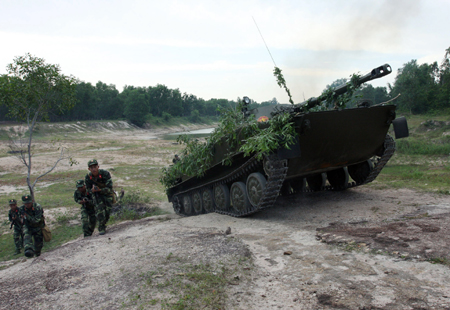
416th Regiment Tank in Combat Training

07 Juli 2012


416th Regiment of the army units Military Region 9 has good training mission ready combat maneuver, strong protection raid southwest of the country. (photo : BaoDatViet)

Recently, the units in the armed forces of Military Region 9 always completes all assigned tasks: Just make sure to practice good works, ready to fight just as well the increasing production ensure health officials and soldiers.

Amphibious tank PT-76 is one of the main tank of Vietnam Army, well equipped for the type of naval units.(photo : BaoDatViet) 

Particularly in the last round of training, 100% of officials and soldiers who meet the requirements, which are pretty good rate over 75%.

PT-76 tanks equipped with a 76mm cannon, armor is quite thin due to the ability to sacrifice vital to ensure vehicle weight amphibious task. (photo : BaoDatViet)

In the first months of 2012, the unit always completes assigned tasks, fulfill the tactical exercises with troops involved always reached 99.36%, 100% training results are satisfactory.

Force infantry 29 and 416 regiments of tanks in combat training, Infantry move forward with the support of tanks. (photo : BaoDatViet)

Consecutive years, 416th Regiment was awarded the flag levels on “comprehensive strong unit”, unit points in the movement of the Military Zone 9.

06 Juli 2012

Five Type Warplanes were Expected to be Delivered within Two Years

06 Juli 2012

Five type aircraft : attack aircraft, lead-in fighter-trainers, attack helicopters, light transport and medium transport aircraft were all expected to be delivered within two years (photo : Militaryphotos)

Philippine Air Force to Get New Warplanes by 2014

The Philippines, which is now embroiled in a territorial dispute with China, is set to acquire new warplanes in two years to upgrade its poorly-equipped air force, the defence minister said Friday.

Attack aircraft, lead-in fighter-trainers, attack helicopters and light and medium transport aircraft were all expected to be delivered within two years, Defence Secretary Voltaire Gazmin said.

Speaking at the 65th anniversary of the Philippine Air Force, Gazmin said "these aircraft shall once and for all, erase the ironic and naughty commentary that our present airforce is all air, devoid of force."

The defence department also plans to sign contracts by July 31 to implement 138 military modernisation projects over the next five years, he added, without saying how much the contracts would cost or who would supply such equipment.

The Philippines has one of the most poorly-equipped militaries in the region, having retired the last of its fighter jets in 2005.

The weakness of the military was highlighted when the Philippines got into a standoff with China in April over the Scarborough Shoal, an outcropping of rocks in the South China Sea that both countries claim as their territory.

China claims nearly all of the South China Sea, even waters close to the coasts of neighbouring countries. The Philippines says the shoal is well within its 200-nautical-mile exclusive economic zone.

The two countries also have wider territorial disputes over parts of the Spratly islands in the South China Sea .

Gazmin did not mention the territorial dispute but stressed that air force personnel were all over the archipelago, including the West Philippine Sea-- the local term for the South China Sea.

The Philippines has looked to its main defence ally, the United States, to help it upgrade its armed forces but President Benigno Aquino said in an interview in May, that it was looking for aircraft from outside the US as well.

(MSN)

EOS and Hyundai Join Forces for Remote Weapon Systems

06 Juli 2012

In May 2010 EOS and Northrop Grumman Corporation agreed to jointly develop RWS. Now, with the agreement with Hyundai-WIA, EOS has completed agreements with partners in both the USA and Northern Asia to produce, support and enhance its RWS  products (photo : EOS) 

Electro Optic Systems Holdings Limited (ASX: EOS)  has executed  agreements with Hyundai-WIA, a Korean corporation, relating to the  joint  development, marketing, production and support of remote weapon systems.

Under the agreements, Hyundai-WIA will produce remote weapon systems [RWS] in Korea.  Initially these will be drawn from the current EOS product range, but the parties expect new and upgraded RWS products to issue from joint development programs in the near term, to address emerging global market requirements.  The collaboration will draw heavily on the deep technology and production capabilities of both companies.

The EOS Defence Systems sector is concentrated on the development, marketing, production and support of remote weapon systems [RWS] for global markets.

Hyundai-WIA is a subsidiary of Hyundai Motor Group [HMG], a major Korean corporation with diverse technology, manufacturing and service businesses and with global revenues of US$99 billion [2010].  Hyundai-WIA is  a HMG subsidiary focussed on defence products and with global revenues of US$6 billion.  It is based in Changwon, Korea and employs around 6,000 staff.  It is a leading innovator in defence products and manufacturing technology.

The arrangements with Hyundai are similar to those announced 19 May 2010 when EOS and Northrop Grumman Corporation agreed to jointly develop, produce and support RWS for the USA and certain export markets.  Those arrangements included EOS and Northrop Grumman teaming to compete for the US Army CROWS program requirement for RWS.

In December 2011 EOS announced amended collaboration arrangements with the relocation of EOS’ own RWS capabilities in the USA from Tucson, Arizona to Huntsville, Alabama.  This places them alongside those of Northrop Grumman to allow EOS and Northrop Grumman to address even more efficiently RWS opportunities in general, and CROWS  requirements in particular.  The CROWS program award  by the US Army is expected by October 2012.

EOS now has completed agreements with partners in both the USA and Northern Asia to  produce, support and enhance its RWS  products.   These  partners have  significant investments in scalable production capacity and the incremental cost of adding  RWS capacity is relatively small.  Importantly, these plants have the necessary infrastructure for production of  modern  military equipment, including next-generation systems for quality management, record-keeping, government accounting and supply chain management.

As pressure on Australian manufacturing industry increased over the past two years due to currency appreciation and labour market constraints,  EOS has migrated to a production approach where its Australian plant in Queanbeyan has retained only around 65% of its historical scope of work.  EOS expects improved competitiveness and market access will support sales  growth  and  offset the  effect of  transfer of  some  production activities offshore.

(EOS)

First Launch of "Brahmos" Submarine-Based Missile to be Held in Oct-Nov

06 Juli 2012

Brhamos submarine-based anti-ship missile (photo : Militaryphotos)

Submarine-based version of the BrahMos Russian-Indian missile will be launched for the first time in Oct-Nov, 2012, the director of BrahMos Aerospace Sivathanu Pillai told ARMS-TASS at the 2-nd international engineering technology forum.


"We're going to hold the first launch of the submarine-adapted missile version by underwater testing platform in October or November", Dr. Pillai said.

According to him, the coming launch will be an important stage in the BrahMos program development because after that test Indian Navy will decide whether to arm India's prospective non-nuclear submarines with these missiles.

Representative of Rubin Central Design Bureau earlier told ITAR-TASS that Russian designers were ready to offer Indian Navy non-nuclear submarine Amur-1650 armed either with Club or BrahMos missile systems.

"So far, Indian partners have not brought up an issue of BrahMos integration into Amur-1650 submarine put up for Indian tender under the 75I prospective submarine program", said Andrei Baranov, deputy director general of Rubin bureau for foreign economic activity. 


As for him, "the Amur-1650 submarine project is currently armed with Club attack missile system, well-known in Indian Navy and launched by horizontal torpedo tubes. But if Indian party wants the sub to be equipped with vertically-launched BrahMos attack missile system, Rubin bureau would amend the project", Baranov explained.


"BrahMos can be integrated into Amur-1650 as an additional compartment with vertical launch tubes", pointed out the design bureau's director.

"Amur and BrahMos are pretty compatible; we had worked on the sub's architecture in this regard. So, if Indian partners want to have the BrahMos-equipped submarine, that would strengthen chance of Rosoboronexport in the India's program 75I tender", emphasized Baranov.

Rosoboronexport will put up prospective non-nuclear submarine Amur-1650 powered by air-independent plant for Indian tender providing procurement and license production of 6 non-nuclear submarines.


05 Juli 2012

BAE Systems Tawar Pilihan

05 Juli 2012

BAE Systems memberi peluang bagi Malaysia untuk memilih komponen pesawat Typhoon yang akan dibuat di Malaysia jika Malaysia memilih pesawat ini (photo : Eurofighter)

KUALA LUMPUR  - Malaysia boleh memilih komponen pesawat Typhoon Eurofighter untuk dibina di dalam negara jika Multi-Role Combat Aircraft (MRCA) memenangi kontrak penggantian MiG-29N Tentera Udara Diraja Malaysia (TUDM).

Pengarah Urusan Asia Tenggara BAE Systems, John Brosnan berkata, rakan usaha sama konsortium Eurofighter bersetuju bahawa syarikat Malaysia boleh mengambil bahagian sehingga 90 peratus dalam projek pembinaan pesawat terbabit.

"Kebanyakan komponen pesawat mungkin tidak dibina di Malaysia, namun terpulang kepada Malaysia untuk memutuskan bahagian mana yang mahu dibina di sini. Tidak seperti pesawat lain, kami menyerahkan kepada Malaysia jika negara ini mahukannya," kata Brosnan kepada Bernama.

"Satu perkara mengenai urus niaga pertahanan, ramai pesaing yang mengatakan apa yang mereka kata mungkin dan tak mungkin dilakukan," katanya.

Syarikat yang berpangkalan di UK itu ialah kontraktor utama bagi pihak negara Eurofighter iaitu United Kingdom, Jerman, Itali dan Sepanyol.

BAE Systems dilaporkan sudah mengemukakan cadangan kepada Kerajaan Malaysia untuk membida kontrak penggantian MiG-29N TUDM, yang meliputi senarai 100 muka surat mengenai teknologi yang syarikat berkenaan sedia memindahkan, selain nama syarikat tempatan dan luar negara yang sedia menyertai dalam proses itu.

Eurofighter Typhoon membida kontrak itu bersama-sama empat pesaing lain - Dassault Aviation"s Rafale Perancis; Boeing F/A-18E/F Super Hornet US; JAS-39 Gripen Sweden dan Sukhoi Su-35 Flanker-E Rusia.

Brosnan berkata bersama Typhoon, Malaysia memperoleh generasi kelima utama MRCA di dunia.

Setakat ini, 707 pesawat Typhoon dibangunkan mengikut kontrak dan lebih daripada 300 sudah diterbangkan untuk perkhidmatan enam pasukan tentera udara di seluruh dunia, katanya.

"Sudah terbukti dalam operasi di pelbagai negara. Malaysia mahukan produk terbaik yang mampu kami sediakan. Berdasarkan keupayaan, kami yakin kami berada pada kedudukan yang baik," katanya.

Brosnan berkata, Typhoon dikeluarkan oleh sebuah konsortium "100 bilion dolar yang memiliki rangkaian bekalan industri pertahanan Eropah".

"Ia bukan sekadar kesediaan teknologi, malah rekod baik kami dalam melaksanakan komitmennya untuk menfaat ekonomi," katanya.

Tentera Udara dan Tentera Laut Malaysia merupakan pelanggan BAE Systems, menerusi pembelian pesawat 10 Hawk Mk108 dan 18 Mk208 pada awal 1990-an. –

(Utusan)

‘Spy’ Radar Arrays Arrive in Adelaide

05 Juli 2012

AN/SPY-1D(V) phased array radar for Hobart Class Air Warfare Destroyers (all photos : Lockheed Martin)

Minister for Defence Materiel Jason Clare announced the arrival in Adelaide of the first two state of the art ‘SPY’ radar array faces that will be installed on the Air Warfare Destroyers (AWDs).

“The multi-function SPY radar is capable of search, automatic detection, tracking of air and surface targets and missile engagement support,” Mr Clare said.

“It works to distinguish signals from stationary or moving targets and to identify and reject ‘clutter’ such as clouds and flocks of birds.”

The AN/SPY-1D(V) phased array radar will provide the Hobart Class destroyers with comprehensive surveillance around the ship.

The SPY radar is the main sensor for the Aegis Weapon System and is readily recognisable by the four octagonal-shaped array faces that are located on the superstructure of the ship.

The four array faces send out beams of electromagnetic energy in all directions, providing a continuous search and tracking capability for hundreds of targets.

The SPY radar, combined with the SPQ-9B horizon search radar, will ensure each of the AWDs go into service with state-of-the-art radar packages.


“Work on the future HMAS Hobart and HMAS Brisbane is well underway at Techport Australia, and work on the future HMAS Sydney will commence later this year,” Mr Clare said.

“All three AWDs will be armed with a 48 cell Vertical Launch System, Mk 45 5″ gun, phalanx close-in weapon system, torpedoes, anti-ship harpoon missiles, Nulka missile decoy system and hull mounted sonar, as well as variable depth sonar for detection and defence against enemy submarines and torpedoes.”

“This gives each destroyer an air defence, anti-submarine and anti-surface warfare capability as well as the ability to embark a helicopter at sea.”

The AWDs will provide greater protection for Australian Defence Force personnel by providing air defence for accompanying ships as well as land forces and infrastructure on nearby coastal areas. The AWDs will also provide self-protection against attacking missiles and aircraft.

The AN/SPY-1D (V) radar was supplied by United States company Lockheed Martin and acquired by the Australian Government through the Foreign Military Sales program.