26 Desember 2018
The Lao Army's D30 howitzer after upgrading (photo : Soha)
With the small artillery force, the equipment was not really good, but the Lao Army overcame by mechanizing one of the most powerful firepower in the service, the D30.
A number of recently released images have surprised Asian Military Forums when the Lao People's Army successfully mechanized the 122mm D30 howitzer model developed by the former Soviet Union. It is worth mentioning that there are only about 10 cannons of this type in Laos artillery.
In such a modest amount, it seems that the Lao Army decided to mechanize the entire number of D30 artillery they had on the active Ural-4320 3-wheel military transport chassis (6x6), Similar to what Vietnam has been doing with the 105mm M101 model of American artillery.
It is possible that Laos has referred to the mechanized and self-propelled artillery M101 solution that Vietnam has implemented to upgrade the D30 by placing it behind the Ural-4320 body on a fixed welding platform on the chassis and 3 more. Hydraulic legs, on both sides and middle of the rear.
The Lao Army's D30 howitzer after upgrading (photo : Soha)
It is also worth mentioning that in the Lao Army staff, another model of self-propelled self-propelled gun could be used as a model for the country to mechanize the D30 howitzer, CS/SH-1 made by China. .
The way Laos improved the Ural 4320 and combined with the D30 cannon was quite similar to the CS/SH-1 design, especially in the more hydraulic position in the center of the body, more notably the Chinese 122mm model. for CS/SH-1 is the localized variant of the D30 cannon built by the country itself, the Type 86 or Type 96.
Thanks to mechanization and optimization of operation, the Lao D30 artillery shell after being upgraded can be pulled from 8 to 4 people, similar to CS/SH-1 and carry the number of bullets from 20-30. .
Meanwhile the range of the D30 cannon will be almost constant, reaching 15km with normal bullets and 22km with bullets that increase range and maintain the average rate of fire of the D30 from 5-6 transmitter/minute or maximum 12 plays/minute.
The Lao Army's D30 howitzer (photo : Soha)
The total combat weight of this self-propelled artillery model after the upgrade can fall to around 12-13 tons, including the number of spare ammunition to carry, quite suitable for the ability to maneuver on Ural-4320 and The conditions of the field roads are as in Laos.
With the technical parameters - tactics of the D30 after being mechanized, the combat capability of this model will be significantly improved with faster and more dynamic deployment and recovery time on the field and just from 4-5 gunners to operate.
Basically, the combination of wheeled truck with ground cannon is considered a good plan for the military of countries with limited defense potentials to modernize or improve the fighting capacity of the force. Low-cost artillery, while being able to maximize the mobility of the weapons on the battlefield.
It can be seen that the solution Laos chooses to upgrade the D30 cannon is perfectly reasonable. In terms of their current level of defense industry, this can be considered a huge step forward. However, it is not clear at what stage the mechanized program of Laos's D30 122mm cannon has reached, and whether it is supported by foreign experts.
(Soha)
26 Desember 2018
HMPNGS Ted Diro P401 (all photos : Brian Wayne Scott)
One week after being handed over from Australia to the Papua New Guinea Defence Force, NUSHIP Ted Diro has passed its initial sea-readiness evaluation with support from Navy’s Sea Training Unit - Defence Cooperation Program.
Commander Sea Training Defence Cooperation Program, Captain John Cowan, said Ted Diro’s ship’s company had been put through a comprehensive training program that culminated in a whole ship evaluation before sailing for Port Moresby, Papua New Guinea via Darwin.
“The training has specifically focussed on mariner skills to ensure that the ship’s company can navigate their ship, operate the ship’s systems correctly, and can conduct all of the activities that the ship needs to safely complete the long voyage back to Papua New Guinea,” he said.
“We’ve been conducting training with the ship’s company for the past week and today is the evaluation day where the assessment of the crew is being conducted under the authority of the Papua New Guinea Defence Force Patrol Boat Squadron Commander.”
Captain Cowan said the crew of Ted Diro had faced a number of challenges to get to this point.
“Firstly, they had to come together as a crew in the Pacific Patrol Boat, the former HMPNGS Rabaul,” he said.
“They honed their skills in Rabaul and then conducted the long voyage from Port Moresby to Port Macquarie, NSW for the disposal of the Pacific Patrol Boat.
“The crew then travelled to Western Australia to conduct individual conversion training to prepare for the first of the Guardian class Patrol boats, Ted Diro.
“Once they were proficient in operating the ship’s systems from an individual skills point of view, we commenced training with ship’s company to bring them together as a team performing to the standard and the program required by the PNG Defence Force.”
See full article RAN
26 Desember 2018
MPAC Mk III with Spike-ER missile (photo : PN)
MANILA -- 2018, which will end in a few days time, can be considered as a banner year for the Armed Forces of the Philippines, especially the Philippine Navy (PN), as it formally entered the missile age and demonstrated its capability to sail beyond its territorial waters during deployments to the US, South Korea and Russia.
The PN's formal entry to the missile age took place off Lamao Point, Limay, Bataan last Nov. 21, when three of its multi-purpose assault craft (MPACs) fired the newly-acquired and installed Rafael Advanced Defense Ltd. Spike-ER (extended range) surface-to-surface missile during a capability demonstration witnessed by Defense Secretary Delfin Lorenzana and Navy flag-officer-in-command Vice Admiral Robert Empedrad.
During the exercise, the MPACs fired two Spike-ER missile rounds, which hit two surface targets. The said craft also utilized remote-controlled .50 caliber machine guns to neutralize another target.
AW-109 light attack helicopter (photo : PN)
An AgustaWestland AW-109 attack helicopter armed with 2.75-inch high-explosive rockets also provided air support to the MPACs by firing its weapons. "Impressive. Not one (missile) round was wasted," Lorenzana said in describing the Spike-ER capability demonstration, which he witnessed aboard the BRP Davao Del Sur (LD-602).
The PN MPAC Acquisition Project entered into a contract with Rafael, through SIBAT of Israel Ministry of Defense, for the supply and integration of the weapons systems to three Mark III MPACs.
Empedrad, meanwhile, said missile-armed MPACs can be utilized to defend Philippine waters through the so-called "swarming tactic", where these craft will be committed to engage larger and more capable ships posing a threat to the country's waters.
PCC-765 Pohang class corvettes (photo : slams tistory)
The PN chief added that the Navy needs an additional 42 MPACs to further enhance its capabilities to defend the country's waters.
Pohang Class Corvette
Zata added that the PN will gain more capability to operate modern naval weaponry with the arrival of the Pohang-class frigate next year.
"The Pohang-class frigate from ROK will also be delivered by next year equipped with a better weapons system that the Navy can already use as it prepares for the delivery of the two purposely-built frigates starting 2020," he stressed.
The Pohang-class frigate is equipped with a primary and secondary gun system, sensors and torpedoes for anti-submarine as well as sensors for anti-air operations, Zata disclosed.
HHI HDF-2500 frigates (photo : rhk111)
Progress steady in construction of Navy's first missile-armed frigates
The construction of the first missile-armed frigate by South Korean shipbuilder Hyundai Heavy Industries (HHI) is proceeding smoothly, Empedrad said.
"(Construction for) our (first-missile) frigate is moving forward, darating na siya sa February (or) March of 2020, all systems go and we should very happy, we should be happy for our country," he said.
The keel-laying for the first-missile-armed frigate took place last Oct. 16 in Ulsan, South Korea while the steel-cutting for the second ship took place last Sept. 17.
HHI is expected to lay the keel of the second frigate by the first quarter of 2019.
The Philippines and HHI signed a PHP16 billion contract for two missile-armed frigates with another PHP2 billion set aside for its weapon systems and munition. The projected delivery date of the first frigate is by 2020 while the second one will be in 2021.
BRP Davao Del Sur L-602 (photo : dvids)
PN blue-water capability boosted thru international exercises
For the first time in its history, two PN ships, the BRP Davao Del Sur and BRP Andres Bonifacio (FF-17), joined this year's "Rim of the Pacific" (RIMPAC) exercises, which took place in Hawaii on June 27 and ended Aug. 2.
Also deployed were around 700 sailors and marines.
RIMPAC is the world's largest joint and combined naval exercise.
Aside from RIMPAC, the Navy made history with BRP Tarlac (LD-601) making the first-ever port visit of a Filipino warship to Vladivostok, Russia.
The ship and its 300-man contingent aboard left Manila South Harbor last Sept. 21 and arrived in time for her scheduled Oct. 1 to 6 port visit.
One of three Del Pilar class BRP Andres Bonifacio FF-17 (photo : dvids)
During its visit to Russia, the ship and the contingent aboard it participated in several activities, which enhanced their relationship with their Russian counterparts.
Another Navy milestone, in terms of overseas deployment, is the participation of BRP Dagupan City (LC-551) and the 200-man contingent aboard her in the first-ever ASEAN-China Maritime Exercise (ACMEX) that took place in Zhanjiang in Guangdong, China last Oct. 21 to 28.
The participation of the PN had greatly addressed inter-operability issues between the participating navies.
The ACMEX 2018 was an exercise hosted by the Republic of Singapore Navy and the China People's Liberation Army Navy that aimed to promote regional cooperation between ASEAN member states navies and focused on maritime safety and search and rescue at sea with emphasis on the use of Code of Unplanned Encounter at Sea (CUES).
AW-159 Wildcat of PN (photo : AF Monthly)
Anti-submarines choppers, more air assets for PH fleet
With the pending arrival of the Navy's first two AgustaWestland AW-159 "Wildcat" anti-submarine helicopters by the first quarter of 2019, the PN will now have the capability to detect and engage underwater targets.
"(And with the arrival of the AW-159), we can detect submarines, we can detect underwater vehicles and also the capability to engage underwater vehicles within our territory, so it’s a tremendous leap from our current inventory," Zata stressed.
He said the AW-159 will be based aboard the two new frigates being constructed by HHI and whose deliveries are scheduled for 2020 and 2021.
The PN spokesperson said the aircraft will be fitted with sensors and weapons capable of neutralizing sub-surface threats.
TC-90 paytol aircraft (photo : PN)
Earlier, the Department of National Defense (DND) said initial flight-testing is now ongoing for the two Philippine-ordered AW-159 anti-submarine helicopters.
Meanwhile, the PN's surveillance and monitoring capability was boosted with the formal donation of the Japan Maritime Self Defense Force of three more Beechcraft King Air TC-90 patrol aircraft last March 26.
"The (donation) is expected to boost the capability of the PN and enhance the capacity of its personnel primarily in conducting maritime security and sovereignty patrols, as the Navy stays true to its commitment to protect the seas and secure the nation's future," then PN spokesperson Capt. Lued Lincuna said.
The first two TC-90s were delivered to the Philippines on March 27, 2017 while the last three aircraft were handed over to the PN last March 26.
As of this time, the Navy is operating around six Norman Britten "Islander" patrol aircraft, five AgustaWestland combat utility helicopters and one Robinson R-22 training helicopter.
See full article PNA
25 Desember 2018
JASDF F-15 (photo : hyakuri)
Japan wants to sell old F-15s to US to fund F-35 purchases
TOKYO -- The Japanese government is considering selling some F-15 jets to the U.S. to raise funds for purchases of cutting-edge F-35 stealth fighters, Nikkei has learned, with Washington in turn weighing the sale of those outdated planes to Southeast Asian countries.
Several Japanese officials have revealed that discussions are underway for what would be the nation's first sale of used defense equipment to the U.S. Tokyo sounded out Washington on the possibility of such a sale as part of negotiations to purchase 105 F-35 jets from the U.S. The two sides are trying to iron out such details as the number of F-15s to be sold and their prices.
By arranging such a sale with Washington, Tokyo hopes to quell public criticism of expanding defense spending amid efforts for fiscal consolidation. Turning to Washington would also help Japan, as it lacks experience in selling defense equipment to third countries.
Japan's roughly 200 F-15s form the core of the Air Self-Defense Force's air defense capabilities. About half the fleet has undergone modernizing overhauls, including updates to electronic equipment, but the 100 or so fighters being eyed for a sale are an older design that cannot receive the electronics upgrades. The government decided at a cabinet meeting last Tuesday to gradually swap these out for more capable F-35s.
F-15J Japan Air Force JASDF (photo : Lui Ortiz)
The oldest of the F-15s were first deployed in the early 1980s. But even they can be kept in working condition if parts are replaced as needed.
Washington has told the Japanese side that it would consider selling the aircraft to nations with weak air forces. The arrangement would enable the U.S. to provide fighter jets to Southeast Asian nations at cut-rate prices as China expands its military presence in the South China Sea.
Japan's planned F-35 purchase was due in part to heavy pressure from U.S. President Donald Trump to narrow the wide bilateral trade imbalance by buying more American defense hardware. Tokyo hopes to appease Trump while using the F-15 sale to lower costs.
The Japanese government also judged that given its lack of experience in exporting defense equipment, it would be more prudent to work indirectly through the U.S., which has successfully sold arms across the globe, than to try to sell the fighters directly to a third country.
Japan barred exports of defense equipment for decades until 2014, when the cabinet laid out principles allowing them under certain conditions. It maintained a ban on exports to countries involved in armed conflict but permitted them when doing so contributes to Japanese security, for instance.
(Nikkei)
25 Desember 2018
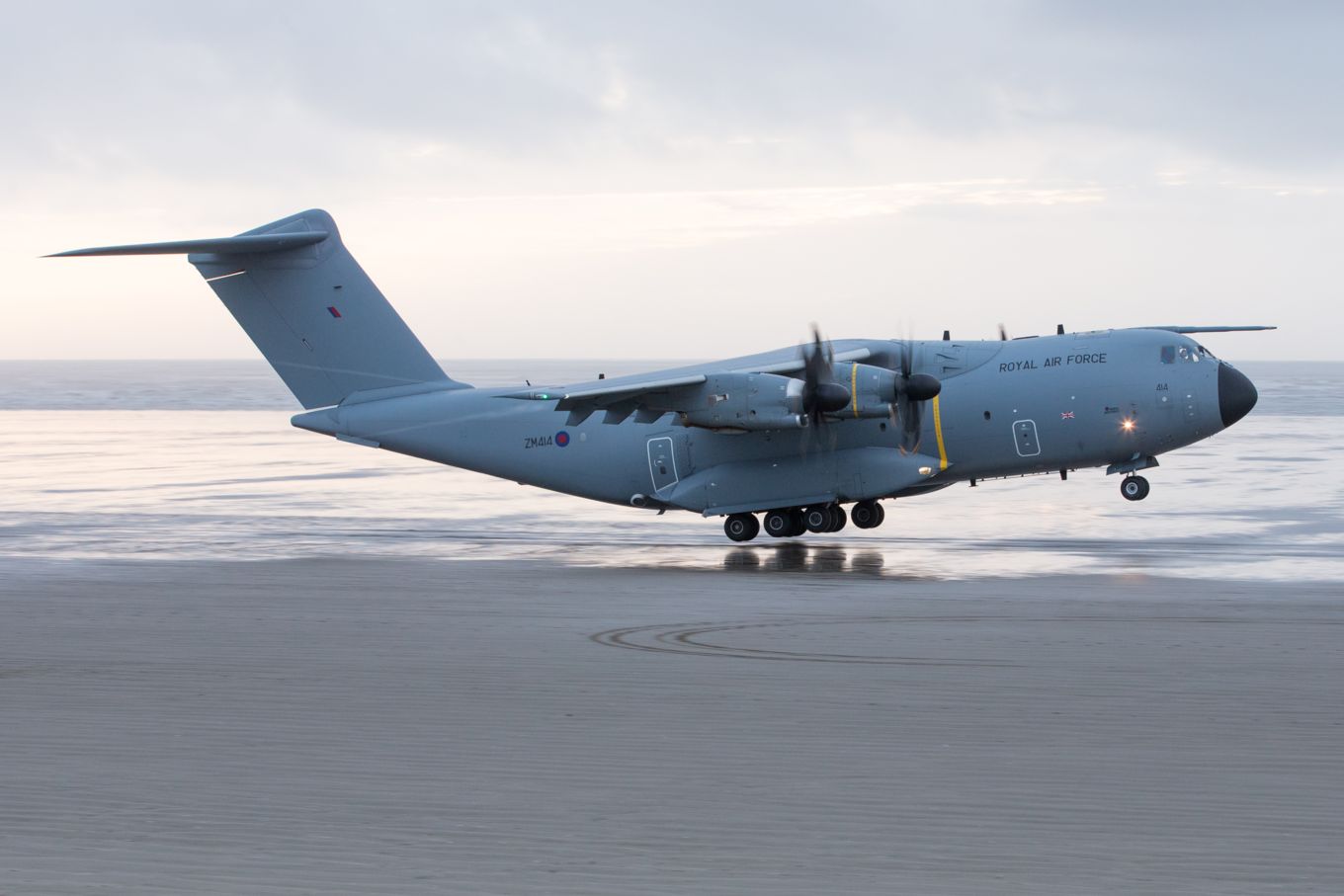
The 120-tonne RAF A400M landing and taking off from Welsh beach (all photos : RAF)
Members of 206 Squadron, supported by LXX Squadron Engineers based at RAF Brize Norton have been practicing their skills during beach landing trials in Southern Wales.
Beaches are routinely used by the RAF for training operations with other tactical airlifters. The A400M showcased its superb tactical capabilities on natural surfaces by performing take-off, landing and taxiing manoeuvres.
Flight Lieutenant Cheng, 206 Squadron Pilot said :
“The advanced flight deck of the A400M and cutting-edge fly by wire controls made this task easier to fly than other platforms. We are now looking forward to the challenge of conducting this operation using night vision goggles later in the trial.”
The versatility of the A400M Atlas means it has the capability to land on a wide variety of surfaces including natural surfaces carrying a very large payload. This tactical capability was demonstrated during trials on Pembrey Sands beach.
Wing Commander Neil Philp. Officer Commanding 206 Squadron said :
“My specialist team has worked hard to deliver this trial and it has showcased the tremendous tactical potential of the A400M. Once this capability is handed over to the front line it has the potential to have a great impact on operations.”
(RAF)
24 Desember 2018
Presumably, the first combat training aircraft Yak-130, received by the Laotian Air Force (tail number "044"). Vientiane, December 2018 (photo : AeroLaos)
A widespread shot from a video from a Lao resource, which allegedly demonstrates the first Yak-130 combat training aircraft received by the Lao Air Force. It is reported that this aircraft (tail number "044") was delivered to the capital of Laos, Vientiane on December 20, 2018 from Irkutsk on board the IL-76TD transport aircraft (registration number RA-78765) of the Russian airline Aviakon Tsitotrans.
Previously, there was no information on the conclusion by the Russian side of the contract for the supply of Yak-130 aircraft to Laos, although in the beginning of 2016, Russian media spread information about the interest of the Laotian military to the Yak-130, and it was stated that Laos "can get 16-20" of these airplanes. Analysis of the Lao military media shows that since the end of 2017, they have repeatedly published materials on the Yak-130 aircraft.
Thus, if the information on the delivery of the Yak-130 to Laos is correct, this state will become the fifth foreign recipient of the Yak-130 aircraft produced by the Irkutsk Aviation Plant PJSC "Irkut Corporation", after Algeria (received 16 cars), Bangladesh (16), Myanmar (six) and Belarus (eight units).
(BMPD)
24 Desember 2018
RNZAF T-6C Texan II aircraft are flying around the South Island until December 21 and again in early January as part of an Air Force flying instructors’ course. (photo : NZDF)
Keeping a stream of highly skilled pilots flowing through the veins of the Royal New Zealand Air Force (RNZAF) comes down to the high calibre of qualified flying instructors, some of which are honing their skills in the South Island skies this week as part of a flying instructor’s course.
All the pilots on the course are converting from other RNZAF aircraft and have been captains on either C-130H (NZ) Hercules, P-3K2 Orion, Boeing 757–2K2 and NH90 MUH capability.
They are getting to grips with the capability and power of the T-6C Texan II aircraft in navigation, formation and low-level flying in terrains they may not have encountered before.
The flying instructors’ course can be considered in two parts. The first part is converting already skilled pilots onto the T-6C and the second part is training those pilots to be excellent instructors.
“They all have different skillsets, and this is a great opportunity for them to cross pollinate the knowledge, experiences, thought processes and tactics they have gathered over their careers,” says Central Flying School Flight Commander Squadron Leader (SQNLDR) James Peters.
RNXAF NH90 MUH (photo : AircraftNut)
“They all bring something different to the table and this course is about standardising those skills and getting everyone at the same level.
“For example, pilots on the Orion would not have a lot of mountain flying, but plenty of search and rescue and surveillance experience.”
The pilots will be training out of Christchurch until December 21 and again from January 7–10. Being away from home base with four T-6C aircraft familiarises them with operating around the country with the aircraft in scenarios they will encounter with future students.
“We really appreciate the communities around New Zealand that welcome us to train in their back yards. We need to be able to train in all terrains and scenarios to ensure we are ready for all eventualities,” says SQNLDR Peters
“Qualified Flying Instructors are crucial to keep the ab initio pilot training going and to ensure we have an uninterrupted flow of pilots through the Air Force.
“This is a high priority flying course in the Air Force, as these future instructors will grow the next generations of RNZAF pilots and aircrew.’
(Medium)