25 Januari 2010

UK, Australia Begin Talks on Future Ship Projects

25 Januari 2010

Anzac class frigate, will be replaced in the 2020 (photo : DefenseIndustryDaily)

The UK and Australia have opened a government-to-government dialogue to explore the potential for co-operation on their respective frigate and minor war vessel replacement programmes.

Information exchanges are expected to continue around the Pacific 2010 conference and exhibition, running in Sydney from 27-29 January. The UK has also engaged with its counterparts in New Zealand with regard to its ANZAC frigate replacement plans.
The UK Ministry of Defence (MoD) is expected to announce in February the start of a four-year assessment phase for the Future Surface Combatant (FSC) C1 variant.

Under a separate funding line, concept phase activities for a Future Mine Countermeasures/Hydrographic/Patrol Vessel (FMHPV), previously identified as FSC C3, are expected to commence in April 2010.

Meanwhile Australia's Defence White Paper (DWP), released in May 2009, laid out plans for a new class of eight Future Frigates to succeed the Royal Australian Navy's (RAN's) current ANZAC-class vessels one-for-one in the post-2020 timeframe.
A separate programme, Project SEA 1180, plans to rationalise the RAN's existing patrol boat, mine countermeasures, hydrographic and oceanographic forces into a single modular offshore combatant vessel class.

Commodore Steve Brunton, the UK MoD's Head of Above Water Capability, told Jane's: "Our timescales are slightly different ... at this stage we are just informing each other by talking within a wider scoped information exchange agreement. Where this leads to will be dictated by agreeing mutual benefit and interest."

Asian Fighter Requirements Continue to Grow

25 Januari 2010

Lockheed Martin is pusing its F-35, the only fifth-generation fighter available for export (photo : Lockheed Martin)

The Asia-Pacific fighters market will continue to be the world's most active over the next decade, with the countries likely to buy more than 500 aircraft to supplement existing fleets, embark on upgrades and acquire new capabilities to take them into the next stage of their development.

"For many Asian countries, fourth-generation planes will be useful and relevant for decades to come, and we'll see orders for a few more batches of these," says Richard Aboulafia, vice-president analysis at the Teal Group. "But for Japan and Singapore, there's a need for any technology that will help them overcome quantitative inferiority and cement a strategic relationship with the USA."

Lockheed Martin is pusing its F-35, the only fifth-generation fighter available for export Western manufacturers such as Boeing and Lockheed Martin from the USA, France's Dassault, the Eurofighter consortium and Sweden's Saab are vying for several potentially lucrative contracts around the region. They face stiff competition from the Russian alternatives, which will take advantage of Moscow's long-standing political and military relationships. China, too, is fast emerging as a viable alternative supplier.

What, however, do the various air forces really need? While there is a lot of talk about fourth- and fifth-generation fighters, these labels are of little help in understanding the actual requirements of the various countries. It is far better, say observers, to talk about the capabilities that are available and link them to national requirements.

Lockheed, which is pushing both its latest version of the F-16 single-engined multi-role fighter and the
F-35 Joint Strike Fighter, the only fifth-generation aircraft available for export, believes that having situational awareness and denying it to adversaries will be increasingly important.

"Through stealth, electro-optical sensors, a powerful and advanced AESA [active electronically scanned array] radar, electronic warfare, inherent jamming capability, and the ability to share information via secure datalinks, the F-35 combines its sensor capability like no other platform before it," says Steve O'Bryan, vice-president, F-35 business development and customer engagement.

"So while those types of sensors and the situational awareness they provide will become increasingly important, they are most effective when their information is fused and presented to the pilot in a single, coherent display, as they are on the F-35. It's difficult to remove the platform from the equation, because the platform itself is integral to the capability."

Rival Boeing is promoting its F/A-18E/F Super Hornet and F-15 Silent Eagle multi-role fighters actively in the Asia-Pacific region. It also believes that platforms are key.

"That said, we think there will be continued fusion and integration of on-board and off-board sensors and weapons, giving pilots the ability to detect and engage targets in any domain - in the air, at sea, or on the ground. We will also develop engine capability that is quieter and provides more range at less fuel burn," it says.

"Multirole capability is paramount for countries investing in fighters. Fighters don't just exist in one or two spectrums any more. They must be able to fulfil a variety of missions over vast geographic space. These aircraft will handle both strategic and tactical missions, including air-to-air, maritime strike, air-to-ground, and ISR missions. Long endurance and versatility will always be factors in Asia Pacific, given the vast geographic diversity - over water, over mountain ranges, and other terrain."

Lockheed, reflecting the fact that its products are primarily for allies of the USA, adds that threat perceptions matter. "Given the continued increase in capability - and numbers - of fighters being developed by China and Russia, it becomes imperative that regional governments continue to equip their air forces with the leading-edge capabilities required to counter the emerging threats to security," says O'Bryan.

Russia has been a mainstay in Asia for decades. Rosoboronexport, the country's arms export agency is promoting its
Sukhoi Su-30, Su-35 and RSK MiG-35 as replacements for earlier aircraft such as the Su-27, MiG-29 and MiG-21.

"We have many close friends in Asia - India, China, Malaysia, Indonesia and Vietnam are just some of them," says Victor Komardin, deputy director-general of Rosoboronexport. "Yes, there is more competition from the USA and Europe. But we are confident in our ability to secure more contracts in the coming years. Russia has never stopped helping its friends, and our friends know we are here for them."

Representatives from the Eurofighter Typhoon consortium and Dassault Rafale have been active in the region as well. Neither, however, has had a sale yet. Saab, on the other hand, had its first success in Asia Pacific after signing a contract with Thailand for six Gripens. It is pushing Bangkok to buy another six and is promoting the fighter in India and Malaysia. Its sales pitch is essentially that its "ideologically neutral" fighter is cheaper than and just as capable as its competitors.

China is becoming more active. Beijing has exported fighters for several decades - most notably the Chengdu F-7 interceptor and Nanchang A-5 ground attack aircraft to the likes of Bangladesh, Myanmar, Pakistan and Sri Lanka. But it has newer-generation fighters and it is now casting its net wider.

Beijing has held talks with several countries on the Chengdu FC-1, also known as the JF-17 in the export variant that was developed with Pakistan, and the light attack variant of the Hongdu L-15 advanced jet trainer. For JF-17 customers, China could set up an assembly line or produce components for the aircraft, just like some Western suppliers. This includes traditional and non-traditional clients, say officials.

"We are talking to about five to six countries for each aircraft, and air force pilots from some of them have already flown test flights," says Ma Zhiping, president of China National Aero-Technology Import & Export Corporation, which markets China-made military aviation products globally.

"We provide very capable aircraft at a very reasonable price compared to what else there is in the market. One of the biggest problems for many of our customers is financing. Many are developing countries and their payment abilities are limited. We work with the Chinese government in these cases to help them get cheap credit."

Exports of the Chengdu J-10 fighter are possible, but Beijing's priority is to develop an upgraded version of the aircraft. "This will take a bit of time and we are confident we will have a very good fourth-generation fighter when this is completed. Then, we could export the J-10 to our friends," says Wang Yawei, president of AVIC Defence, the military arm of state-owned aircraft manufacturer China Aviation Industry (AVIC).

The development of indigenous fighters is also under way in India, Japan and South Korea, with various degrees of success, and some could involve foreign partners. These programmes reflect a desire to acquire the technology to develop new combat aircraft and insecurity about the future availability of imports, say observers.

Boeing points out that the USA has spent billions on research to develop various fighter capabilities, and says that countries that embark on indigenous programmes could succeed if they do the same. There is an easier alternative, it adds.

Boeing's Super Hornet for Australia (photo : Boeing)

"In each case, it would make more sense to partner with the US government and US industry that has already made this investment, and has not only developed the technology but has also integrated those disparate capabilities into an effective weapons system. Boeing would certainly be interested in this type of collaboration," says the company.

This could happen in India. The Indian air force is due to take delivery of the first batch of the long-delayed Tejas Light Combat Aircraft (LCA) later in 2010 - although, going by its past record, that event could face a further postponement.

The pain that the air force went through with the LCA, however, means that foreign collaboration is a possibility for the proposed Medium Combat Aircraft, on which the country's Aeronautical Development Agency could begin work on it in the middle of this decade.

The twin-engined aircraft will incorporate stealth features, have air-to-ground and air-to-air capabilities and be able to perform suppression of enemy air defence, precision strike and close combat missions, says the ADA.

The 20t aircraft will also have a low radar cross-section, "serpentine-shaped" air intakes, internal weapons bays and advanced radomes to increase its stealth features. All of these technologies are already available in the USA, observers point out.

India is also in talks with Russia to collaborate on a fifth-generation fighter programme. This aircraft will be based on Russia's Sukhoi-led PAK-FA fighter, which is likely to have its first flight in 2010. Officials from both countries are confident that they can reach an agreement on the joint venture shortly, but there are worries within India about the level of access their researchers will get to the Russian programme.

In South Korea, the KF-X programme to develop a successor to the country's F-16s and McDonnell Douglas F-4s has stalled at the study stage. Seoul declined to finance the development stage due to the economic downturn, and there is still no clear indication of when that will go through. The focus of the study appears to have shifted.

Initially, the plan was to develop an advanced fighter similar to the Rafale or Typhoon. Last year, however, the research institute that is studying the feasibility of the programme recommended that it instead focus on developing a larger version of the F-16. That could involve Lockheed, which helped the county's Korea Aerospace Industries develop its T-50 advanced jet trainer that is based on the F-16. But the uncertainty, and potential $10 billion bill, means that this should remain in limbo.

Seoul, however, has given KAI the go-ahead to develop a prototype of a light attack version of its T-50, with a production contract likely after the air force tests the aircraft. The F/A-50 also has export potential, says KAI.

Japan has been working for years on the ATD-X programme to develop a stealth fighter that would be similar to the Gripen in size. It would be powered by a pair of IHI XF5 afterburning, thrust-vectoring engines derived from the XF7 turbofan used by Japan's Kawasaki XP-1 maritime patrol aircraft.

Indegenousf ighter developments like Japan's proposed ATD-X have largely stalled (image : FlightGlobal)

However, there has been little word on the programme since the defence ministry unveiled the first full-sized mock-up of the demonstrator at Japan Aerospace 2008. That same year, it decided against proceeding with the development stage and instead continued to fund the studies.

Some observers say that Japan would fund the development of a fighter only to satisfy the needs of its indigenous aerospace industry. Others say that this is just a ploy to get the USA to release access to the Lockheed F-22 Raptor, which Japan covets but Washington is refusing to release for export.

When it comes to indigenous programmes, Aboulafia proposes his "Rule of National Fighter Creation" to assess why countries embark on them. It can mean one of four things: they have a big budget and are not prepared to compromise on quality, they believe that it would be cheaper than the alternative imports, only local firms can meet the country's requirements, or they do not mind having an inferior aircraft.

His point is that, when indigenous programmes are closely scrutinised, none of those reasons really holds up. Almost inevitably, these plans cost too much and produce an inferior or outdated aircraft.

"India's LCA, for example, is quick becoming a multi-decade horror story, despite a large market and an abundance of talent and cash," Aboulafia points out. "National fighter concepts are almost always a very bad idea."

India Heads Clutch of Competitions

India is likely to order more Sukhoi Su-30MKIs, which Hindustan Aeronautics licence-produces in India (photo : Wiki)

There are several big fighter requirements around the Asia-Pacific region, with the countries assessing a variety of aircraft.

India has the biggest competition in the region - a $10-12 billion tender for 126 medium multi-role combat aircraft. The Saab Gripen NG, Dassault Rafale, Boeing F/A18-E/F Super Hornet, Eurofighter Typhoon, Lockheed Martin F-16 and RSK MiG-35 are in contention in what could be a product-saving opportunity for some.

New Delhi requires naval fighters as well, and has sent a request for information to Boeing, Dassault and Lockheed for the carrier version of its F-35 Joint Strike Fighter. New Delhi is also likely to order more Sukhoi Su-30MKIs, which Hindustan Aeronautics licence-produces in India.

Neighbouring Pakistan, with one eye on its rival, has begun indigenous production of the Chengdu JF-17 that Pakistan Aeronautical Complex helped to design. It also began to receive its newer batch of F-16s last year. In a few years, Islamabad is likely to ask Washington for more F-16s and attempt to buy a batch of the Chengdu J-10, China's latest fighter.

Further east, Lockheed is pushing South Korea to select the F-35 for the third phase of its F-X competition, with the company saying that Seoul could get access to the aircraft from 2014 if required. Seoul is looking to buy around 60 fighters, but worries about possible delays to the F-35 and that the early variants may not be as sophisticated.

That could pave the way for Boeing and its F-15 Silent Eagle variant, which the company has proposed with countries such as South Korea in mind. The F-15K was selected for the first two phases of South Korea's F-X competition, and Boeing is pushing Seoul to consider the F-15SE.

Japan Studies

Japan is studying the F-35, the F-15SE and the F/A-18E/F, along with the Eurofighter Typhoon, for its F-X competition. Its first choice, however, is the Lockheed F-22 Raptor. Washington's reluctance to export the fighter, however, could lead Japan to the F-35 instead. If there is a delay, one of the others could be an interim solution.

The Obama administration is still studying Taiwan's long-standing request for 66 new F-16C/Ds worth $1.3 billion, and Taipei has asked to buy mid-life upgrade kits for its existing F-16A/Bs as well. It is keen on the F-35, but that is a long shot. Aerospace Industrial Development Corporation, the island's national aircraft manufacturer, proposes upgrades to half of the service's existing 130 A/B-model IDFs.

In South-East Asia, Singapore has ordered 24 Boeing F-15SGs to complement its older fleet of Lockheed F-16s. It could buy up to 60 aircraft, although the Singapore air force could begin evaluating the F-35 in the coming years. It is unlikely to proceed with an order until the F-35 has entered into service with several air forces, and proven its capabilities. When that order comes, the air force is likely to retain the region's most modern and capable combat aircraft fleet.

The Royal Malaysian Air Force bought 18 Su-30MKMs and was considering a follow-on order. However, in October, the Malaysian government decided to retire the country's fleet of MiG-29s because of their high operating costs. It plans to assess fighters from the USA, France, Sweden and the UK to replace them, and Russian arms export agency Rosoboronexport says that it is likely to offer the Sukhoi Su-30MKM for the tender.

Thailand has ordered six Saab Gripens, but it has delayed the purchase of an additional six due to the deepening economic crisis. Its neighbour Vietnam is reported to be going ahead with the purchase of a new batch of Su-30s and could order more advanced fighters from its traditional supplier Russia.

Indonesia hopes to buy F-16C/D block 50/52 and upgrade its F-16A/B before 2014 (photo : Kusri H)

Indonesia has taken delivery of five Su-30MKs and two Su-27SKs, with another three Su-30SKMs likely to be delivered in the coming year. It also hopes to buy six Block 50/52 F-16C/Ds and upgrade six of its airworthy F-16A/Bs to the enhanced standard. This would enable Jakarta to stand-up an F-16 squadron to replace its F-5s by 2014.

Last year, Australia ordered an initial batch of 14 F-35s - the first country in the Asia Pacific region to commit to the fighter. The first F-35 is due to be delivered in 2014, and the first operational squadron to be stood up by 2018. Approval for a second batch will be considered in 2012, fulfilling Australia's commitment to form three operational squadrons and a training squadron.

Canberra also ordered 24 Boeing F/A-18E/F - becoming the first export customer for the type - but could convert around 12 of them to the E/A-18G electronic attack configuration.

Singapore First to Order F-15 SG

Singapore has ordered 24 Boeing F-15SG multi-role fighters, making it the first South-East Asian country to order the type and ensuring its air force retains its edge as the region's most potent strike force.

Republic of Singapore Air Force pilots began training with the F-15SGs at Mountain Home AFB in Idaho, USA, last year. The air force will replace its McDonnell Douglas A-4 Skyhawks with the F-15s, but has not said when it would fly the aircraft from Singapore.

It has also not released details about their configuration, apart from confirming that 29,000lb-thrust (130kN) General Electric F110-GE-129 engines will power them.

A US Defense Security Cooperation Agency notification to the US Congress in 2005, when the service made an initial order for 12 F-15s, said that the weapons included 200 AIM-120C AMRAAM medium-range air-to-air missiles with six captive air training rounds, and 200 AIM-9X Sidewinder missiles with 24 CAT and dummy rounds.

For the air-to-ground role, Singapore was to get 50 GBU-38 Joint Direct Attack Munitions and 30 AGM-154A-1 Joint Stand Off Weapons both with BLU-111 warheads, and 30 AGM-154C Joint Standoff Weapons. It was also to be supplied with 24 Link 16 multifunctional information distribution system/low volume terminals (fighter datalink terminals) and 44 pairs of AN/AVS-9(V) night vision goggles.

Singapore may next add the F-15 Silent Eagle (photo : Boeing)

The aircraft are also likely to be fitted with the Raytheon AN/APG-63(V)3 active electronically scanned array radar, and the Data Device high-performance 1553 databus or HyPer-1553TM tested by the Boeing Phantom Works F-15E1 Advanced Technology Demonstrator aircraft.

It has been speculated that Singapore will work with Israel to modify and upgrade its F-15s. The Israeli F-15I Ra'am (Thunder) has an Elisra SPS-2110 integrated electronic warfare system, and its crews wear DASH helmet sights.

A new round of procurement decisions to replace Northrop F-5s with a new tactical fighter are due to start soon, with Singapore likely to choose between the F-15 Silent Eagle - Boeing's latest variant - and the Lockheed Martin F-35. Singapore joined the F-35 Joint Strike Fighter programme in 2002 at the "security co-operation participant" level, and could ask for more information in the next year. Pentagon officials say that the island could buy up to 100 F-35s.

23 Januari 2010

Lapan Operasikan Stasiun Bumi di Biak

23 Januari 2010

Coverage satelit Lapan Tubsat (photo : Lapan)

Jakarta (ANTARA News) - Lembaga Penerbangan dan Antariksa (Lapan) telah mengoperasikan stasiun bumi yang dibangunnya sendiri di Pulau Biak, Papua, demikian diumumkan Lapan hari ini di Jakarta.

Para teknisi Lapan membuat stasiun bumi itu dengan mengintegrasikan komponen-komponen yang dibelinya dan membuat sebagian software (perangkat lunak) sendiri untuk mengoperasikannya.

Sebuah kemajuan karena dua stasiun bumi sebelumnya yang ada di Rumpin dan Rancabungur, Bogor, bukan dibuat sendiri tetapi dibeli dari Amerika Serikat.

Stasiun bumi Biak digunakan untuk menerima data dari LAPAN-TUBSAT, satelit mikro yang berbobot hanya 100 kilogram yang dikembangkan bekerjasama dengan Universitas Teknik Berlin, Jerman.

LAPAN-TUBSAT diluncurkan ke orbit polar dengan ketinggian 635 km di atas permukaan bumi pada Januari 2007. Dengan dua kamera, satelit itu mampu memotret berdimensi 5 meter dan lebar 3,5 km serta 200 m dan lebar 81 km.

Perangkat komunikasi tersebut telah berhasil mengambil berbagai citra di wilayah Indonesia bagian barat, mencakup Singapura hingga Bali.

Pada tahun lalu, LAPAN-TUBSAT digunakan untuk memantau pembangunan jembatan Suramadu dan proyek jalan tol di wilayah utara Pulau Jawa. Citra LAPAN-TUBSAT dapat dilihat di situs http://www.lapantubsat.org/.

Stasiun bumi Lapan di Biak memiliki antena untuk menangkap sinyal satelit berorbit rendah. Dalam menangkap sinyal satelit semacam itu, antena harus dapat bergerak atau berubah orientasi secara cepat karena satelit muncul dan hilang dari horizon dalam waktu singkat, kurang dari 15 menit.

Beroperasinya Stasiun Bumi penerima Biak menambah cakupan LAPAN-TUBSAT hingga wilayah Indonesia timur, bahkan hingga pantai utara Australia.

Keberhasilan beroperasinya stasiun bumi di Biak menunjukkan bahwa teknisi Lapan telah menguasai teknologi perekayasaan stasiun bumi untuk satelit orbit rendah.

Lapan akan membangun stasiun bumi serupa mulai awal tahun ini di Kotatabang, Sumatra Barat, sehingga menambah cakupan LAPAN-TUBSAT melampaui Aceh hingga Semenanjung Malaya.

Bila stasiun bumi Kototabang terwujud, maka hanya wilayah Indonesia bagian tengah saja yang belum tercakup LAPAN-TUBSAT. Namun, itu tidak berlangsung lama karena pada 2011 akan dibangun stasiun bumi di Parepare untuk menjangkau wilayah itu.


Baca Juga :

Belajar Satelit, Lapan dan Telkom Kirim 7 Orang ke Rusia
22 Januari 2010

JAKARTA, KOMPAS.com — PT Telekomunikasi Indonesia Tbk (Telkom) dan Lembaga Penerbangan dan Antariksa Nasional (Lapan) sepakat mengirim tujuh pegawai mereka ke Zhelesnogorsk, Krasnoyarsky, Rusia, untuk mengikuti pelatihan mengenai satelit.

Pelibatan tenaga kerja dari Lapan dimungkinkan oleh salah satu lingkup pekerjaan yang dicantumkan dalam kontrak pembelian satelit Telkom-3 antara PT Telkom dan Joint-Stock Company Academician MF Reshetnev ISS Russia.

Pengiriman pegawai kedua perusahaan ini diawali dengan perjanjian kerja sama yang ditandatangani Direktur Utama Telkom Rinaldi Firmansyah dan Kepala Lapan Dr Adi Sadewo Salatun, Jumat (22/1/2010) di Jakarta. Turut menyaksikan penandatanganan itu Menteri BUMN Mustafa Abubakar dan Menteri Ristek Suharna Surapranata.

Mustafa mengapresiasi kerja sama itu. "Dana riset di Indonesia terbatas dan kerja periset seolah sendiri-sendiri. Saya mendukung kerja sama lebih luas antara lembaga seperti Lapan dan perusahaan seperti Telkom ini," kata Mustafa. Dia berharap hasil-hasil riset dapat diterapkan langsung di dunia kerja.

Rinaldi mengatakan, untuk pelatihan selama 18 bulan, dibutuhkan dana Rp 2,7 miliar bagi tujuh pegawai, yang terdiri dari lima pegawai Telkom dan dua tenaga ahli dari Lapan.

NH-90 NFH Arrives in Australia for Demo Tour

23 Januari 2010

NH-90 NFH helicopter (photo : Airliners)

The new generation NH90 NFH (NATO Frigate Helicopter) naval helicopter has arrived in Brisbane Australia. It has been transported from Milan Italy to Brisbane in one of the biggest aircrafts in the world, the ANTONOV 124 along with the PT1 NH90 Demonstrator.

During this demonstration tour, the audience composed of Public, Australian military and political authorities will have the opportunity to assist to several flight demonstrations as well as static display presentations of the helicopter in Brisbane, Sidney (Pacific 2010), Nowra Navy Base. The NH90 NFH will be displayed with its complete mission and weapon suites.

The NH90 NFH is proposed by Australian Aerospace and NHIndustries for the replacement of the ageing fleet of Seahawks naval helicopters in the Royal Australian Navy.

The NH90 NFH is currently the most modern helicopter in its class, it is a true multirole aircraft able to perform a wide spectrum of missions such as Search and Rescue, support, utility, anti piracy, Antiship and Anti Submarine missions anytime anywhere. It has been designed to operate from a ship or a land base.

This 21st century helicopter, currently in production for several European countries, is delivered with the most up to date sensors, equipments and weapon system available on the market in order to achieve mission success without compromise on the crew’s safety.

The NH90 features a quadruple redundant Fly By Wire system, a wide, corrosion free, fully composite fuselage as well as a very effective floatation gear.

Its unique wide cabin , fitted with a mobile rear ramp as well as its integrated mission system allow the NFH’s crews to perform several missions in the same flight. This versatility explains why the NH90 NFH is the new world reference in term of naval military helicopter.

The NH90 NFH shares a high degree of commonality with the MRH90 already produced by Australian Aerospace in Australia and in service in the Australian Army and Navy. This 80% commonality between the NH90 naval and tactical transport versions allow its users to rationalise their helicopter fleets in order to make substantial savings.

The twin-engine, medium-size NH90 helicopter is provided by the consortium NHIndustries, the Company owned by AgustaWestland (32%), Eurocopter (62,5%), and Fokker (5,5%).

The NH90 helicopter programme is the largest ever launched in Europe, with firm orders now reaching 529 units to equip and modernize the Armed Forces of France, Germany, Italy, The Netherlands, Portugal, Finland, Norway, Sweden, Greece, Oman, Australia, New-Zealand, Spain and Belgium. Final negotiation steps are yet under process with several other Defence Forces to secure contracts concerning additional NH90, both in the Tactical Transport and Naval versions.

(NHIndustries)

22 Januari 2010

Indonesia Jajaki Pembelian Alutsista ke China

22 Januari 2010
Rudal C-705, TNI AL membutuhkan rudal ini untuk melengkapi armada kapal perangnya (photo : Militaryphotos)

JAKARTA, — Pemerintah Indonesia akan menjajaki rencana pembelian alat utama sistem persenjataan (alutsista) asal Republik Rakyat China. Bahkan, pemerintah juga akan berupaya dapat merakit produk alutsista China di Indonesia.

Penjajakan itu disampaikan Menteri Koordinator Politik Hukum dan Keamanan Djoko Suyanto, saat menjawab pers, seusai mengikuti Sidang Kabinet Paripurna di Istana Wakil Presiden, Jakarta, Jumat (22/1/2010) malam.

Sebelumnya, Djoko Suyanto bersama Menteri Luar Negeri Marty Natalegawa mendampingi State Councelor RRC (Menko Polhukam) Dai Bingguo secara terpisah menemui Presiden Susilo Bambang Yudhoyono di Kantor Presiden, Kompleks Istana, dan Wapres Boediono di Istana Wapres, Jakarta, pada Jumat siang dan sore.

Kunjungan Dai Bingguo beserta delegasi China ke Indonesia bertujuan untuk menindaklanjuti perjanjian kerja sama kemitaraan antara Indonesia dan China yang sebelumnya ditandatangani oleh Presiden Yudhoyono dan Presiden China Hu Jin Tao saat kunjungan kenegaraan Presiden ke China.

Selanjutnya, kerja sama itu ditindaklanjuti oleh masing-masing Menko Polhukam kedua negara pada tahun 2006 dengan membentuk forum untuk menyusun rencana aksi. Rencana aksi sudah ditandatangani dan akan ditindaklanjuti di tingkat teknis oleh sejumlah kementerian, di antaranya Kementerian Pertahanan dan Keamanan dan Kementerian Riset dan Teknologi.

"Kita memang pernah membeli alutsista China beberapa waktu yang lalu. Sekarang tidak lagi. Yang baru kita lakukan sekarang adalah penjajakan. Kita belum sampai kepada jenis alutsista seperti apa yang akan dibeli. Itu diserahkan kepada Kementerian Pertahanan dan TNI sendiri," tandas Djoko.

Dikatakan Djoko, kerja sama pertahanan yang dilakukan kedua negara pada prinsipnya akan saling menguntungkan. "Kerja sama juga akan mengarah pada kerja sama industri pertahanan," tambah Djoko.

Djoko mengatakan, sejak kerja sama kemitraan dilakukan Indonesia dan China, sudah tercapai sejumlah kesepakatan dalam bentuk nota kesepahaman, seperti soal ekstradisi dan antipencucian uang.

Menurut Juru Bicara Wapres Yopie Hidayat, Boediono dalam pertemuan dengan Dai Bingguo menyambut baik dan mendukung kerja sama pertahanan kedua negara itu. "Ini sangat penting, terutama bagi kebutuhan dasar TNI dan pertahanan kita," ujar Yopie.

Yopie menambahkan, kerja sama Indonesia dan China akan semakin meningkat. "Tahun 2010 ini adalah 60 tahun peringatan hubungan Indonesia dan China," demikian Yopie.

US offers F 35 Joint Strike Fighter to India

22 Januari 2010

F-35 STOVL version (photo : Lockheed Martin)

New Delhi. The India-US defence cooperation seems to be steadily growing with Washington now offering its latest Joint Strike Fighter (JSF) F-35 Lightning-II aircraft to India. But in the long run, there could be limitations over issues of Transfer of Technology (ToT) that India mandates now for major arms deals.

Representatives of Lockheed Martin, which is developing the aircraft, have indicated in the past that the aircraft could be available to India if the Indian Air Force (IAF) opted for the F-16 Super Viper in its quest for some 200 Multi Role Combat Aircraft (MRCAs) but recently, the company made a presentation to the Indian Navy without this condition.


Lockheed Martin’s Vice President for Business Development Orville Prins told India Strategic defence magazine that a presentation about the aircraft was made to the Indian Navy recently after it expressed interest in the newer generation of aircraft for its future carrier-based aircraft requirements.

The Indian Navy is buying 45 Mig 29Ks for the Gorshkov, or INS Vikramaditya, which it will get from Russia in 2012 and its first indigenous aircraft carrier. But for its second indigenous carrier, and possibly more in the future, the Navy is looking for a newer generation of aircraft.

Although the best of the weapon systems in the US are developed by private companies, the funding for their research and development is provided by the Government which exercises full control on the resultant products and their sale to any foreign country. ToT is a serious issue and in most cases, technology, particularly source codes, is not shared even with Washington’s best allies in the West or East.

Lockheed Martin apparently made the presentation to India after authorization by the US Department of Defense (DOD), but Prins pointed out that the F 35 could be sold only after clearance from the US State Department, for which bilateral negotiations between New Delhi and Washington would need to be held once India expressed interest.

The US is steadily emerging as a new supplier of sophisticated arms to India, which urgently needs to replace and augment its mostly outdated Soviet-vintage systems with high technology weapons of the 21st century.

Beginning 2002, when an agreement for the sale of 12 Raytheon’s artillery and short-range missile tracker system, the AN/TPQ 37 Weapon Locating Radars (WLRs) was signed, the US has supplied systems worth nearly $ four billion. But over the last few weeks, the Indian Ministry of Defence has sent firm orders, or Letter of Request (LoR) for 10 C 17 Globemaster III strategic lift aircraft for the Indian Air Force (IAF) and 145 Bofors M 777 ultra light howitzers the Indian Army badly needs for its mountain operations.

The competing gun from Singapore Technologies lost out as the company was mired in allegations of corruption in an Indian Ordnance Factory Board scam.
Originally a Swedish company, Bofors was purchased by the US United Defense in 2000, and later acquired by the US arm of BAE Systems. In fact, as the US Administration had imposed restrictions on the sale of military equipment to India after the 1998 nuclear tests, President Bill Clinton went out of the way to allow United Defense- Bofors an exception to sell its guns to India if the Indian Army opted for them.

The Indian Army is badly in need of various types of artillery guns, and keeping in mind the developments in the neighbourhood, the Indian government recently cleared the acquisition of this ultra light howitzer in a government-to-government deal under the US Foreign Military Sales (FMS) programme. The gun has been deployed with excellent results in the rugged mountains of Afghanistan. Made with titanium alloys, the M 777 is about 40 per cent lighter than a standard gun and can be easily transported under-slung by a helicopter.

Originally a Swedish company, Bofors has been much maligned in India due to the allegations of corruption in the sale of its 155 mm FH 77B guns in the mid-1980s. Operationally however, these guns played a significant role in India’s victory in the 1999 Kargil War to evict Pakistani intruders from the Himalayan heights on the Indian side of the border. India has also deployed the gun at the highest battlefield in the world at Siachin.

Ferrying them to those daunting heights in parts and then assembling them has been a terrific job by itself for the Army.

Boeing C-17 Globemaster (photo : Jefflewis)

LORs for both the C 17 and M 777 have been issued only in the past couple of weeks.

India has less than 20 IL 76 Soviet-supplied Il-76 aircraft, which will mark 25 years of their induction in April 2010.

Although a fuel-guzzler, the IL 76 has served the IAF well and still has a residual life of 10 to 15 years with some periodic modifications as the IAF has utilized it carefully. Manufactured in Uzbekistan, which was a part of the Soviet Union, the IL 76 is now out of production and most of its existing serviceable units have been acquired by China.

There is no matching aircraft to replace the IL 76, the closest being the C 17, although bigger aircraft are available from both the US and Russia.

The C 17 has nearly double the capacity of an IL 76, but according to Air Marshal Goel, a veteran of IAF’s transport fleet, full load on an aircraft is never really carried as it hinders its range and fuel capacity. Unlike the IL 76 though, the C 17 can be refueled midair for much longer flights, and needs only two pilots and one loadmaster for operations, that is half the crew of what the IL 76 requires.

Despite its massive size, the C 17 can take off and land on unpaved grassy fields like a football ground at very steep angles, an important capability in battle conditions.

Lockheed Marton C-130J Hercules (photo : Benallsup)

Notably, IAF had also placed an order for six C 130J Special Operations aircraft with an option for six more in 2008 with the US Lockheed Martin. A smaller aircraft than the C 17, it is also very capable and can operate from small grassy fields to quickly get away after loading or unloading. Lockheed Martin has offered to transfer the manufacturing facility to India if 40 or 50 aircraft are ordered for military and civil use, particularly in the mountainous north-east regions.

The Border Security Force (BSF) is also considering to buy one or two C 130Js, albeit without some specialized systems that the IAF needs.

The JSF is a fifth generation aircraft, to be used by the US Air Force, Navy and Marines, and perhaps will be the last manned aircraft by that country before unmanned, high-powered long-range drones and helicopters fully take over the skies by the middle of this century. The USAF is already conducting joint manned and unmanned combat operations in Afghanistan, clearly indicating the gradual transition underway.

The unmanned systems, controlled from airbases in the US itself on the other side of the globe, are both reconnaissance and armed, and their use has increased in the recent years to neutralize terrorists in the troubled mountainous region on both sides of the Afghan-Pakistan border.

F 35 is a single-engine, single-seat stealth aircraft, being developed with several foreign partners to help reduce development and production costs, and is still being tested for its varied capabilities. It will be available in conventional takeoff and landing mode as well as in short-take-off-and-vertical-landing (STOVL) for carrier landings. Thanks to the numbers, it could cost as low as $ 50 million only per unit, or the price of a modern Medium Multi Role Combat Aircraft (M-MRCA) despite its highly advanced features.

The JSF 35B conducted its first STOVL propulsion test in flight for the first time on Jan 7 last week at the Naval Air Station (NAS) Patuxent River, and it will be some time before it goes into production. Its programme partner countries include Britain, Italy, Netherlands, Canada, Turkey, Australia, Norway, Denmark , Singapore and Israel, all of whom would possibly supply some components, and investments.

Whether India joins the production programme or not is an open question, depending upon the numbers required. The Indian Navy cannot have a large requirement and the Indian Air Force is already committed to buying the similar but perhaps more expensive Fifth Generation Fighter Aircraft (FGFA) to be jointly produced by Russia’s Komsomolsk-on-Amur Aircraft Production Association (KNAPPO) – which produces SU 30 jets – and India’s HAL.

The Russians have done substantial work in this regard, and hope to fly its single seat version by 2015-16 while the IAF hopes to induct its two-seat version by 2017. IAF wants the second seat “missionised” for weapon operations for the co-pilot, a practice that the Israelis have also opted for in their F-16 aircraft.
China, which has been accused of stealing technology by Russia, is also trying to develop a 5th generation fighter.

In any case, it’s a question of time when the environment in the strategic Indian Ocean region, and around India, is filled by the likes of stealth and futuristic aircraft.

The Americans had proved to be unreliable in the 1960s when they made several promises for equipment after the Chinese aggression on India and did not fulfill them. The geopolitical realities have perhaps changed and they are willing to offer some of their best technologies.

The US is steadily opening its stable of sophisticated weapons to India. After the sale of Raytheon’s WLRs, which was actually the first combat system under the Foreign Military Sales (FMS) received from the US after India’s nuclear tests in 1974 and 1998, the US has also sold eight highly advanced Boeing P8-I Multi-mission Maritime Aircraft (MMA) to the Indian Navy to patrol the Indian Ocean. The aircraft is still under development, and significantly, will be available to the Indian Navy nearly at the same time as to the US Navy, which has paid for its development.

This was preceded by the transfer of an old amphibious ship, USS Trenton, renamed INS Jalashwa, and its six onboard Sikorsky utility helicopters at nominal costs for the Indian Navy.

Boeing P-8 Poseidon (photo : Nemesiscom)

The P8-I is the most hi-tech system yet to be acquired by India, and according to Boeing’s Integrated Defense Systems India Head, Dr Vivek Lall, “its sale is unprecedented” in terms of US transfer of technology.

In August last year, another US arms major, Northrop Grumman, also offered its futuristic Hawkeye 2-D combat management aircraft to the Indian Navy. This aircraft is also under development and it India opts to buy it, then this system will also be available to the Indian Navy nearly at the same time as the US Navy.
The P8-I deal is the biggest yet at $ 2.1 billion, while the other major deal for C 130Js has been placed at nearly $ one billion.

The deal for the 10 C 17s, which was formally announced by Boeing from Long Beach. California on Jan 8, could be bigger than that of the P8-Is, depending upon the configuration and requirements of the Indian Air Force. No details are available.

Lockheed Martin F-16IN Super Viper (image : Lockheed Martin)

Notably, Boeing and Lockheed Martin have also fielded their respective F/A-18 Super Hornet and F-16 Super Viper combat jets to India in the six-cornered MRCA competition, but the US is also adding other sophisticated systems like the Lockheed Martin’s Aegis shipboard anti-missile system, which had been used two years ago to shoot down a satellite in space with precision as part of an apparent technology demonstration.

Orville Prins said that presentation on the Aegis system had also been made to the Indian Navy and the Ministry of Defence.

On offer are also some of the best precision missiles and engagement systems from Raytheon, which does not make any platforms but builds onboard capabilities. Sources say that it is also offering its latest Airborne Standoff Radar (ASTOR), which is perhaps the latest in Synthetic Aperture Radar (SAR) technology, to India. The system has been fielded in Afghanistan by the British forces only llast year.

Notably, most of the combat systems with the Indian Armed Forces are either old or outdated. For instance, except for the Su 30MKI combat aircraft, all the fighter and transport aircraft with the Indian Air Force are at least 20 years old.
Onboard precision engagement technology is the key to modern warfare and defence.

The US has that. But how far India goes in buying the US systems will largely depend not only on the technology and price offered, but also on the Transfer of Technology (ToT) that most major deals now warrant as a policy.


(India Strategic)

See Also :

India Looks at KC-767
21 Januari 2010

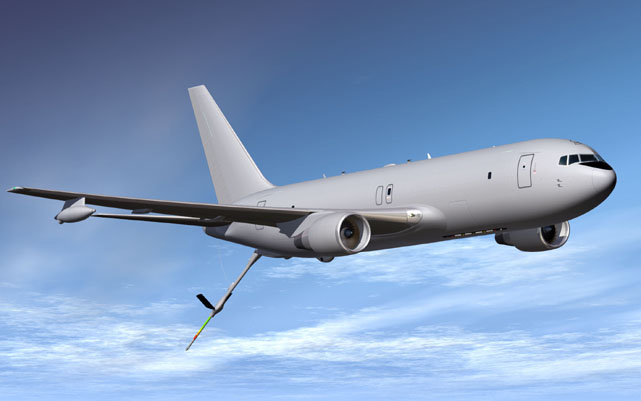
Boeing KC-767 tanker aircraft (image : Australian Aviation)

India has requested information from Boeing on the KC-767 tanker after the Indian Finance Ministry cancelled an order for six Airbus A330 based MRTT tankers last month.

The request is for six KC-767s potentially valued at US$1.5bn (A$1.62bn), with Indian defence officials telling local media that they “urgently need refuellers” and that they intend to “speed up the acquisition process”.

The KC-767 is in service with Japan and is due to enter service with Italy this year after a delayed development process.

(Australian Aviation)

J-10 Fighter Enters International Market at $40 million

22 Januari 2010

J-10A variant (photo : Combat Aircraft)

Recently, the U.S. think tank, International Assessment and Strategy Center, published an article about the Chinese J-10 fighter. The article claimed that the J-10 fighter is about to enter the international market after 2010, while its price tag of 40 million U.S. dollars is half of its U.S. counterpart, the F-16 fighter.

According to the article, the J-10 fighter is going to sell on the international weapons market around 2010 after extensive R&D and equipping of the Chinese Air Force is complete. It is understood that the Chinese Air Force started developing J-10 back in the 1960s, and it has been fully equipped for the last five years.

The progress that China has made in developing the engine makes the fighter very competitive on international markets; while with its good quality electronics and weapon systems, the price is just half of an American F-16. Pakistan is sure to be the first buyer, and many countries including Iran and the Philippines are also planning to introduce the fighter.

According to Pakistani sources, Pakistan has already reached an agreement with China to buy 36 J-10 fighters at a total value of 1.4 billion U.S. dollars (40 million U.S. dollars for each fighter). While the single price for an F-16, which U.S. sold to the UAE affiliated with AN/APG-80 radar, was 80 million U.S dollars. At the moment it is unclear whether spare parts, maintenance support, training and other services are included into the J-10's price. It is estimated that Pakistan might buy 70 to 150 J-10 fighters in all.

J-10B variant (photo : Airforceworld)

Besides price, what makes the J-10 attractive is its competitive electronics and weapon systems. The latest version, sometimes called the J-10B (or FC-20 when slated for Pakistan) emerged in Internet photos in January 2009. It features a driverless supersonic inlet similar in principle to that of the Joint Strike Fighter. The nose is redesigned, with an infrared search-and-track system in front of the windscreen and what appears to be a canted radar bulkhead consisting of a fixed, electronically scanned array radar. If true, this would be a major advance for China's radar technology, and may make the J-10 competitive with upgraded Western and Russian fourth-generation-plus fighters. The cockpit is dominated by three multifunction displays and a heads-up display.

The J-10 has 11 hardpoints, including five on the fuselage. Its principal counter-air weapon is the Luoyang PL 12 active radar-guided air-to-air missile (AAM) with 70-km. range. With a twin-AAM pylon on the inner wing mount, plus two on forward fuselage mounts, the J-10 can carry eight PL-12s. Short-range AAMs include the PL-8, a copy of the Israeli Python-3, and an improved version of this missile, the PL-9, both helmet-sighted. The J-10 may soon feature a more capable helmet-mounted display and a new fifth-generation AAM from Luoyang.

The fighter's market success will depend on China's ability to produce reliable advanced turbofan engines. Rival fighter maker Shenyang has been developing its WS-10A Taihang turbofan since the mid-1980s, which could offer 13.2 tons of thrust. Russian sources believe it is beset by developmental difficulties.

Chengdu may have a competing Huashan advanced turbofan engine program, which some Chinese sources note is based on its late-1990s acquisition of the engineering data and sales rights to the Tumansky R-79 turbofan developed for the defunct Yakovlev Yak-141 supersonic vertical/short-takeoff-and-landing fighter. Nevertheless, Russian sources say China remains interested in more powerful versions of the Salyut AL-31FN, which could come in 13.5- and, eventually, 15-ton-thrust versions.

Chengdu remains ready to develop a carrier-based version of the J-10. During the PLAAF anniversary, a test pilot was reported noting that ground-test simulations prove the J-10 can operate from a carrier.

(People Daily)