18 Juli 2013
Collins class submarines (photo : Aus DoD)
After more than a decade of controversy, shipbuilder ASC says it has finally solved outstanding problems with the navy's six Collins submarines.
Steve Ludlam, managing director of ASC, formerly the Australian Submarine Corporation, said he believed Collins' much publicised problems were now behind them.
"We are getting a much higher level of availability. We are getting good reliability at sea," he told AAP.
"They are very complex machines and we can't guarantee that everything will run perfectly all the time, but the principal areas of concern have now been solved."
Collins submarines had a range of problems from the outset, including excessive noise and an unreliable computerised combat system, prompting an extended and costly remediation program.
But reliability problems persisted with Collins' diesel-electric propulsion system. Each boat has three large diesel engines, three generators and an electric motors. Each has had problems.
Mr Ludlam said they had been able to work out how to reduce diesel engine vibration and a reliable engine-start system.
"Our engineer team here at ASC, who are some of the world's best, have been able to figure that through," he said.
"We worked with an international diesel specialist company to make sure we were getting the right answers."
Neither were generators problem-free.
"We found a method of rewinding those generators. They are much more reliable now. Progressively we are replacing generators on the submarines," he said.
Similarly, the large electric motor experienced a particular issue where the windings had relaxed.
"Working with the DSTO (Defence Science and Technology Organisation) and DMO (Defence Materiel Organisation) we have figured out to fix that and progressively we are fitting that fix to each of the submarines as they come in for various levels of maintenance," he said.
ASC is now working on two of the Collins subs.
HMAS Collins, the first of the Collins boats has been undergoing full cycle docking, a regular and comprehensive refurbishment, since last August. That should run for two years.
HMAS Rankin, the youngest of the Collins boats, has been out of the water for six years and mothballed for much of that time. Its full cycle docking started in 2011 and it should be back in the water next year.
(Sidney Morning Herald)
18 Juli 2013
Australia plans to buy more P-8 Poseidon to replace 18 AP-3C Orions (photo : US Navy)
Boeing Maritime Jet Gains Favor in Australia, Paring Drone Need
Australia plans to buy more Boeing Co. (BA:US) P-8 Poseidon maritime patrol jets than initially projected to replace planes dating from the 1970s, reducing its requirement for drones built by Northrop Grumman Corp. (NOC:US)
Funding for the purchase will be sought next year, with talks under way about the exact mix of P-8s and MQ-4C Triton unmanned aircraft, the head of the Royal Australian Air Force, Air Marshal Geoff Brown, said in an interview in London.
Australia currently uses 18 Lockheed Martin Corp. (LMT:US) AP-3C Orions upgraded a decade ago to hunt submarines, monitor ship traffic and aid in rescue missions, with some planes also deployed in combat operations in Iraq and Afghanistan. While it had planned to acquire eight aircraft and seven drones, the number of P-8s could now reach into double figures, Brown said.
“We are making an argument that a larger number of P-8s would be better,” he said. “I am not looking for more dollars, I am just looking at where we spend the money.”
While the P-8 -- a Boeing 737 airliner modified to carry gear that can detect submerged submarines, drop torpedoes and fire weapons -- is more capable than the AP-3C, wider global demands mean a substantial fleet is required, Brown said.
The shift in thinking toward P-8s, currently operated by the U.S. Navy and Indian air force, doesn’t mean drones such as the Triton, a version of the U.S. Air Force’s Global Hawk that’s also used by the U.S. Navy -- are out of favor, he said.
“I’m still a great supporter of unmanned air systems,” Brown said, adding that the Triton, while lacking weapons, would be able to monitor far greater areas than an aircraft.
JSF ‘Confidence’
Brown said he also expects the RAAF to examine requirements for smaller drones once operations in Afghanistan cease, to be purchased outright or under a fee-for-service arrangement.
Australia deploys Israel Aerospace Industries Ltd. Heron unmanned aircraft in that role and may replace them with larger Heron-TPs, also built by the Tel Aviv company, or Reaper drones from San Diego-based General Atomics Aeronautical Systems Inc.
Among other impending orders is one for Lockheed Martin’s F-35 Joint Strike Fighter, of which Australia has bought 14 of 72 it plans to take with the aim of reaching operational status by 2020, two years before Boeing Co. F/A-18 Hornets are retired.
The country has acquired 24 newer F/A-18E/F Super Hornets as a gap filler, while planning to add 12 EA-18G Growlers -- a version of the same aircraft used for electronic warfare.
Additional Super Hornet purchases are unlikely given “increasing confidence” in the F-35 schedule, Brown said.
The initial JSFs will establish three combat squadrons and a training unit, and Australia retains a long-term objective of fielding 100 of the planes, with an order decision likely after 2020 when the Super Hornets will need retiring or upgrading.
Brown said that while he’s a backer of the F-35, he’s frustrated by delays in arming the plane with an anti-ship weapon, regarded as central to Australian requirements.
“A maritime strike missile is an important weapon for us,” he said. “If there was any part of the program I have been disappointed with it has been the slowness to address the maritime strike weapon.”
(BusinessWeek)
17 Juli 2013
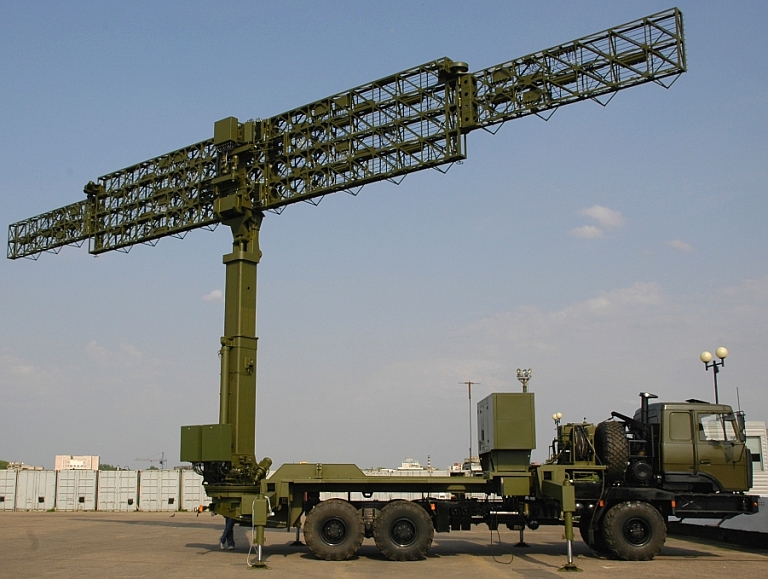
“Vostok-E” Mobile Solid-State 2D Digital VHF Radar from Belarus (all photos : KBRadar)
Vietnam prepares countermeasures against China's stealth fighters
Before the J-20, China's first stealth fighter, enters service with the PLA Air Force, Vietnam will purchase the Vostok-E 2-Dimensional Metric Band Surveillance Radar from Belarus with the ability to detect and attack stealth aircraft, reports the Military Analysis based in Moscow.
Developed by KB Radar based in Belarus, the Vostok E VHF band radar is a replacement to the P-18 radar system during the Soviet era.
KB Radar claims the Vostok E radar is able to detect stealth fighters such as the US F-117A Nighthawk from 74 kilometers nautical miles away in a jammed environment. In an unjammed environment, the distance can be increased to 350 kilometers.
With a unique wideband "Kharchenko" square ring element radiator arranged in a diamond lattice pattern, the Vostok E radar is designed to improve its frequency agility against earlier generation stealth fighters.
Even when facing more advanced stealth aircraft like the F-22, the Vostok E can detect targets from 57 kilometers away and shoot them down with the S-300 surface-to-air missile. It is a new design to challenge the aerial domination of American stealth aircraft.
However, Vietnam will probably become the first nation to use the radar system in an asymmetric warfare strategy against stealth fighters from China including the J-20 and J-31 over the disputed South China Sea.
Military Analysis said Belarus has agreed to sell about 20 Vostok E radar systems to Vietnam, as well as send advisers to train Vietnamese operators to use the hardware.
(WantChinaTimes)
17 Juli 2013
Helikopter EC-725 Cougar TUDM (photo : hafizuddin sulaiman)
SUBANG – Panglima Tentera Udara, YBhg Jen Tan Sri Dato’ Sri Rodzali bin Daud TUDM telah menghadiri majlis penerimaan dua buah pesawat EC725 yang diadakan di Pusat Simulator, Eurocopter Subang.
Dalam majlis tersebut, Panglima Tentera Udara telah menandatangani sijil penerimaan kedua-dua pesawat dan turut dibawa melihat serta diberi penerangan oleh wakil Eurocopter.
(TUDM)
17 Juli 2013
AW-109 Power naval helicopter (photo : AgustaWestland)
The maintenance crew of the soon-to-arrive AgustaWestland AW-109 "Power" naval helicopters are now undergoing training in Italy.
"There are a series of training being held at Sesto Calende, Italy (and) these are avionics and maintenance trainings," Philippine Navy (PN) spokesperson Lt. Cmdr. Gregory Fabic said Tuesday.
The first batch of PN personnel who will undergo avionics training have already left last month.
"While those involved in aircraft maintenance have already left last week (while) the first batch of pilots will depart for Italy before the end of June," Fabic said.
The PN spokesperson added that these specialized trainings vary from two to four months.
"It is included in (acquisition) package and at no costs to the government," he stressed.
Fabic said that morale is pretty good at the PN and personnel selected for these training programs are very proud that they are called to serve their country anew.
"The PN is also very thankful to the present administration for the continued support that the Navy is receiving," the PN spokesperson emphasized.
The contract for the three AW-109 naval helicopters were signed last April and will be delivered this coming December.
These choppers are worth around P1.33 billion.
The AW-109 "Power" is a three-ton class eight seat helicopter powered by two Pratt and Whitney PW206C engines.
The spacious cabin is designed to be fitted with a number of modular equipment packages for quick and easy conversion between roles.
The aircraft's safety features include a fully separated fuel system, dual hydraulic boost system, dual electrical systems and redundant lubrication and cooling systems for the main transmission and engines.
The AW-109 has established itself as the world's best selling light-twin helicopter for maritime missions.
Its superior speed, capacity and productivity combined with reliability and ease of maintenance make it the most cost effective maritime helicopter in its class.
For shipboard operations, the aircraft has a reinforced-wheeled landing gear and deck mooring points as well as extensive corrosion protection measures.
The ability to operate from small ships in high seas state enables the AW-109 to perform its mission when many other helicopters would be confined to the ship's hangar.
Over 550 AW-109 "Power" and AW-109 light utility helicopters have been ordered for commercial, parapublic and military applications by customers in almost 50 countries. The maintenance crew of the soon-to-arrive AgustaWestland AW-109 "Power" naval helicopters are now undergoing training in Italy.
"There are a series of training being held at Sesto Calende, Italy (and) these are avionics and maintenance trainings," Philippine Navy (PN) spokesperson Lt. Cmdr. Gregory Fabic said Tuesday.
The first batch of PN personnel who will undergo avionics training have already left last month.
"While those involved in aircraft maintenance have already left last week (while) the first batch of pilots will depart for Italy before the end of June," Fabic said.
The PN spokesperson added that these specialized trainings vary from two to four months.
"It is included in (acquisition) package and at no costs to the government," he stressed.
Fabic said that morale is pretty good at the PN and personnel selected for these training programs are very proud that they are called to serve their country anew.
"The PN is also very thankful to the present administration for the continued support that the Navy is receiving," the PN spokesperson emphasized.
The contract for the three AW-109 naval helicopters were signed last April and will be delivered this coming December.
These choppers are worth around P1.33 billion.
The AW-109 "Power" is a three-ton class eight seat helicopter powered by two Pratt and Whitney PW206C engines.
The spacious cabin is designed to be fitted with a number of modular equipment packages for quick and easy conversion between roles.
The aircraft's safety features include a fully separated fuel system, dual hydraulic boost system, dual electrical systems and redundant lubrication and cooling systems for the main transmission and engines.
The AW-109 has established itself as the world's best selling light-twin helicopter for maritime missions.
Its superior speed, capacity and productivity combined with reliability and ease of maintenance make it the most cost effective maritime helicopter in its class.
For shipboard operations, the aircraft has a reinforced-wheeled landing gear and deck mooring points as well as extensive corrosion protection measures.
The ability to operate from small ships in high seas state enables the AW-109 to perform its mission when many other helicopters would be confined to the ship's hangar.
Over 550 AW-109 "Power" and AW-109 light utility helicopters have been ordered for commercial, parapublic and military applications by customers in almost 50 countries.
(RadyoNatin)
16 Juli 2013
UJI MERIAM: Personil TNI AD melakukan uji Meriam Howitzer 105 mm jenis tarik KH-178 buatan Korea Selatan di pesisir selatan Desa Setrojenar, Kebumen. (photo : Suara Merdeka)
KEBUMEN, suaramerdeka.com - TNI AD menggelar uji terima terhadap Meriam Howitzer 105 MM jenis KH-178 di pesisir selatan Desa Setrojenar, Kecamatan Buluspesantren, Kebumen, Selasa (16/7). Uji terima meriam produksi Kores Selatan itu ditinjau langsung oleh Wakasad Letjen TNI M Munir.
Ikut mendampingi Waasop Kasad Brigjen TNI George I Supit, Kadislitbang TNI AD Brigjen TNI Kun Priambodo, dan Dirpalat Brigjen TNI I Wayanb Cager. Tampak pula Kasdam IV Diponegoro Brigjen TNI Agus Kriswanto, Danrem 072 Pamungkas Brigjen TNI Adi Wijaja dan Dandim 0709 Letkol Dany Rakca Andalawasan.
Kalakgiat Uji Meriam Howitzer 105 MM Kolonel CPL Sri Sunanto menjelaskan, dalam uji terima di Urut
Sewu pihaknya melakukan uji penembakan sebanyak dua pucuk meriam sebagai simpel. Pengujian dilakukan dengan jarak 6 km, 10 km dan 11,8 km.
"Uji terima meriam guna mendapatkan data dan fakta terhadap meriam produk Korea Selatan itu, sesuai dengan spesifikasi standar penerimaan (SSP)," ujar Kolonel CPL Sri Sunanto kepada suaramerdeka.com di sela-sela uji terima.
Kolonel Sri Sunanto yang sehari-hari menjabat Kasubdit Binjat Ditpalat TNI AD tersebut menambahkan, materi uji yang dilakukan meliputi uji non destructive (tidak merusak) dan uji destruktif bersifat merusak. Uji sebelumnya dilakukan di Lapangan Tembak ASR TNI AU Pandanwangi, Lumajang.
"Nanti masih ada rangkaiannnya lagi, seperti latihan dari operator dan perawatannya," imbuhnya.
Lebih lanjut, dia menyebutkan, pembelian meriam tersebut merupakan lanjutan dari kontrak eksport (KE) pembelian Alutsista TNI AD dari Korea Selatan. Adapun jumlahnya sekitar 54 pucuk meriam.
(Suara Merdeka)
16 Juli 2013
PF-16 BRP Ramon Alcaraz (photo : pdff)
After receiving a warm welcome from the Filipino community in Hawaii, the crew of the BRP Ramon Alcaraz, the Philippines' newest warship, prepared to leave and continue their journey to the Philippines.
Photos posted on the BRP Ramon Alcaraz's Facebook page on Tuesday (Philippine time) showed the crew busy making preparations for the trip home.
"(The ship's crewmembers are) conducting refueling, coordination on the engineering requirements, admin(istrative) and logistical requirements and the testing of other equipment to be utilized during the voyage," the captions on the photos read.
The Department of Foreign Affairs earlier said the BRP Ramon Alcaraz is expected to reach the Philippines on August 3.
During its stay in Hawaii, the crew headed by Capt. Ernesto Baldovino toured the USS Arizona Memorial.
Last weekend, the BRP Ramon Alcaraz arrived in Hawaii to a warm welcome from the Filipino-American community there.
An earlier Philippines News Agency report said Hawaii is the frigate's second port call en route to the Philippines.
Last June 28, the BRP Ramon Alcaraz (PF-16) docked at San Diego 28 for refueling and re-provisioning.
Following its Aug. 3 arrival, the newest warship may be commissioned in September.
The ship is named after Filipino naval hero Commodore Ramon Alcaraz, who gained distinction in World War II by shooting down three Japanese Zero fighters who tried to attack his ship.
(GMA Network)