27 Oktober 2017
Su-35/Flanker E (photo : Ochevidets)
Jakarta (ANTARA News) - Menteri Pertahanan, Ryamizard Ryacudu, menegaskan 11 unit pesawat tempur Sukhoi Su-35 Flanker E yang dipesan Indonesia dari Rusia dalam konfigurasi bersenjata lengkap.
"Senjatanya lebih dari lengkap karena dapat pengurangan diskon, jadi ada tambahannya," kata dia, di Jakarta, Kamis.
Rencananya, penandatanganan pembelian Sukhoi Su-35 Flanker E itu akan dilakukan pada November 2017.
"Sudah tinggal tanda tangan pada November siap. Semuanya itu Rp16 triliun," kata dia.
Namun begitu, dia tidak merinci jenis, tipe, dan varian persenjataan yang dia maksud. Pun demikian dengan sistem avionika dan radar pada 11 unit Sukhoi Su-35 Flanker E itu.
Sebelumnya, BUMN Rusia, Rostec, sudah melakukan penandatanganan nota kesepahaman dengan BUMN Indonesia, PT Perusahaan Perdagangan Indonesia, terkait barter 11 unit Sukhoi Su-35 Flanker E itu dengan sejumlah komoditas nasional.
Pembelian Sukhoi Su-35 Flanker E melalui mekanisme imbal beli itu sesuai UU Nomor 16/2012 tentang Industri Pertahanan.
35 persen nilai transaksi pada pengadaan Sumhoi Su-35 Flanker E ini dalam bentuk offset dan 50 persen dalam bentuk imbal beli. Dengan demikian, Indonesia mendapatkan nilai ekspor sebesar 570 juta dolar AS dari 1,14 miliar dolar AS total nilai pengadaan.
Kapal Selam
Sedangkan terkait kapal selam asal Korea Selatan, dia bilang, memang masih ada masalah dalam alih teknologinya.
"Kapal selam Korea Selatan sudah kita proses kemarin tapi lambat karena kapalnya besar tapi baterainya kecil, itu (kapal selam) yang pertama. Tapi saya sudah langsung ke pabrik, di sana sedangkan untuk kapal selam kedua dan ketiga dilakukan di PT PAL," kata dia.
Dia bilang, pemerintah masih belum akan menambah jumlah kapal selam lagi.
"Kita lihat dulu kalau bagus tambah lagi, tidak mahal, yang mahal beli teknologi dan mendidik orang yang mahal," kata dia.
(AntaraNews)
26 Oktober 2017
During ADEX 2017, Terma introduces its concept of bringing the aircraft self-protection capability of the F-16 to the T-50 family of Light Combat Aircraft. (all images : Terma)
Aarhus, Denmark – During ADEX 2017, Terma will introduce its concept of bringing the aircraft self-protection capability of the F-16 to the T-50 family of Light Combat Aircraft. At Terma’s booth (no D21) we will demonstrate to operators of T-50 LCA how a similar concept to that of our F-16 self-protection upgrade can be applied to the T-50 LCA family with the same low impact with respect to aircraft modification which has made the F-16 upgrade so successful for decades.
We present the solution as well as mock-ups of the modified wing weapon pylon (ACE-Pylon) providing the T-50 family of LCA’s with the same capabilities as those provided to the F-16 by the PIDS pylon family, including the high increase in chaff/flare payload capacity.
Highly Experienced Provider
Terma has been involved in retrofitting fighter aircraft with self-protection systems for more than 30 years. Our most famous contribution is probably the F-16 retrofit, where our PIDS pylon-family enhances the aircraft’s chaff/flare payload capacity with up to 300% and optionally provides installation of Missile Approach Warning systems adds inflight automatic threat response, inflight EW training and greatly enhances situational overview.
Today, more than 400 F-16s operated by the US Air Force and the air forces of Norway, Denmark, The Netherlands, Belgium and Portugal are equipped with the Terma self-protection upgrade solutions.
More sophisticated self-defense strategies
The consequence of recent time proliferation of 2nd and 3rd generation surface to air weapons is that survivability of aircraft is highly dependent on more and more sophisticated self-defense strategies. This implies the simultaneous use of flares of different spectral characteristics and the use of multiple types of chaff in complex dispense patterns.
Moreover, in the future, air forces will have the option of including new types of payloads such as multi-shot flares and smart active decoys when flying missions. It has become clear that many aircraft have a gap between current chaff/flare payload capacity and the capacity needed to execute sufficient self-defense strategies.
Directional Infrared Counter Measures
On our stand, we will also present our approach to the installation of Direct Infrared Counter Measures (DIRCM) systems on rotary wing as well as fixed wing aircraft. On display is a mock-up of our Universal DIRCM Pod, which provides flexibility with respect to mission capability across aircraft within a specific platform as well as across different aircraft platforms. This provides for the deployment of DIRCM systems on a wider number of platforms economically as well as practically feasible.
The concept includes the integration of whole self-protection suite for fixed as well as rotary wing aircraft such as C-130 Hercules, CH-47 Chinook, UH-60 Blackhawk and more.
3D-Audio and Active Noise Reduction
Finally, on Terma’s stand, you can experience a Virtual Reality demonstration of Terma 3D-Audio and Active Noise Reduction Aircraft Audio Management System, which in popular terms can be described as “surround sound in a headset”. This solution provides for significant reduction of ambient noise, special separation of radios and directional threat cues.
(Terma)
26 Oktober 2017
RTA UH-72A Lakota (photo : sanguantongkam)
In 2014, the Royal Thai Army acquired six UH-72A Lakota helicopters from Airbus Group through the US’s foreign military sales programme. After receiving training and in-country support, the Lakotas’ first two years in operation have gone smoothly, an example of hard work and dedicated personnel.
The Royal Thai Army (RTA) is Thailand’s largest military branch. In addition to conventional military undertakings, its airborne arm is responsible for emergency medical services (EMS), evacuation, reconnaissance and utility services. Its rotorcraft fleet comprises a variety of makes, many of which – as in the case of its Vietnam-era Huey helicopters – are in need of replacement.
To this end, the RTA acquired six new Lakota helicopters from Airbus’ North American division, Airbus Helicopters, Inc., in 2014. For the army’s pilots, like Captain Pongsaton, the commander of the RTA who has experience on the older helicopters, the new aircraft offer a distinct advantage. “The Lakota is very easy to fly. We mainly fly utility, transporting equipment to the mountains or jungle, and we need to take off in confined areas. The Lakota’s instruments and autopilot systems help us avoid obstacles.”
The RTA’s purchase of the Lakotas came with a unique support set-up: five weeks of training for pilots and maintenance personnel at the division’s headquarters in Grand Prairie, Texas, followed by support in the form of one field service and one logistics representative in Thailand.
RTA UH-72A Lakota (photo : Peeratchai Frem)
“The RTA saw that in-country support was needed because it was the first time they had acquired this type of helicopter,” says Chong Eu Chuah, the contractor field service representative (CFSR) from Airbus. “My role is part of Airbus’ support guarantee to ensure a smooth entry into service for the Lakotas in Thailand.”
Originally a technician at Airbus Singapore, Chauh trained for a month in Texas along with Chong Siew Fwai, the contractor logistics service rep (CLSR). They joined a group of six RTA pilots and ten technicians who would complete theory and simulator instruction, as well as flight training on the UH-72A. In all, 18 pilots and 30 technicians trained through the programme. “We got to know our future colleagues well, as well as setting up lines of communication,” says Chuah. “By the time the aircraft arrived in-country we were ready to assume our duties.”
In Thailand, Chuah’s responsibilities vary from troubleshooting and on-the-job training, to supporting maintenance or supplying technical assistance at one of the RTA’s five bases – Phitsanulok, Lopburi, Roi Et, Bangkok, and Nakkon Si Thammarat. “For troubleshooting, I normally drive to the sites,” he says. “If it is too far (Nakhon Si Thammarat is 900 km from Lopburi), I travel by commercial airlines. It is a tiring job but we show commitment to our customer.”
Speaking for the RTA’s technical staff, one mechanic offered the comment, “The RTA’s missions cannot be carried out if we don’t have perfect maintenance and a great contribution from the US Army and Airbus Helicopters in sending someone who is an expert.”
RTA UH-72A Lakota (photo : Jean Marc Braun)
On the logistics side, Chong Siew Fwai set up a warehouse and inventory of Lakota spares, equipment and tools. Based in Bangkok, he handles purchase orders, equipment loans, parts shipments, and consults on nearly all logistics issues that come up with the new Lakotas.
The entry into service was not without a snag. “During the initial entry into service, we faced some avionics problems, possibly due to humidity during the sea journey from the USA coupled with the rainy season in Thailand,” says Chuah. However, with time, his help has shifted from problem-solving to supplying hand’s on – or even remote – training. “As the mechanics gain more experience, I do not travel to the sites as often. I can provide instructions, drawings, photos and video through smartphone.”
During their two years in operation, the RTA’s Lakotas have seen an availability rate of 100% when the aircraft are not scheduled for maintenance. “We selected the Lakota for use as a utility helicopter,” says one pilot, speaking on behalf of his colleagues. “[We] like the UH-72A because it is large, comfortable and easy to fly. It’s almost too powerful when hovering into a nose wind and very stable with low vibration.”
Behind the Lakotas’ success is a team of dedicated people. “Chong Siew Fwai and I stayed on in Grand Prairie after the type course training to meet key personnel at Airbus in the technical support and logistics departments,” says Chuah. “It is easier to help someone you know than a total stranger. I believe these are the reasons for the Lakotas’ smooth entry into service.”
(Airbus Helicopters)
26 Oktober 2017
Pesawat CN-295 (photo : Ryan Ahmad)
Jakarta (ANTARA News) - Produsen pesawat komersial Airbus berencana menggandeng PT Dirgantara Indonesia (Persero) untuk membangun fasilitas perawatan pesawat di Indonesia.
Menteri Koordinator Bidang Kemaritiman Luhut Binsar Pandjaitan di Kemenko Kemaritiman Jakarta, Selasa, mengatakan rencana itu disampaikan langsung oleh President Asia Pacific Airbus saat menggelar pertemuan dengannya.
"Tadi kami bicara kerja sama di bidang pesawat terbang. Mereka ingin punya fasilitas perawatan pesawat di sini," ungkapnya.
Mantan Menko Polhukam itu menuturkan ada sejumlah pesawat Airbus atau yang berlisensi Airbus yang bisa dirawat di fasilitas tersebut nantinya, misalnya saja pesawat multiguna CN295 atau pesawat transportasi militer A400M. Termasuk pula pesawat angkut CN235 yang digunakan TNI Angkatan Udara.
"Mereka mempertimbangkan sekali untuk ada kerja sama dengan PT DI," katanya.
Menurut Luhut, meski sejumlah jenis pesawat yang disasar untuk fasilitas tersebut adalah pesawat militer, namun fasilitas perawatan itu juga dipertimbangkan untuk dapat digunakan oleh jenis komersial.
Terutama, lanjut dia, Indonesia diperkirakan akan banyak menambah armada pesawat terbang dari perusahaan yang berbasis di Toulouse, Prancis itu.
"Untuk maintenance (perawatan) lain, untuk Airbus, mereka juga mempertimbangkan," katanya.
Kendati demikian, Luhut belum dapat memastikan waktu realisasi rencana tersebut karena akan ada pertemuan lanjutan dengan melibatkan Kementerian Perhubungan.
"Segera. Tadi dia datang dan janjian untuk ketemu lagi. Urusannya dengan Kementerian Perhubungan," katanya.
(Antara)
26 Oktober 2017
Anggaran Kemhan tahun 2018 adalah Rp 107,4 triliun (photo : Koarmatim)
Ini Kementerian dan Lembaga dengan Anggaran Terbesar di 2018
Jakarta - Anggaran belanja untuk Kementerian/Lembaga pada tahun 2018 mencapai Rp 847,4 triliun. Angka ini naik Rp 33,4 triliun dibanding usulan RAPBN tahun 2018.
Dalam APBN 2018, Kementerian Pertahanan menjadi instansi yang mendapatkan alokasi terbesar, yakni Rp 107,7 triliun. Angka ini lebih besar dibanding RAPBN 2018 sebesar Rp 105,7 triliun.
Sementara di posisi kedua, ditempati oleh Kementerian PUPR yang juga naik anggarannya dibanding RAPBN 2018 menjadi Rp 107,4 triliun.
"Alokasi terupdate, Kementerian Pertahanan Rp 107,71 triliun, itu paling tinggi. Kedua PU Rp 107,4 triliun. Kemudian yang lain tidak ada perubahan," kata Dirjen Anggaran Kementerian Keuangan, Askolani dalam konferensi pers di Kementerian Keuangan, Jakarta, Rabu (25/10/2017).
Anggaran tersebut akan berfokus pada perbaikan perencanaan dengan berbasis kinerja yang sejalan dengan prioritas pembangunan, lewat efisiensi belanja operasional, monitoring dan evaluasi pelaksanaan proses pelelangan yang lebih awal.
Upaya-upaya yang dilakukan pemerintah dalam meningkatkan kualitas belanjanya di antaranya dengan melakukan penajaman prioritas pembangunan yang mengacu kepada prioritas dalam RKP 2018, koordinasi antar kegiatan dan stakeholder serta penyelesaian proyek-proyek strategis.
Pemerintah juga akan melakukan perbaikan pelaksanaan anggaran lewat pelelangan yang lebih awal, perencanaan penganggaran yang lebih matang dan monitoring serta evaluasi yang lebih ketat.
Berikut rinciannya:
(Detik)
26 Oktober 2017
AK-47M rifles (photo : Reuters)
President Rodrigo Duterte and the Philippine and Russian defense ministers on Monday witnessed the turnover of military equipment from Russia.
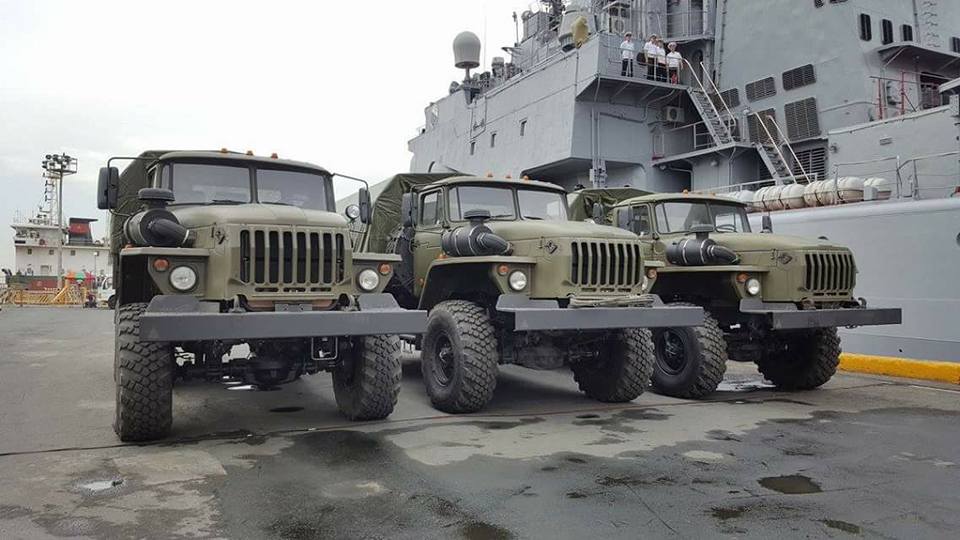
The Philippines received 20 trucks, 5,000 units of AK-74M Kalashnikov assault rifles, one million units of 1943-type cartridges with steel core bullets, and 5,000 units of steel helmets.
Defense Undersecretary Raymundo Elefante and Major General Aleksandr Kshimovksiy of the main department for international military cooperation of the Russian Ministry of Defense signed the certificate of donation.
Defense Secretary Delfin Lorenzana and Russian Defense Minister Sergei Shoigu witnessed the turnover at the Port of Manila.
Duterte also toured the large anti-submarine ship Admiral Pantaleev to check its air defense system and wardroom.
Ural tactical truck (photo : Inquirer)
The Russians also showcased the ship's firearms and conducted an artillery demonstration during Duterte's tour.
On Tuesday, Lorenzana and Shoigu signed an agreement for military and technical cooperation, according to a report by Tass Russian News Agency.
The report said the agreement was signed in Clark, Pampanga.
ASEAN defense ministers and dialogue partners gathered in Clark for the fourth ASEAN Defense Ministers Meeting with the Dialogue Partners
(GMANetwork)
25 Oktober 2017
One of two Schiebel S-100 Camcopters that crashed while on trial with the Royal Australian Navy. (Photo: AusDoD)
Two S-100 Camcopter VTOL UAVs being provided by their Austrian maker Schiebel to the Royal Australian Navy (RAN) for trials have crashed. But the service still plans to buy two S-100s plus two ground stations. Separately, the RAN is upgrading its fleet of 24 manned Sikorsky MH-60R helicopters, the last of which was delivered just over a year ago.
Speaking at a Naval Aviation Symposium on the sidelines of the Pacific 2017 Maritime Exhibition in Sydney, Commodore Chris Smallhorn, the commander of the RAN’s Fleet Air Arm, said both unmanned helicopters crashed for similar reasons and that investigations are ongoing. However trials with the S-100 are set to continue, with delivery of two more powered by a new heavy-fuel engine. According to documentation from Schiebel, the new engine will be able to use JP-5 fuel with its higher flash point for shipboard operations.
Australia selected the S-100 Camcopter for its Navy Minor Project (NMP) 1942 in December last year to meet the RAN’s interim requirement for a VTOL UAV, signing a three-year contract. This project will lead to Project SEA 129 Phase 5 Stage 1, which will select a UAV to go aboard the RAN’s 12 Offshore Patrol Vessels (OPV) whose construction is due to start in 2018. Phase 2 of this project will select another UAV type to equip nine frigates the RAN is planning to build for service from the early 2030s.
At the symposium Commodore Scott Lockey, director general of Navy Aviation Systems at the Capability Acquisition and Sustainment Group (CASG), said that the timeline for the start of SEA 129 Phase 5 Stage 1 has slipped by two years although he expects that with a compressed timeline the program will still be able to deliver UAVs to operate on board the OPVs when they are commissioned in the early 2020s.
See full article AINOnline