05 Juli 2018
RSAF's Surface-to-air PYthon-5 and DERby (SPYDER) (photo : Sing Mindef, Nighteye)
Senior Minister of State for Defence Dr Mohamad Maliki Bin Osman officiated at a ceremony to mark the achievement of Full Operational Capability (FOC) status by the Republic of Singapore Air Force (RSAF)'s Surface-to-air PYthon-5 and DERby (SPYDER) Ground Based Air Defence system at Chong Pang Camp this afternoon.
Speaking at the FOC ceremony, Dr Maliki highlighted the significance of this milestone to the overall enhancement of the Next Generation Singapore Armed Forces (SAF)'s capabilities. He said "The SPYDER is an improvement from the Rapier system as it is able to intercept not just aircraft but also munitions, therefore widening the spectrum of threats that our air defences can tackle. An all-weather system equipped with advanced infra-red and radar-guided missiles, the SPYDER can intercept aerial threats at more than twice the range and three times the altitude of the Rapier, while engaging multiple targets at the same time."

The SPYDER is part of the enhanced Island Air Defence system, which is an island-wide networked system that brings together sensors, weapon systems, command and control elements, and decision-making tools to further strengthen Singapore's air defence. As an all-weather air defence system, the SPYDER possesses anti-aircraft and anti-munition capabilities to effectively deal with a wide spectrum of aerial threats, and only requires four-man crew to deploy.
The SPYDER crew has undergone extensive training in order to operate and maintain the system, and has also validated the system's capabilities in local and overseas exercises. The SPYDER allows the RSAF to continue to protect Singapore's skies effectively.
Also present at the ceremony were Chief of Defence Force Lieutenant-General Melvyn Ong, Chief of Air Force Major-General Mervyn Tan, and other senior officers from the SAF.
(Sing Mindef)
05 Juli 2018
PAF modernizaion plan until 2022 (image : PAF)
The government is set to invest more than P139 billion over a five-year period until 2022 to modernize the Philippine Air Force (PAF), President Rodrigo Duterte said Tuesday.
Speaking at the 71st PAF anniversary in Pasay City, Duterte said there are 16 projects intended for the PAF in the second phase of the Revised Armed Forces of the Philippines Modernization Program.
"Just this year, we have completed the acquisition of air defense surveillance radars, utility aircraft and unmanned aerial vehicles to complement our existing air assets. We are also expecting the delivery of additional equipment and machinery in the following years," Duterte said.
"Be assured that we remain steadfast in supporting the PAF as we implement the necessary reforms that will enable you to become effective agents of genuine and lasting peace," he added.
Under the modernization plan approved by Duterte, the PAF will get multi-role fighter aircraft, a radar system, light utility aircraft, and medium lift aircraft.
Heavy lift helicopters, unmanned aerial vehicles, attack and combat utility helicopters, special mission and long-range patrol aircraft, and trainer aircraft are also on the shopping list.
In his speech, Duterte lauded the PAF's contributions and accomplishments in air operations for territorial defense; counterterrorism and internal security; international defense and security engagements; and humanitarian assistance and disaster operations.
He also urged the PAF to remain vigilant "as we intensify our fight against the current challenges of terrorism and external security."
"I therefore ask of you to join me in this endeavor, not just for ourselves, but for the sake of the generations to come, especially our nation," Duterte said.
(GMA News)
04 Juli 2018
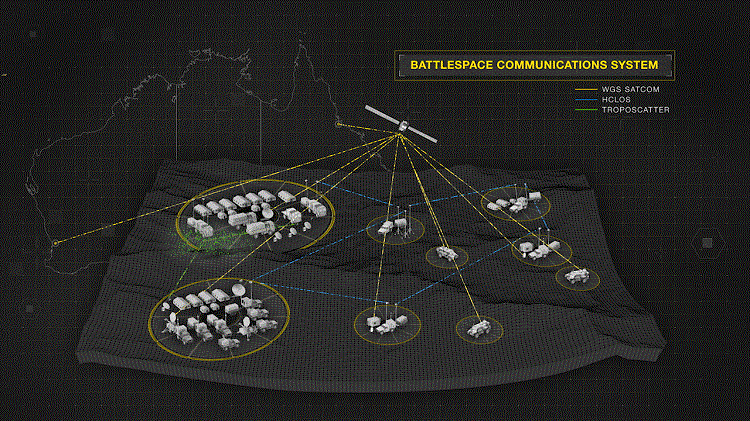
Battlespace Communications Systems (image : Boeing Defence)
The ADF’s Project LAND 2072 Phase 2B Currawong Battlespace Communications System has achieved an initial operating capability (IOC).
The $950m Currawong program will provide a digital strategic communications system to replace the Parakeet tactical satellite and trunk communications system in service.
Boeing Defence Australia vice president and managing director Darren Edwards said with the declaration of IOC, the Australian Defence Force now has the world’s most advanced battlespace communication system to transfer secure data, voice and video between Australian headquarters and deployed forces globally.
“The system improves the set-up time, capacity, flexibility, and responsiveness of the Australian Defence Force information exchange while reducing equipment size, weight and power during operations,” Mr Edwards said.
“The rapid implementation of the Australian-designed and manufactured communications network is testament to the high customer engagement during product development and the expertise of Boeing’s Australian team in delivering complex development systems.”
Officer 7th Combat Signal Regiment, LTCOL Les Juckel Commanding said IOC was achieved during the recent Exercise Carbon Diamond. “The Integrated – Battlefield Telecommunications Network (I-BTN) was unquestionably superior to previous Defence networks in terms of ease of configuration, situational awareness for the operators, and network performance,” he said.
“Overall the operation of the network was beyond the expectations of the operators and left them awaiting future material and software releases for further capabilities.”
IOC comes on schedule, just four months after the project’s Initial Material Release (IMR). Under release 1, the project has to date delivered the core communication network software and hardware, and 39 deployable communication nodes to the ADF.
The world-leading system is believed to be of interest by several other nations, including the UK.
(ADBR)
04 Juli 2018
Model of Type 218SG submarine (photo : Straits Times)
SINGAPORE: More than 30m under the waters around Singapore, where light hardly penetrates the murky depths, noise is perhaps the last thing you would expect.
But the Republic of Singapore Navy’s (RSN) latest submarine, the Type 218SG, hears and senses a cacophony of chatter. Not of people, but of the 2,000 ships that sail through the Singapore Strait every day.
“Many of the boats in the world are not designed for such environments: Warm, shallow, noisy, crowded,” RSN’s head of naval operations Cheong Kwok Chien told Channel NewsAsia in an exclusive interview on Saturday (Jun 30).
“The operating environment makes a lot of difference to a submariner, and if you design a boat meant for this type of environment, you can make a lot of difference to whoever you’re up against.”
And so the RSN searched all over the world for a submarine that could replace its ageing Archer-class and Challenger-class predecessors. A submarine that could truly be made for Singapore from scratch.
“We’ve operated second-hands for 20 years,” Rear-Admiral (RADM) Cheong said of the retrofitted Swedish submarines. “Over 20 years, we’ve built up knowledge of what a submarine would be that’s designed for local waters.”
In the end the Germans, masters of the submarine craft, “offered the best deal” in terms of technology, logistics, training and knowledge exchange. It has been reported that the contract for the first two Type 218SGs is worth more than 1 billion euros (S$1.6 billion).
The deal clincher? “The Germans were also very willing to listen to our requirements and change a lot of the original design to suit what we need in our waters,” RADM Cheong said.
The manufacturer, ThyssenKrupp Marine Systems (TKMS), also prepared high-resolution, virtual reality goggles for Singapore officials to put on and “walk” through the submarine, allowing them to tweak even the smallest details.
RSS Chieftain, from the older Challenger class (Swedish Sjöormen) (photo : cks2k2)
“We can actually know the ergonomics,” RADM Cheong said. “For a Singaporean’s height, can I reach the top? We could also make the pathways smaller and put more equipment because we are smaller in size.”
The Defence Ministry said Singapore will get four Type 218SGs, with delivery from 2021. The programme is “progressing well”, with the first two and remaining two submarines having commenced construction and steel-cutting, respectively.
LIGHTING UP THE UNDERWATER WORLD
But perhaps the most crucial customisations are in the Type 218SG’s combat system. Its improved sonar, which listens to sounds like propeller noises and water flow, locates enemies faster and identifies them more accurately.
“That’s when digital audio recognition comes in. We will hear frequency, sound wave profiles, and compare to known sounds that we have,” RADM Cheong said. “That basically helps us light up the underwater world.”
With the waters around Singapore so shallow and congested, the Type 218SG can tell whether it’s facing a merchant ship, cruise liner or warship better than RSN’s current submarines.
“It’s like going into a disco and picking up the sweetest voice,” RADM Cheong added. “You need to be quite capable. If not you will be blasted, and in our environment everybody gets blasted.”
Once the target is locked on, then come the torpedoes. A Type 218SG model that TKMS had displayed at an exhibition last year indicated that the submarine will be fitted with eight forward-firing torpedo tubes for heavyweight torpedoes.
The "big improvement", however, lies in the submarine’s electronics and computers that enable fewer crew members to do more with the weapons.
“If you watch the old war movies, it’s a whole bunch of people trying to hear (the enemy) then get the torpedo ready; there’s a whole lot of activity on the boat,” RADM Cheong said. “No, what we are going for now is one guy pressing a button to release the torpedo.”
RSS Swordsman - an Archer class submarine (was the Swedish Navy Västergötland class) (photo : Danny Clh)
Another improvement is the Type 218SG’s air-independent propulsion (AIP) system, which RADM Cheong said is more efficient than the one in the Archer-class submarine.
The AIP allows submarines to stay underwater longer before surfacing to recharge the battery that powers its systems. The battery is charged by a diesel engine that needs air to operate.
As such, the Type 218SG can last underwater two times longer than RSN’s current submarines. “That makes the submarine even more stealthy and mysterious because it can be all over the place without coming up,” RADM Cheong said.
SHIP KILLERS
This stealth is what makes the Type 218SG so lethal, as RADM Cheong spoke in broad terms about how the submarines fit into RSN’s overall strategy.
“All over the world, submarines are what we call strategic capabilities,” he said. “Because they are stealthy, can go to a lot of places and deliver a very impactful strike. So, most navies will use the submarine to deliver these effects.”
Besides hunting ships, submarines can do surveillance, deliver special forces, unmanned underwater vehicles and high-end weapons like nuclear missiles.
“Sometimes, you have to strike at the Achilles heel of the adversary, somewhere he thinks he’s quite safe and doesn’t expect anybody to come,” RADM Cheong said, highlighting the “psychological threat” a submarine poses.
Type 218SG submarine (image : Sing Mindef)
When RSN’s submariners go for exercises, they typically train in some of these skills.
“It makes all the seagoers, especially people on ships, quite fearful because you don’t know where it is,” RADM Cheong added. “Surface ships dislike submarines a lot, because most egos are broken by submariners.”
In a one-on-one situation with conventional warships, RADM Cheong stated that submarines “always win”. “When the submarine hears you, with the range that it shoots, there’s not much you can do about it.”
INVISIBLE, NOT INVINCIBLE
However, submarines are not invincible. RADM Cheong pointed out that they lack speed and are prone to being spotted when they surface.
"So, these are inherent vulnerabilities,” he added. “Fast things and aircraft hunt submarines. To hunt a submarine, you must operate out of its element. If you operate in water, you must be something that it cannot or doesn’t want to kill."
One example of a low-value target is an unmanned underwater vessel.
Nevertheless, RADM Cheong said a good submariner can remain undetected if he knows where to position the vessel in relation to how sound waves travel underwater.
“If he exploits all these black holes underwater, nobody can hear him and he can hear everybody else,” he added. “He can be quite silent and maybe even invisible.”
For the Type 218SG, RSN’s submariners will train in simulators and abroad with their German counterparts, who RADM Cheong described as some of the best in the world. “They like to have a worthy partner to spar with,” he said. “We also take this opportunity to learn from them.”
Type 218SG submarine (image : Sing Mindef)
BMW FOR SINGAPORE ROADS
RADM Cheong said the Germans were also grateful that the RSN wanted to fully customise its submarine, pointing out that they gained “a lot of interesting insights”. “They said not many customers are so forthcoming in saying that this doesn’t work.”
To that end, RADM Cheong said the Type 218SG answers a lot of challenges.
“German submarines are like BMWs, so we are very glad we decided on this class of submarine,” he added. “This new build is designed for Singapore roads, tailored to our ergonomics, size and driving range. Even the horn sounds better.”
The RSN also ensured that the internal systems, like the engine and electronics, were cost-efficient and maximised the crew’s capabilities.
“On board, every submariner you bring is a huge investment,” RADM Cheong said. “So in terms of combat fighting, you want the submarine to be able to do a lot but not by putting in a lot of people.”
RADM Cheong said this is crucial to tackle the “ever-present” threat of terrorism at sea with an increasingly constrained manpower base. The saying is that one US aircraft carrier carries more people than the number of active personnel the RSN has.
“Almost everything that we wear, eat and the energy that we consume every day comes through the sea,” he added. “So, what the Navy has done is to look at this environment and recognise that we need to defend our lifelines."
(ChannelNewsAsia)
04 Juli 2018
KRI Teluk Lada, 521Kapal LST baru Kolinlamil (photo : Kemhan)
Berusia 30 Tahun, Alat Utama Sistem Persenjataan Komando Lintas Laut Militer Akan Diremajakan
WARTA KOTA, KOJA---HUT ke-57 Komando Lintas Laut Militer (Kolinlamil) diperingati dengan upacara militer yang digelar di Lapangan M Silam, Dermaga Kolinlamil, Tanjung Priok, Jakarta Utara, Selasa (3/7/2018).
Hadir Kepala Staf Angkatan Laut Laksamana TNI Siwi Sukma Adji yang bertindak sebagai inspektur upacara.
Dalam kesempatan itu Siwi mengatakan, alat utama sistem persenjataan (alutsista) Komando Lintas Laut Militer (Kolinlamil) akan diremajakan.
Keputusan itu diambil karena usia alutsista yang ada sekarang ini rata-rata sudah tua, yakni mencapai 30 tahun.
Menurut Siwi keputusan itu untuk menunjang peran penting Kolinlamil dalam operasi perang.
Pasalnya alutsista yang ada sudah tidak memadai karena usia yang sudah mencapai 30 tahun. Sehingga diperlukan alutsista yang terbaik untuk menunjang tugas.
Progres LPD baru TNI AL (photo : defence.pk)
"Kedepan alutsista laut Kolinlamil ini memiliki kurang lebih 17 alutsista yang rata-rata sudah di usia 30 tahun. Perlahan-lahan kedepannya kita akan ganti dengan unsur-unsur yang baru," kata Siwi.
Siwi mencontohkan beberapa alutsista yang perlu peremajaan seperti kapal berjenis LST (landing ship tank) dan LPD (landing platform dock).
Diharapkan dengan alutsista yang baru, tidak ada lagi hambatan saat menjalankan tugas.
"Itu sudah menjadi program kami dan menjadikan program Angkatan Laut untuk mengganti dengan unsur-unsur yang baru dalam rangka melaksanakan tugas. Sehingga tugas paling lama kedepan tidak terhambat karena kondisi alutsista yang sudah tua," katanya.
Menurut Siwi, tantangan Kolinlamil kedepannya adalah bagaimana membina dalam situasi dan kondisi yang diperlukan, baik dalam kondisi damai maupun kondisi konflik.
Sehingga peran daripada operasi militer harus dibina dan juga tentunya dalam kegiatan penyelamatan.
(Warta Kota)
03 Juli 2018
Silhouette image of the Multi-Role Combat Vessel, based on a similar image released (image : Jane's)
The Republic of Singapore Navy (RSN) will retire its class of six Victory-class corvettes, and replace these with a new type of platform known as the Multi-Role Combat Vessel (MRCV).
The matter was disclosed by Singapore’s Defence Minister Ng Eng Hen at a media conference held in conjunction with the country’s Singapore Armed Forces (SAF) day, which falls on 1 July.
The 62 m Victory-class vessels were first commissioned in 1990 and are currently in service with the RSN’s 188 Squadron. The corvettes can attain a top speed of 35 kt, and a standard range of 2,000 n miles at 22 kt.
Each vessel is armed with a 76 mm Oto Melara naval gun in the primary position, and six 324 mm torpedo tubes to prosecute submarines. The class is also capable of deploying the McDonnell Douglas Harpoon anti-ship missile, and the Israeli-made Barak I surface-to-air missile.
The Victory-class corvette, RSS Valiant. The class will reach the end of its operational life in 2025. (photo : Sing Mindef)
The class underwent a service-life extension programme (SLEP) from 2009 to 2014, and these enhancements include installation of the Saab Sea Giraffe Agile Multiple Beam (AMB) radar, an improved combat management system, and a launch and recovery system for the ScanEagle unmanned aerial vehicle (UAV).
The class, which is deployed regularly for maritime patrol duties in the Strait of Malacca and the South China Sea, will reach the end of its operational life in 2025.
Meanwhile, the MRCVs, which will be introduced after 2020, will be conceived as “mothership” platforms that will host a spectrum of unmanned air, surface, and sub-surface vehicles, said the defence minister.
(Jane's)
03 Juli 2018
Lanud Sjamsudin Noor Banjarmasin (image : GoogleMaps)
Pangkoopsau II Lantik Komandan Lanud Sjamsudin Noor
TNI AU. Panglima Komando Operasi TNI AU II (Pangkoopsau II) Marsekal Muda (Marsda) TNI Fadjar Prasetyo, SE.,M.P.P., bertindak selaku inspektur upacara pada Upacara presmian peningkatan status Lanud Sjamsudin Noor menjadi tipe B dan Pengambilan Sumpah dan serah terima jabatan Komandan Lanud Sjamsudin Noor, Senin (2/7).
Pada Upacara tersebut dihadiri oleh Pangkosekhanudnas II Marsma TNI Andi Heru, Danlanud Sultan Hasanuddin Marsma TNI Bowo Budiarto, Ketua PIA Ardhya Garini Daerah II Koopsau II dan Pengurus, para pejabat Makoopsau II, Para pejabat Lanud Sultan Hasanuddin, para pejabat Kosekhanudnas II dan pejabat Wing 2 Paskhas Makassar.
Komandan Lanud Sjamsudin Noor, diserah terimakan dari Letkol Pnb Abdul Haris kepada penggantinya Kolonel Pnb Riadi Widyoko. Penggantian tersebut terkait dengan validasi organisasi, maka pimpinan TNI AU melalui Peraturan Kasau No. 8 tahun 2017 tanggal 31 Juli tahun 2017 telah menetapkan dan mengesahkan organisasi dan tugas Lanud dari Lanud Tipe “C” menjadi Lanud Tipe “B” sehingga Komandan Lanud dijabat oleh Pamen TNI AU berpangkat Kolonel.
Dalam amanatnya, Pangkoopsau II, mengatakan kedudukan dan peran Lanud Sjamsudin Noor sebagai pangkalan pembinaan dan pelaksana dukungan operasi, sangatlah strategis, maka Lanud Sjamsudin Noor dituntut untuk mampu memainkan perannya secara optimal. Bentuk konkrit dari optimalisasi kinerja Lanud Sjamsudin Noor akan terlihat apabila mampu mengambil peran dalam pelaksanaan tugas-tugas yang telah diberikan pimpinan TNI AU kepada komandan dan seluruh prajurit dan PNS Lanud Sjamsudin Noor, ujar Pangkoopsau II.
Dalam rangkaian Sertijab Komandan Lanud Sjamsudin Noor juga diserah terimakan Ketua PIA Ardhya Garini Cabang 12/ D II Lanud Sjamsudin Noor dari Ny. Abdul Haris kepada NY. Riadi Widyoko yang disaksikan Ketua PIA Ardhya Garini Daerah II Koopsau II Ny. Inong Fadjar Prasetyo beserta pengurus PIA Daerah II Koopsau II.
(TNI AU)