02 Agustus 2018
Dominator XP Medium Altitude Long Endurance UAS (MALE UAS) serves as a strategic asset, providing comprehensive ISR missions at ranges beyond line-of-sight. The Dominator mission system is characterized by a multiple-purpose payload such as EO, SAR, ELINT COMINT, and MIST, and by extended operation capability over long range, enabling the platform to perform a wide range of military or civilian missions, over land and sea. (photos : Aeronautics)
Yavne-based Aeronautics Ltd. (TASE:ARCS) will supply Dominator unmanned aerial vehicles (UAVs) to the Thai Ministry of Defense, the company today reported to the Tel Aviv Stock Exchange (TASE). The volume of the deal, which includes UAVs, land equipment, and accompanying services, is $27 million over three years. Payment will be according to the milestones set in the agreement.
The Dominator, developed by Aeronautics on the basis of a manned aircraft converted by the company into a UAV, can carry up to 1,900 kilograms in special payloads (such as a camera, radar, or bomb), simultaneously and can stay airborne for 20 hours.
Aeronautics said that the Thai Ministry of Defense was one of its veteran customers and that the Thai army had been using the company's UAVs for the past decade.
Aeronautics develops and manufactures UAVs, observation balloons, bomb fuses, and advanced navigational systems. The company is controlled by the KCPS, Viola, and Bereshit funds. Its CEO is Amos Mathan and its chairperson is former Israeli navy commander and former Rafael Advanced Defense Systems Ltd. CEO Vice Admiral (res.) Yedidia Yaari, who recently replaced former Israel air force commander Maj. Gen. Eitan Ben Eliyahu.
Aeronautics' share price responded to the news by rising, but has lost nearly 60% of its value since the company went public in June 2017, following weak results and an affair that culminated in the Ministry of Defense suspending Aeronautics' license to market the K1 Orbiter UAV to an important customer in a foreign country (a gag order is still in effect in the affair after a criminal investigation was opened last November).
The company reported a 5% decrease in revenue in the first quarter, compared with the first quarter in 2017, and posted a $1.2 million operating loss, compared with an $858,000 operating loss in the corresponding quarter last year, due to higher research and development expenses, among other factors. Aeronautics' first quarter net loss was $1.8 million, compared with a $180,000 net profit in the first quarter of 2017.
Aeronautics became a public company in the summer of 2017 when the funds controlling the company conducted a massive offer of sale amounting to over NIS 400 million. The company issued new shares for NIS 53 million at the same time to Leumi Partners. Trading on the TASE in Aeronautics' share began at a NIS 1 billion market cap, which has since shrunk to NIS 405 million.
(Globes)
01 Agustus 2018
Exercise Pitch Black 18 kicked off in Darwin on Monday with more than 60 aircraft from eight nations taking to the skies in under 90 minutes. (all photos : RAAF)
Aircraft from Australia, India, Malaysia, Indonesia, Thailand, Singapore, France and the United States took off for the first week of the exercise, known to participants as Force Integration Training (FIT) week.
Commander Task Unit Headquarters for Exercise Pitch Black, Group Captain (GPCAPT) Rob Denney said FIT week is designed to prepare RAAF and international aircrew to operate safely as an integrated force throughout the exercise.
“The missions are based largely around familiarisation training on the basics like radio calls, local Darwin airspace and airfield procedures as well as those of any airfields they may need to divert to.”
“It’s also about getting comfortable with flying as part of larger missions that will include aircraft and aircrew from other participating nations,” he said.
For this first week of familiarisation participating nations will conduct a range of missions including ‘dogfighting’, air-to-air refuelling, beyond-visual-range engagements, and even high-explosive missions utilising the Delamere Weapons Range where aircrew will have the chance to practice coordinating live-fires with a multinational Combat Controller force on the ground.
“A typical mission will differ depending on the aircraft type but for the fighter aircraft it would include coordinating with air traffic control, getting out into the airspace, conducting some air-to-air-refuelling, and then carrying out some basic fighter manoeuvring missions,” GPCAPT Denney said.
“This week prepares everyone for the last two weeks of the exercise where we’ll see the launch of large packages of up to 50 and even 60 aircraft flying together.”
GPCAPT Denney said the airspace in Darwin is potentially the biggest to exercise in anywhere the world offering a unique draw card for Exercise Pitch Black.
Being less densely populated than most other airspaces in the world, access to the Darwin airspace allows participating nations to operate their aircraft without many of the usual constraints they would otherwise have.
“We’re lucky in Australia to have airspace like this; other countries don’t have that luxury,” GPCAPT Denney said.
“Coming along to Exercise Pitch Black provides them with an excellent opportunity to operate in this unique airspace and gives the Royal Australian Air Force the chance to exercise with our partner air forces, from all around the world, right in our own backyard.”
The Flying Program for Exercise Pitch Black runs for three weeks from Monday, 30 July to Friday, 17 August.
(RAAF)
01 Agustus 2018
UAV MALE untuk TNI AU (image : Angkasa Review)
Sssttt.., Ini Dia Penampakan Drone MALE Nasional yang Ditunggu Itu
ANGKASAREVIEW.COM – Banyak penggemar alutsista tentunya penasaran dengan progres pengembangan drone nasional jenis MALE (Medium Altitude Long Endurance) yang proyeknya telah disiarkan sejak tahun 2016 silam.
Rasa penasaran itu juga dirasakan awak Redaksi Angkasa Review yang akhirnya terjawab sudah saat kami mengunjungi PT Dirgantara Indonesia (PTDI) pada 10 Juli lalu. Informasi resmi disampaikan langsung oleh Nainar, Project Engineer PTTA (Pesawat Terbang Tanpa Awak) PTDI yang menjadi nara sumber wawancara kami.
Pengembangan PTTA MALE ini mulai di canangkan pada 2015 silam yang merupakan tindak lanjut dari kesuksesan proyek PUNA/PTTA Wulung untuk TNI AU.
Proyek drone MALE ini juga dijalankan oleh tim yang sama seperti proyek Wulung. Yaitu kolaborasi antara Kementerian Pertahanan, TNI AU, PTDI, BPPT, PT LEN Industri, dan ITB (Institut Teknologi Bandung).
Kali ini kinerjanya dan perannya akan jauh lebih ampuh dibanding Wulung yang durasinya hanya maksimal empat jam dan berperan sebagai drone pengawasan (surveillance) saja. Sedangkan PTTA MALE dapat beroperasi enam kali lipatnya dan menjalankan misi ISR penuh (intelligence, surveillance, reconnaisance).
UAV MALE untuk TNI AU (image : Angkasa Review)
Seperti diutarakan Nainar, MALE Nasional ini dirancang untuk dapat beroperasi selama 24 jam dengan ketinggian maksimum hingga 7.000 m dan jangkauan jelajah operasi sejauh 5.000 km.
Nainar juga mengungkapkan, drone MALE ini akan dibangun dalam empat fase atau yang disebut sebagai ‘Block’. “Pertama adalah Block O, lalu Block L, selanjutnya Block D, dan terakhir Block C,” ujarnya.
Pada fase awal atau Block O (O=kosong) sang MALE belum dilengkapi sistem misi. Fase ini adalah pembuktiaan konsep (proof of concept) apakah MALE bisa terbang sesuai dengan target atau kinerja yang ditentukan sebelumnya. Lalu fase kedua atau Block L (L=LEN) mulai menerapkan sistem misi yang dikembangkan oleh PT LEN Industri.
Selanjutnya dalam Block D (D= Data link-BLOS), MALE akan dilengkapi sistem terkait dengan perannya sebagai pesawat ISR penuh. Untuk mendapatkan sistem yang telah proven, PTDI dan Tim akan mencari mitra dari negara lain.
Spesifikasi teknis UAV MALE untuk TNI AU (image : Keris)
Baik dalam Block O dan Block L, MALE yang akan dibangun oleh PTDI ini sistem roda pendaratnya masih belum dimasukkan ke dalam badan pesawat (fixed landing gear). Baru pada tahap ketiga dan keempat sistem roda sudah dirancang bisa masuk ke dalam yang juga akan meningkatkan aerodinamis pesawat.
Seperti yang diungkap Nainar, setidaknya telah ditetapkan tiga mitra sebagai pemasok sistem misi ISR tersebut, yaitu dari perusahaan asal Cina, Turki dan Perancis.
Meski tidak mengungkapkan secara detail, dari banyak berita yang beredar di dunia maya, sistem ini akan serupa dengan milik drone CH-4 dari Cina, Anka dari Turki, dan drone Patroller buatan Safran-Perancis. Namun dipastikan oleh Nainar, MALE tetap murni rancangan Indonesia, hanya sistemnya saja yang akan diambil dari luar.
Sampai saat ini progres PTTA MALE yang belum mendapatkan nama ini telah masuk detail desain untuk pembuatan purwarupa. Diharapkan tahun 2019-2020 telah menjalani penerbangan perdananya. Dua tahun selanjutnya proses untuk mendapatkan sertifikasi sehingga tahun 2022 sudah bisa masuk jalur produksi.
(Angkasa Review)
01 Agustus 2018
RMAF Su-30MKM fighter (photo : pixelsniper)
KUALA LUMPUR: Only four out of the 28 Russian fighters jets owned by the Royal Malaysian Air Force (RMAF) are able to take to the skies, says Mohamad Sabu.
The Defence Minister said that the RMAF had 18 Russian-made Sukhoi Su-30MKM and ten MiG-29 jetfighters.
"Only four of the Sukhois are able to fly well," he said, adding that the remaining 14 are under repair.
In his reply during the motion of thanks on the royal address in Parliament Tuesday (July 31), Mohamed Sabu said the RMAF was unable to properly maintain the fighter jets' airworthiness.
RMAF MiG-29N fighter (photo : nvgui)
He said the Defence Ministry had terminated the contractor engaged by the former administration and was looking at replacing them with local contractors.
Mohamad Sabu also informed the House that the ten MiG-29 multi-role jets entered service in 1995, while six Sukhoi Su-30MKM Air-Superiority Fighter were delivered in 2007 and the remainder in 2009.
Earlier, he said that the ministry would stop awarding honorary ranks to politicians to avoid any instances of them "pulling rank" and abusing their position.
(The Star)
01 Agustus 2018
Terma Scanter 6000 series radar (photo : Terma)
Copenhagen and Singapore - In May 2018 the contract signing for the SEA1180 Offshore Patrol Vessel (OPV) was successfully completed between Saab Australia and Terma Singapore for the customer, the Royal Australian Navy, (RAN).
Terma is contracted to deliver the SCANTER 6002 radar for all 12 OPVs over a period of 10 years. The Lürssen designed OPVs will replace and improve upon the capability delivered by the existing Armidale Class Patrol Boats. The primary role of the OPV will be to undertake constabulary missions and the OPV will be the primary RAN asset for maritime patrol and response duties.
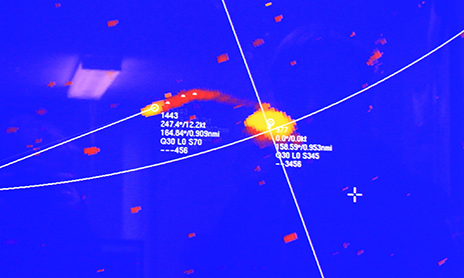
Radar image recorded from SCANTER 6000 display (photo : Terma)
The SCANTER 6002 is a combined Air and Surface Surveillance radar providing unique capabilities for advanced navigation, air and surface surveillance, and helicopter control. On the OPV, the SCANTER 6002 radar is configured with its compact 12 feet antenna and is integrated with Saab Australia Situational Awareness System. The SCANTER 6002 radar enables the operator to detect surface and short range air contacts and provides the capability to track and control air vehicles operating in proximity to the OPV.
The SCANTER 6002 radar has become a preferred choice for both navigation and surveillance purposes by a large number of navies and coastguards around the world. The SCANTER 6002’s unique Surface Surveillance capability with superior small target detection and target separation in bad weather conditions - unmatched by no other Surface Surveillance radar.
(Terma)
01 Agustus 2018
FPB 72 Mk II Panglao (photos : OCEA)
The “PANGLAO”, a Fast Patrol Boat type OCEA FPB 72 MKII loaded on the July 18th 2018, at the OCEA site located in: Saint-Nazaire.
This 24m versatile vessel is designed to meet the operational requirements of the Philippine Coast guards for numerous missions such as:
-Coastal patrol in territorial and Exclusive Economic Zone waters
-Surveillance operations
-Fishing surveillance operations
-Fight against smuggling and illegal immigration
-Search and rescue operations
-Natural disaster management
-Control of vessels at sea
The “PANGLAO” will follow the way of her sistership “BOROCAY” and be transported to the Philippines.
(OCEA)
01 Agustus 2018
Kapal Littoral Mission Ship TLDM (image : TLDM)
TLDM Dijangka Terima LMS Pertama Disember 2019
KUALA LUMPUR – Tentera Laut Diraja Malaysia (TLDM) dijadual menerima kapal pertama misi pesisir (LMS) yang kini dalam pembinaan pada 31 Dis tahun depan sebelum menerima kapal kedua pada 31 Mac 2020.
Menurut kenyataan Markas Tentera Laut, fasa reka bentuk LMS telah selesai dan kini memasuki fasa pembinaan kapal keseluruhannya yang mengambil tempoh kurang 18 bulan termasuk proses pemasangan peralatan dan sistem kapal serta aktiviti ujian di pelabuhan dan di laut.
“Ini merupakan tempoh paling singkat pernah dilaksanakan dalam sejarah pembinaan kapal perang TLDM. Sejumlah 21 pegawai, jurutera dan anggota daripada TLDM serta Boustead Naval Shipyard Sdn Bhd (BNSSB) kini berada di China sepanjang pembinaan bagi mengawasi serta mengurus projek pembinaan, sekali gus menjaga kepentingan kerajaan sejajar dengan keperluan kontrak,” menurut kenyataan itu.
Upacara First Steel Cutting (FSC), simbolik bermulanya fasa pembinaan kapal sejurus selesai reka bentuk, bagi LMS TLDM yang pertama dilaksanakan di Wuchang Shipbuilding Industrial Group (WSIG), Shuangliu, China.
Ia disempurnakan Panglima TLDM Laksamana Tan Sri Ahmad Kamarulzaman Ahmad Badaruddin yang turut disaksikan Pengarah Urusan BNSSB Tan Sri Ahmad Ramli Mohd Nor, pihak China Shipbuilding Industry Corporation (CSIC) dan China Shipbuilding & Offshore International Co Ltd (CSOC).
Pembinaan LMS adalah satu daripada lima kelas atau jenis kapal yang dilulus kerajaan di bawah program transformasi armada TLDM ‘15 to 5’ dan bakal menjadi pemangkin kepada industri pembinaan kapal di dalam negara.
Melalui kontrak perolehan yang dimeterai di antara Kerajaan Malaysia dengan syarikat pembinaan kapal tempatan iaitu BNSSB pada 23 Mac tahun lepas, TLDM bakal menerima empat LMS dengan nilai kontrak RM1.17 bilion termasuk kos latihan komprehensif bagi bakal warga kapal.
BNSSB dengan kerjasama China Shipbuilding Offshore and International Corporation LTD sedang melaksanakan pembinaan dua LMS di Wuchang Shipyard, China dan diikuti dua buah lagi di Malaysia sebagai sebahagian daripada rancangan pemindahan teknologi serta menyumbang kepada peningkatan keupayaan pembinaan kapal perang tempatan.
Menurut kenyataan itu, pembinaan kapal LMS ketiga dan keempat di negara ini akan dilaksanakan serentak pada pertengahan tahun depan menggunakan tenaga kerja tempatan sepenuhnya dan dipantau oleh beberapa jurutera dari syarikat China.
Kerjasama dengan negara China selaku peneraju dalam bidang itu mampu meningkatkan keupayaan negara untuk menjadi pengeluar kapal perang yang kompetitif di rantau ini, selain meningkatkan peluang pekerjaan serta ekonomi negara menerusi penglibatan syarikat tempatan dan antarabangsa.
Perolehan itu akan mengukuhkan hubungan kerjasama ketenteraan dan diplomasi pertahanan antara Malaysia dan China serta membuka peluang pembangunan industri maritim yang lain.
(MyNewsHub)