04 Maret 2019
Kawasaki C-2, payload 36 tonnes compared to C-130J payload 19 tonnes (photo : Mark Allison)
MELBOURNE, Australia — Kawasaki Heavy Industries will offer its C-2 transport aircraft to New Zealand for the country’s Future Air Mobility Capability, or FAMC, program, a company representative confirmed Tuesday.
New Zealand has a requirement to replace its aging Lockheed Martin C-130H Hercules and Boeing 757-200C aircraft with a new capability. The FAMC program seeks to deliver a strategic and tactical airlift capability, which may involve a mix of two different aircraft types, or a single type able to meet essential requirements in both roles.
Speaking at the 2019 Avalon Airshow, the official said that Kawasaki Heavy Industries, or KHI, had been in discussion with the Royal New Zealand Air Force for several years regarding its requirements.
“We have just started marketing the aircraft,” the official said. “We expect the C-2 to be in production for at least 10 years."
A C-2 from the Japan Air Self-Defense Force’s 3rd Tactical Airlift Wing is on static display at Avalon, and one aircraft had visited New Zealand in November 2017.
The C-2 has been designed against JASDF requirements for an airlifter capable of both strategic and tactical missions to replace the existing Kawasaki C-1 aircraft. Seven aircraft and two prototypes have been delivered to date, against an ultimate requirement of between 20 and 30 aircraft. The aircraft entered service with the JASDF in March 2017, and the official revealed that KHI recently delivered the seventh aircraft to the customer.
The official also said KHI was in discussion with “several other countries” regarding C-2 sales, but he declined to name a specific nation or region. He said the company was consulting with the Japan Defense Agency and Minister of Economy, Trade and Industry Hiroshige Seko for export approvals.
(DefenseNews)
04 Maret 2019
Latihan Kelautan Prajurit Intai Amfibi (all photos : Yon Taifib 1)
Prajurit Batalyon Intai Amfibi 1 Marinir (Yontaifib 1 Mar) yang dikenal dengan sebutan Ipam melaksanakan latihan Long Range Navigation dengan menggunakan SeaRider M10 , Infiltrasi melalui bawah air dengan Selam Close Cirquit dilanjutkan Patroli Intai Tempur dan Penyerangan Sasaran di daerah Pantai Rawa dan Laut di daerah Perairan Jakarta Utara dan Pulau Damar, Kamis, (28 /02/2019).
Kegiatan latihan tahap laut ini merupakan latihan untuk menguji kemampuan individu dan tim prajurit Ipam guna mengukur kemampuan dan kesiapan tempur Satuan. Dengan harapan prajurit Ipam memahami dan mampu melaksanakan Teknik dan Taktik mobilisasi menggunakan Searider, teknik selam Close Cirquit, teknik menembak di atas Kapal, taktik Rawa, Laut, dan Pantai dengan benar dalam rangka mendukung tugas tempur.
Pada materi laut ini, Koordinator Latihan Pasiops Yontaifib 1 Mar Kapten Marinir Mulyadi menjelaskan tentang teknik mengemudi dan Navigasi Searider, teknik menyelam, tahapan pancangan kaki di pantai, Patroli Intai Tempur, teknik menembak senjata GPMG, Gatling Gun dari Sea Rider.
Latihan mengemudi SeaRider ini sudah dilaksanakan sejak hari Selasa tanggal 26 - 28 Februari 2019. Selanjutnya penyelaman bertujuan agar memelihara tuntutan setiap prajurit Ipam memiliki kemampuan penyusupan atau infiltrasi ke daerah musuh tanpa diketahui, untuk itu prajurit Ipam wajib menjalani dan memahami dengan sungguh-sungguh setiap taktik dan tekhnik sehingga mampu melaksanakan operasi di wilayah Rawa, Laut, Sungai dan Pantai.
“Latihan ini dilaksanakan untuk meningkatkan kemampuan prajurit dalam tugas dan operasi-operasi khusus”, ucap Kapten Marinir Mulyadi.
(TNI AL)
04 Maret 2019
Hawk 208 TUDM dengan camo baru (photo : BHC)
SUBANG – Pesawat Hawk yang telah mencapai usia 25 dalam perkhidmatan TUDM masih kekal relevan sehingga kini bagi melaksanakan tugasan utamanya dalam menjaga keselamatan dan kedaulatan ruang udara Malaysia.
Panglima Tentera Udara, Jeneral Tan Sri Affendi Buang menyatakan perkara tersebut di Pangkalan Udara Subang, hari ini.
“Saya ingin yakin skuadron-skuadron Hawk akan terus memberikan khidmat yang terbaik.
“Walaupun pesawat ini telah mencapai usia 25 tahun, tetapi dengan daya usaha daripada semua peringkat dalam TUDM telah menjadikan pesawat ini sebagai salah satu platform dalam mempertahankan kedaulatan ruang udara negara kita,” kata Panglima Tentera Udara sebelum berlepas ke Pangkalan Udara Butterworth.
Beliau menaiki pesawat Hawk 108 yang diterbangkan oleh Leftenan Kolonel Mohammad Syagol Abd Hamid, Pegawai Memerintah No 6 Skn. Penerbangan beliau ke Butterworth turut diiringi dengan sebuah lagi pesawat Hawk 108.
Sejarah permulaan perkhidmatan Pesawat Hawk TUDM bermula pada 15 April 1994 setelah penerimaan 2 buah pesawat pertama melalui Memorandum Of Understanding (MOU) di antara Kerajaan Malaysia dan Kerajaan United Kingdom yang dimeterai pada 10 Dis 1990.
Ketika itu, Kerajaan Malaysia telah bersetuju untuk mendapatkan perkhidmatan 10 buah Hawk 108 dan 18 buah Hawk 208 sebanyak 18 buah. Pesawat ini telah diterima secara berperingkat dengan 2 buah pesawat pada setiap bulan sehingga mencapai keseluruhan 28 buah pesawat.
Tahun 2019 menjadi detik bersejarah dan kebanggaan buat TUDM kerana meraikan Sambutan Ulang Tahun Jubli Perak Pesawat Hawk. Sambutan yang cukup meriah ini telah diadakan di Hangar No 15 Skn, Pangkalan Udara Butterworth.
Pesawat Hawk 208 TUDM dengan camo lama (photo : Weimeng)
Sepanjang 25 tahun perkhidmatan pesawat Hawk, pesawat ini telah dioperasikan oleh tiga buah skuadron iaitu No 6 Skuadron, No 9 Skuadron dan No 15 Skuadron.
Antara operasi terbesar yang melibatkan pesawat ini adalah Ops Daulat pada Mac 2013 dimana 5 buah pesawat Hawk telah ditugaskan bagi melancarkan serangan udara ke kawasan persembunyian pengganas di Lahad Datu.
No 6 Skuadron telah dipindahkan ke Pangkalan Udara Labuan dari Pangkalan Udara Kuantan setelah tamatnya Ops Daulat. Pemindahan ini bagi memperkukuhkan pertahanan negara di Sabah dan Sarawak.
Disamping itu, pesawat ini juga digunakan sebagai pesawat latihan lanjutan. bagi kursus peralihan pesawat pejuang yang dioperasikan oleh No 15 Skuadron di Pangkalan Udara Butterworth dimana juruterbang-juruterbang muda dilatih untuk menjadi seorang juruterbang pesawat pejuang sebelum melayakkan mereka untuk mengendalikan pesawat-pesawat pejuang yang lain dalam TUDM.
Pelancaran gimik Sambutan Ulang Tahun Jubli Perak Pesawat Hawk telah disempurnakan oleh Panglima Tentera Udara.
Turut hadir dalam sambutan ini adalah Panglima Operasi Udara, Leftenan Jeneral Dato’ Sri Haji Abdul Mutalib bin Datuk Haji Ab Wahab TUDM; Ketua Staf Markas Pemerintahan Operasi Udara, Mejar Jeneral Dato’ Zahani bin Zainal Abidin, Pegawai-pegawai Kanan TUDM, Juruterbang serta krew yang berkhidmat dan pernah berkhidmat dengan Skuadron Hawk.
Pesawat Hawk turut dijadualkan untuk terlibat dalam persembahan udara di Langkawi bersempena Pameran Maritim dan Aeroangkasa Antarabangsa Langkawi 2019 (LIMA’19) yang berlansung pada 26 sehingga 30 Mac 2019.
(AirTimes)
03 Maret 2019
A Strong SAF for 2030 and Beyond (all images : Sing Mindef)
................
A Strong SAF for 2030 and Beyond – Ready for SG75
Members have asked more details on our modernisation of the next generation SAF – Mr Vikram Nair, Mr Pritam Singh, Mdm Lateef, Mr Chong Kee Hiong, and Mr Charles Chong. So let me elaborate. Our plans to modernise the Next-Generation SAF to better respond to security threats are progressing well for all three services. With your permission, Mr Speaker, may I display some slides on the LED screens, and also ask for the handout to be distributed.
Let me begin with the air. I think Mr Henry Kwek has asked about the F-35s. We have announced our plans to replace the F-16s, which will face obsolescence post-2030, with the F-35s. This will mean that the RSAF fighter fleet will consist of F-35s and F-15SGs, if plans come to fruition a decade or so from now.
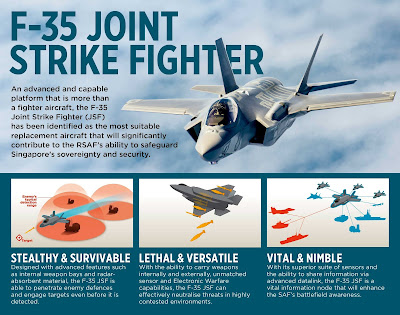
As stated previously, MINDEF will issue a Letter of Request (LOR) to the US to acquire F-35s. As required by US law for foreign military sales, the US Congress must approve the sale of F-35s. Our LOR will request an initial acquisition of four F-35s, with the option of a subsequent eight if we decide to proceed. Singapore has the endorsement of both the US Administration and the Department of Defense for our proposed purchase of F-35s, but the Congress must still approve it. In fact, President Trump wrote to PM Lee last month welcoming Singapore's plans to acquire the F-35. During my meeting with Acting Secretary of Defence Patrick Shanahan at the Munich Security Conference two weeks ago, he also said that the US was greatly appreciative of Singapore's decision and his department supported it.
A word on price. The price of F-35s has been steadily falling due to the healthy orders from the US and ten other countries, including the UK, Italy, Australia, Japan and South Korea. DSTA's assessment is that now is an opportune time to put in Singapore's request. The current unit price of the F-35 ranges from US$90 million to US$115 million per aircraft, comparable to what we have paid for our F-15SGs. The Total Cost of Ownership of a fleet of F-35s, including maintenance across its lifespan, will also be similar to our F-15SGs. Nonetheless, MINDEF will continue to work with the US Department of Defense to optimise operating and maintenance costs.

The RSAF will take delivery of new helicopters from 2020 onwards. The H225M medium-lift and our Chinook heavy-lift helicopters will replace our existing Super Puma and our CH-47D fleets. These new helicopters will add capacity and be more effective in Search and Rescue or Humanitarian Assistance and Disaster Relief operations. That is for the Air Force. Let me move on to the Navy.
For the RSN, our submarines in operation are over two decades old. We will replace them with four new Invincible-class submarines. The first was launched recently in Germany, with the other three being built. The Invincible-class submarines will have longer endurance, and also the latest locally-developed sensors and automated systems designed for optimal use in our surrounding waters. We have launched our submarines lately in Kiel, facing the North Sea. We launched our previous class of submarines in the Baltic Sea but you know, those cold waters there are much colder. So we have to optimise them for our warm waters here. We aim to have a full fleet of four Invincible-class submarines by 2025.

For surface ships, our ageing missile corvettes have served with distinction since 1989. They are also pioneer generation and will have to be retired soon and they will be replaced by the new Multi-Role Combat Vessels (MRCVs). The first of these will be delivered around 2025 with full delivery expected 2030. More than just improving capabilities, the new MRCVs will incorporate many new ideas. First of all, they will use less manpower. I think many MPs have asked how we will deal with the one-third reduction in manpower. The MRCVs will use less manpower, about half the size of that found on modern frigates. This is quite an achievement. This is possible because we designed it from the onset, custom-built for lean manning, using technologies which automate many functions, including maintenance, and as a result, there is also a cost saving of up to 10% in operating them, compared to other similar-sized frigates. The MRCVs will also have unmanned air and sea drones, so it will not be just a manned ship, it will have air and sea drones, a modular package to extend their reach and flexibility against threats. Many of you are familiar with our LSTs, our Landing Ships Tank. I think many of you have sailed on them and they have proved their worth time and again. Each time we deploy them in exercises, we say, we are so grateful that we have this platform – so versatile, and able to meet mission objectives. It has been the workhorse in our humanitarian assistance and disaster relief and other missions. Our LSTs are aging too, and will need to be replaced in the next decade by larger and more flexible Joint Multi-Mission Ships.

Let me move on to the Army. For the Army, the Next-Generation Armoured Fighting Vehicle will replace our M113 Ultras as the mainstay of the SAF's mechanised forces from this year onward. Singaporeans will see them soon on our roads at this year's National Day Parade. These Armoured Fighting Vehicles have better armour protection and mobility through urban environments. Another addition to the Army will be the Next-Generation Howitzers with extended range and greater precision strikes compared to our current platforms.
SAF – A Hybrid Force
I have talked about air, land, and sea platforms. But the signature change I think for the SAF of 2030 and beyond is that the SAF will become a more hybrid force. We will use many more unmanned platforms. Some of the RSAF's unmanned aerial vehicles (UAVs) have been operating for more than a decade and they will be replaced by newer UAVs with better capabilities over the next few years. I mentioned the MRCV's unmanned surface vessels too. But in the Army, soldiers within the Army will soon use micro-UAVs, for the first time, which will be particularly useful in built-up and urban environments. These unmanned platforms will complement traditional manned equipment, to enhance responses across the full range of operational scenarios.

In all, the Next-Generation SAF of 2030 and beyond, with this full complement of assets in air, land and sea, will be able to defend Singapore for another generation. This is the SAF that will take us into and guard our future. This is the SAF that our investments have bought, or will buy.
This is the SAF on air, land and sea, with which the next generation of Singaporeans will celebrate for SG75. By then, we will have a state-of-art coastal surveillance network and air defence systems to form a shield around Singapore against incoming threats. The RSAF will fly F-35s and F-15SGs over our skies, supported by A330 Multi-Role Tanker Transport aircraft, G550 Airborne Early Warning Aircraft, new helicopters and a host of new UAVs. The RSN will have MRCVs, Invincible-class submarines, new unmanned surface vessels and larger Joint Multi-Mission Ships, in addition to existing frigates and Littoral Mission Vessels. The Army will be more protected and mobile, with soldiers mounted in the Next-Generation Armoured Fighting Vehicles and Terrex Motorised Vehicles. Leopard tanks, High Mobility Artillery Rocket System (HIMARS) and Next-Generation Howitzers will support them, complemented by a full suite of combat engineers, signals, logistic and maintenance platforms. But hardware alone will not build you a strong army and a strong military. We will have to have new training, both here and overseas, which will ensure that our national servicemen and Regulars can build a modern and capable SAF that can defend Singapore and our interests. I know members here have asked that, Mr Zainal Sapari among others.
.................
See full article Sing Mindef
03 Maret 2019
RAAF AW139 helicopter in SAR configuration (photo : Kayanne Hardsman)
PERTH, AUSTRALIA – CHC Group announced that the Australian business unit has completed the roll out of six new generation Leonardo AW139 aircraft to replace the S-76 SAR helicopter fleet flying for the Royal Australian Air Force (RAAF).
The final AW139 will be on base in East Sale by mid-March after the first aircraft was introduced in Victoria a little more than a year ago.
The AW139 aircraft are search and rescue configured with four-axis auto hover, allowing them to hover over water at night. CHC is the most experienced operator of auto hover technology in Australia. The crews also use white phosphorus night vision technology, introduced into Australia by CHC, which offers greater range and vision clarity than any other existing technology.
CHC Helicopter operates and provides their services to the Royal Australian Air Force, Australian Navy and the Australian Army. The new AW139 aircraft will be in addition to the current AW139 night vision goggle capable, four-axis auto hover machine currently servicing the Australian Navy since May 2017.
“We’re delighted to be able to upgrade our SAR fleet for the Royal Australia Air Force,” said Vincent D’Rozario, CHC’s Regional Director for Asia Pacific. “CHC Helicopter has worked closely with the RAAF for almost 30 years and it is a pleasure to provide of a more capable, new generation aircraft. Fitted with four-access auto hover capabilities and CHC’s award winning night vision technology, we know these aircraft will prove invaluable support during training exercises.
”Leonardo said: “We are glad to finalize the deliveries of the AW139 for such an important program. CHC is one of Leonardo’s most trusted partners worldwide and we are proud that our helicopters are operated by RAAF for such a critical mission.”
(CHC Aus)
03 Maret 2019
Pesawat tempur KFX/IFX (photo : Inilah Koran)
Proyek Jet Tempur RI-Korsel Jalan? Wiranto: Kita Mau Negosiasi
Jakarta - Menteri Koordinator Bidang Politik dan Keamanan (Menko Polhukam), Wiranto, menerima kunjungan Duta Besar (Dubes) Korea Selatan (Korsel), Kim Chang-Beom. Menurut Wiranto dalam pertemuan itu dibicarakan rencana kunjungan ke Korsel untuk negosiasi proyek pesawat tempur Korean Fighter Experimental/Indonesian Fighter Experimental (KFX/IFX).
"Kita mau ke Korsel untuk negosiasi KFX. Biasakan, Dubes dateng untuk menyampaikan beberapa hal dalam rangka kunjungan itu," ujar Wiranto kepada detikFinance di Kemenko Polhukam, Jakarta, Jumat (1/3/2019).
Proyek KFX/IFX digarap Korea Selatan. Pada 2009 Indonesia menyatakan minat untuk terlibat, yang ditandai dengan penandatangan letter of intent (LoI). Kemudian, LoI ini berlanjut dengan kesepakatan pengembangan bersama.
Rencananya, pesawat tersebut akan diproduksi sebanyak 168 unit Korsel 120 unit dan Indonesia diperkirakan 48 unit. Produksi massal rencananya dimulai 2026 nanti.
Wiranto menolak menjelaskan apa saja yang akan dibahas dalam negosiasi dengan pihak Korsel. Dia hanya mengatakan materi negosiasi akan dibahas lebih lanjut di Korsel.
"Kita belum bicara mengenai negosiasi, di sana pemimpinnya Menteri Pertahanan, di sini saya. Nanti sampai di sana baru kita bicarakan negosiasi itu, intinya bagaimana, kebijakannya bagaimana, dan nanti tim teknis yang akan melanjutkan. Itu nanti di sana, kita nggak mendahului, tapi yang pasti di sana," tutur Wiranto.
Dia menambahkan pertemuannya dengan Dubes Korsel sebagai pendahuluan sebelum negosiasi. Menurut Wiranto Dubes Korsel nanti yang akan mengatur pertemuan untuk negosiasi nanti.
"Dubes Korsel itu untuk secara pendahuluan begitu, untuk mengatur pertemuan di sana bagaimana, itu saja," tutur Wiranto.
(Detik)
03 Maret 2019
Diamond DA40 NG Star (photo : NTG842)
Canberra has announced a deal to lease eight Diamond DA40 NG light aircraft, for use by Royal Australian Air Force (RAAF) cadets.
The ten-year contract will see the aircraft leased from local aviation services firm Airflite, which will also provide maintenance support.
“Over the next ten years these aircraft will provide a standardised flight training platform for aspiring young airmen and women, particularly those in regional areas,” says Darren Chester, minister for defence personnel.
“Airflite has been the principal maintenance contractor for the Royal Australian Air Force PC-9/A aircraft and has provided outstanding support for the past 30 years.”
The aircraft will be based at RAAF Amberley, RAAF Richmond, and RAAF Point Cook. During weekends and school holidays they will be deployed to regional areas.
(FlightGlobal)


