28 Maret 2020
80 meters OPV Arafura class (photo : Luerssen)
The Government’s $90 billion Continuous Naval Shipbuilding Program has reached a new milestone with construction on the first Offshore Patrol Vessel (OPV) to be built in Western Australia commencing.
This will be the third of twelve Arafura class OPVs, and the first to be built at the Civmec shipyard in Henderson, Western Australia.
Minister for Defence, Senator the Hon Linda Reynolds CSC said this is the next step in the Morrison Government’s landmark naval shipbuilding program that will keep Australia safe and deliver jobs for generations to come.
“This Government’s investment in Australia’s naval shipbuilding program demonstrates our commitment to strong border protection over greater distances than is currently possible, and our commitment in the local economy and creating more jobs for Australian workers,” Minister Reynolds said.
“Today’s milestone reinforces the OPV program is on schedule to deliver the capability for the Royal Australian Navy when the first ship commences service in 2022.
Minister for Defence Industry, the Hon Melissa Price MP said the OPV program is a key foundation in the Government’s enhancement of Australia’s industrial skill base, growing both capacity and workers’ skills to build and maintain Australia’s sovereign maritime capability.
“The Arafura program is creating jobs across the supply-chain, and I have heard first-hand from over 100 Aussie businesses about how they are benefiting from being an essential part of construction,” Minister Price said.
“I congratulate Luerssen, Civmec and their entire teams for exceeding their commitment to Australian Industry Capability which is having substantial positive flow-on effects right across Australia, particularly during this difficult time as we all manage COVID-19.”
The first two vessels are already under construction by Luerssen Australia and ASC in Adelaide.
The remaining ten vessels will be constructed by Luerssen Australia and Civmec at Henderson in Western Australia under the SEA1180 OPV program.
Luerssen Australia is the Prime Contractor working with key shipbuilding partners Civmec in Western Australia and ASC OPV Shipbuilder in South Australia to deliver the OPV capability for the Royal Australian Navy.
The program will replace and improve upon the capability delivered by the Armidale Class and Cape Class Patrol Boats which entered service in 2005.
(Aus DoD)
28 Maret 2020
ScanEagle II UAV (photo : Insitu Inc)
Malaysia has taken delivery of the first 6 of 12 Insitu ScanEagle 2 unmanned aerial vehicles (UAVs) - along with associated equipment - that were gifted by the United States under Washington's Maritime Security Initiative (MSI) programme.
The first batch of platforms and equipment was delivered in late February, the Malaysian Chief of Defence Force General Affendi Buang told Jane's. The remaining six UAVs are expected to be handed over in 2022.
The package includes training and maintenance and the ability to operate the UAVs for up to 2,000 hours for the duration of the programme.
Gen Affendi pointed out, however, that the recently acquired ScanEagles will not be used to conduct surveillance flights as part of the military's response to the government's 'stay-at-home' order to limit the spread of the Covid-19 coronavirus.
"We will be using commercial drones for the surveillance flights as they are more suitable for the urban environments where most of the non-compliance is occurring,'' said Gen Affendi when asked about his statement on 23 March that the military will be using UAVs for Covid-19 operations.
The delivery of the ScanEagles came at a time of political upheaval in Malaysia of late that led to a new administration being sworn in on 1 March.
All 12 ScanEagles are to be operated by the Royal Malaysian Navy's (RMN') 601 Squadron, which was stood up in November 2018.
When the RMN first announced in November 2018 that it was getting the ScanEagles, it said Washington was only providing six UAVs and associated equipment under the MSI programme, which was initiated by the US in 2015.
However, the Pentagon announced in June 2019 that Malaysia was getting a total of 12 of 34 ScanEagle units ordered from Insitu. Apart from Malaysia, the contract also covered UAV deliveries to Indonesia, the Philippines and Vietnam.
(Jane's)
27 Maret 2020
Fasilitas floating dock Surabaya milik PT PAL sedang digunakan oleh KRI Teluk Banten 516 (photo : PAL)
Salah satu fasilitas PT PAL Indonesia (Persero) yaitu Floating Dock atau disebut juga Dok Apung namanya Floating Dok "Surabaya".
Floating dock atau dok apung adalah bangunan konstruksi baja yang mengapung di atas permukaan air yang berfungsi untuk docking (pengedokan) kapal dengan cara menenggelamkan separuh dindingnya dengan membuka katup yang merupakan konstruksi dibawahnya dan membiarkan terisi penuh dengan air laut.
Ketika kapal sudah berada di dalam area floating dock maka floating dock akan kembali bergerak naik muncul kembali mengapung di permukaan air laut.
(PT PAL)
27 Maret 2020
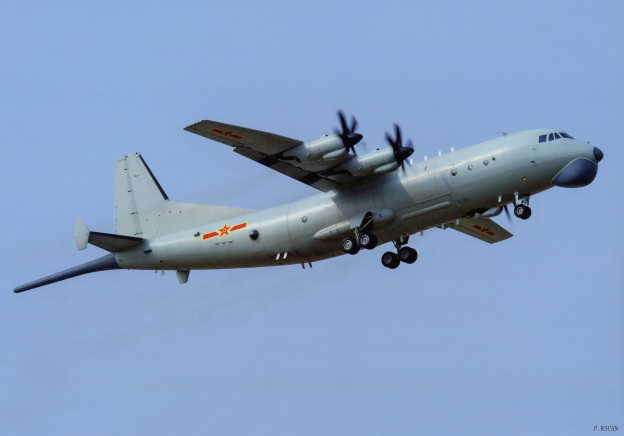
PLAN KQ200 anti submarin aircraft (photo : sinodefence, the diplomat)
Chinese military aircraft recently conducted an anti-submarine drill over the South China Sea, the People’s Liberation Army said on Friday, amid a growing number of patrols and exercises by US warships in the region.
The drill, which involved two aircraft, was conducted earlier this month, not long before the US naval and marine units took part in expeditionary strike force training in the disputed waters, the PLA Navy said in a report.
While acknowledging the difficulties involved in such an operation, the report said the aircraft successfully identified several suspicious objects.
“Anti-submarine exercises are like trying to find a needle in a haystack. It’s difficult, the underwater hydrological conditions are complex,” Yu Yang, the captain of one of the aircraft, was quoted as saying.
But by having two planes working together, it “increase[d] the probability of finding a submarine”, he said.
Wang Shelin, one of the commanders of the exercise, said that anti-submarine operations were not only dangerous but a real test of the pilots’ skills.
Successfully completing the mission demanded precise “control of the speed and altitude of the aircraft”, he said.
The publication of the PLA report came after the United States staged a four-day exercise in the South China Sea last week involving the Theodore Roosevelt Carrier Strike Group, the America Expeditionary Strike Group and the 31st Marine Expeditionary Unit.
At the end of last month, the US Navy accused the PLA of “unsafe and unprofessional” behaviour after a Chinese destroyer pointed a laser at an American maritime patrol aircraft flying over international waters west of Guam.
Collin Koh, a research fellow with the S Rajaratnam School of International Studies at Nanyang Technological University in Singapore, said the Chinese military was keen to promote its anti-submarine capabilities.
“This means we can expect to see more such exercises in the future, with no let up because of the coronavirus,” he said.
“You can also see this as a response not only to the [recent] carrier strike group operations, but the intensified US military presence in the South China Sea.
“And it would not be surprising if a nuclear attack submarine was in the vicinity of the carrier strike group,” he said.
Song Zhongping, a Hong Kong-based commentator on military affairs, said that with the possibility of a military conflict growing in the South China Sea, it was important for the PLA Navy to increase its anti-submarine training.
“The rivalry between the great powers is getting more and more intense, and the PLA must strengthen its preparations,” he said.
Echoing commander Wang’s comments, Song said that the high volume of maritime traffic and sheer size and depth of the South China Sea made searching for submarines difficult
“So the PLA is trying to enhance its capabilities by constantly installing and testing new anti-submarine equipment,” he said.
(SCMP)
27 Maret 2020
F-35 25mm gun ammunition (photo: DailyTech)
Rheinmetall NIOA Munitions set to produce and export medium-calibre ammunition for US Joint Strike Fighter programme
In an Australian first, Rheinmetall NIOA Munitions (RNM) is set to produce and export ammunition for the US F-35 Joint Strike Fighter programme.
RNM has announced that it will begin production of 25mm Frangible Armoured Piercing (FAP) projectiles at the federal government-owned Benalla plant in Victoria.
The deal marks the first expansion of the RNM joint venture beyond its $60m artillery shell forging plant in Maryborough, Queensland.
Rheinmetall Waffe Munitions is a global multinational weapons manufacturer, while Australian-owned NIOA is the leading supplier of weapons and munitions to the Australian Defence Force.
The new Load Assemble Pack (LAP) line at Benalla will be capable of producing 20mm to 35mm medium-calibre ammunition.
Rheinmetall Waffe Munitions aims to serve as a secondary source supplier to the US government for the F-35 Joint Strike Fighter programme.
Werner Kraemer, chairman of the board of directors at RNM, said that with the Maryborough project on track, it was time to expand the footprint and capabilities of the joint venture company in Australia.
“We are totally committed to this joint venture and the Australian market. By committing to develop this medium-calibre production capability here in Australia, we will not only create local jobs and build a supply chain, we will also be developing a proven and sustainable export market,” Mr Kraemer said.
NIOA managing director Robert Nioa noted that the Benalla project would enable development of a true sovereign capability in medium-calibre munitions in Australia.
“The establishment of this new capability at Benalla is a first for Australian industry. On the back of a 100 percent private sector investment, we will ensure that future munitions supplied to the ADF will be made right here in Australia,” Mr Nioa said.
The line is scheduled to be installed in the first half of 2021 and be at full production by September that year.
(Rheinmetall NIOA)
26 Maret 2020
Sea Rider saat dilakukan pengujian menuju Mako Lanal Nunukan (photo : defence.pk, Niaga)
NUNUKAN.NIAGA.ASIA – Karya anak bangsa kembali mengisi kekuatan maritim Indonesia. Kali ini, pangkalan TNI AL Nunukan mendapatkan tambahan Alutsista (Alat Utama Sistem Persenjataan) berupa Sea Rider buatan PT Lundin Industry Invest, dari Banyuwangi, Jawa Timur.
Komadan Lanal Nunukan Letkol Laut (P) Anton Pratomo mengatakan, dua alutsista jenis Sea Rider, telah dilakukan serah terima dari perusahaan PT Lundin Industry Invest kepada Lanal Nunukan, yang diwakili Penjabat Sementara (Pjs) Pasops Lanal Nunukan Lettu Laut (P) Nanang Setyo Budi.
“Hari ini, dilakukan serah terima Sea Rider dari perusahaan PT Lundin Industry Invest ke Lanal Nunukan diwalili Pjs Pasop Lanal,” katanya, Selasa (24/3).
Usai dilakukan serah terima, Sea Rider langsung diujicoba dari pelabuhan Tunon Taka Nunukan, menuju Mako Lanal Nunukan. Sea Rider sendiri dilengkapi dengan 2 mesin gantung merk Yamaha 300 PK.
Alutsista ini memiliki kecepatan maksimal 60 Knot di atas permukaan laut. Sea Rider Lanal juga dilengkapi dengan alat navigasi yang cukup canggih. Seperti radar, AIS (Automatic Identification System), dan Thermal Camera (Kamera Pendeteksi Temperatur).
Dengan adanya Sea Rider, personil patroli Lanal Nunukan setidaknya bisa mendeteksi musuh ataupun hal-hal membahayakan meski, dalam kondisi minim penerangan atau kegelapan, apabila ditunjang dengan kecepatan yang melebihi spedboot biasa, di wilayah perbatasan Nunukan.
“Sea Rider kita mampu mendeteksi musuh walaupun minim penerangan. Soal kecepatan, jangan diragukan lagi,” ungkapnya.
Dikatakan Danlanal, alutsista Sea Rider diharapakan mampu menjaga wilayah kedaulatan teritorial laut Indonesia bagian Utara Kalimantan, sekaligus dapat menjawab segala ancaman di perairan perbatasan Nunukan.
“Gangguan, hambatan dan tantangan di perairan perbatasan semakin kompleks. Kedepannya, Sea Rider juga akan dilengkapi dengan senjata kaliber 7,65 MM di bagian di haluan,” demikian Anton.
(Niaga)
26 Maret 2020
AIM-9X Block II missile (photo : Raytheon)
Raytheon Missile Systems, Tucson, Arizona, is awarded a $392,412,665 modification (P00009) to a previously awarded fixed-price-incentive-firm contract (N00019-18-C-1068). This modification exercises options for the production and delivery of tactical missiles (Lot 20 AIM-9X, Block II and Block II plus), captive air training missiles, plus all up round tactical missiles, captive test missiles, special air training missiles, advanced optical target detectors, Block II and II plus guidance units (live battery), captive air training missile guidance units (inert battery), Block I and II propulsion steering sections, electronic units, multiple purpose training missiles, tail caps, maintenance, sectionalization kits, containers and spares for the Air Force, Navy and the governments of Australia, Bahrain, Belgium, Bulgaria, Denmark, Finland, Israel, Japan, Morocco, the Netherlands, Norway, Oman, Poland, Qatar, Romania, Singapore, Slovakia, South Korea, Switzerland, Taiwan, Turkey and the United Arab Emirates.
Work will be performed in Tucson, Arizona (31%); Andover, Massachusetts (10%); Keyser, West Virginia (9%); Santa Clarita, California (8%); Hillsboro, Oregon (5%); Ottawa, Ontario, Canada (5%); Goleta, California (4%); Cheshire, Connecticut (4%); Heilbronn, Germany (3%); Simsbury, Connecticut (2%); San Jose, California (2%); Valencia, California (2%); Anaheim, California (2%); Cajon, California (2%); Cincinnati, Ohio (1%); Anniston, Alabama (1%); San Diego, California (1%); Chatsworth, California (1%); Amesbury, Massachusetts (1%); Claremont, California (1%); Sumner, Washington (1%); and various locations within the continental U.S. (4%), and is expected to be completed in July 2023.
In addition, this modification provides for material in support of repairs, depot maintenance and refurbishment. The following funds will be obligated at the time of award: fiscal 2020 weapons procurement (Navy) funds in the amount of $135,790,070; fiscal 2020 missile procurement (Air Force) funds in the amount of $129,267,647; fiscal 2020 research, development, test and evaluation (Air Force) funds in the amount of $8,172,170; fiscal 2020 operations and maintenance (Navy) funds in the amount of $2,999,656; fiscal 2020 research, development, test and evaluation (Navy) funds in the amount of $800,197; fiscal 2019 missile procurement (Air Force) funds in the amount of $6,189,530; fiscal 2019 weapons procurement (Navy) funds in the amount of $3,262,027; fiscal 2019 research, development, test and evaluation (Air Force) in the amount of $598,896; fiscal 2018 missile procurement (Air Force) in the amount of $503,814; fiscal 2018 weapons procurement (Navy) funds in the amount of $267,280 and Foreign Military Sales (FMS) funds in the amount of $104,561,378. $4,369,646 of the funds obligated at contract award will expire at the end of the current fiscal year. This modification combines purchases for the Air Force ($144,732,057; 36.88%); Navy ($143,119,230; 36.47%); and FMS customers ($104,561,378; 26.65%). The Naval Air Systems Command, Patuxent River, Maryland, is the contracting activity.
(US DoD)