28 Mei 2021

Australian Technologies for Joint Strike Missile

28 Mei 2021

JSF drop JSM (photo : BAE Systems)

KONGSBERG has placed an order with BAE Systems Australia to acquire an additional 180 Passive Radio Frequency Sensors (PRS) for its Joint Strike Missile (JSM).

This completes the first full rate of production order for 200 PRS sensors and is the result of successful and efficient operations between the two companies over the past five years.
 
Following initial funding from the Australian Government, KONGSBERG and BAE Systems Australia have continued to invest in the development, qualification and integration of the Australian sensor providing additional capability to the fifth-generation, long-range, precision-guided, stand-off missile system. 
 
KONGSBERG’s JSM is highly effective against maritime and land targets, and is the only anti-ship cruise missile that can be carried internally within the F-35 Joint Strike Fighter. 
 
This allows the F-35 to retain its range and stealth capabilities, making it highly suited to meet the RAAF’s F-35 Maritime Strike requirements under Project 3023 Phase 2. 
 
The JSM is from the same family of missiles as the Naval Strike Missile (NSM) that was competitively selected by the US Navy, and is also a candidate missile for Project SEA 1300 for the Royal Australian Navy. 
 
This order demonstrates KONGSBERG’s willingness to work closely with Australian Defence Industry and BAE Systems Australia's commitment to developing sovereign capability in Guided Weapons programs that will benefit the Australian Defence Force.  

Singapore's CH-47F to be Based in Oakey, Queensland

28 Mei 2021

CH-47F of the RSAF (photos : RSAF)

The RSAF has started taking delivery of the CH-47F Heavy Lift Helicopter, which will progressively replace the RSAF’s older Chinooks that have been in service since 1994.

The CH-47F is an advanced helicopter with a fully integrated, digital cockpit management system, and advanced cargo-handling capabilities. These features, coupled with capabilities such as an enhanced self-protection suite and Satellite Communication (SATCOM) system, will enable it to better meet the SAF’s lift requirements. 

When operationalised, the CH-47F helicopters will complement the RSAF’s fleet of helicopters to provide the SAF with a robust heli-lift capability for a wide range of operations including Search and Rescue (SAR), Aeromedical Evacuation (AME) and Humanitarian Assistance and Disaster Relief (HADR).

The initial delivery of the CH-47F to the RSAF Helicopter Detachment in Oakey, Queensland, Australia, will enable the RSAF to leverage the vast airspace and terrain for more realistic training. The opportunity for the RSAF to train in Australia is a reflection of the close and longstanding defence relationship with Australia.

(RSAF)

PT PAL Lakukan Penandatanganan Kerjasama MRO GUN 57mm & 40mm dengan Bofors

28 Mei 2021

Meriam Bofors 57mm KRI Todak (photo : TNI AL)

Surabaya, Direktur Utama PT PAL Indonesia (Persero) Bapak Kaharuddin Djenod melakukan virtual hand shake dengan Presiden Bofors Mrs Lena Gillstrom untuk kerjasama jasa pemeliharaan dan persenjataan kapal perang yang menggunakan produk Bofors.

Dalam kegiatan kerjasama tersebut, hadir mendampingi Direktur Pemeliharaan dan Perbaikan Bapak Kuntjoro Pinardi, SEVP Bapak Weko Pamudji, Bapak Mulyadi dan jajaran kepala divisi di lingkungan PT PAL Indonesia (Persero). 

Meriam Bofors 40mm Fatahillah class (photo : Indomiliter)

Dengan potensi pasar MRO Gun untuk Angkatan Laut Nasional yang mencapai lebih dari 35 unit, diharapkan akan mampu dikerjakan di PT PAL Indonesia (Persero).

(PAL)

Navy 'Wildcat' Helicopters Now Mission Capable: PN Chief

28 Mei 2021

PN AW-159 Wildcat ASW helicopter (photo : MaxDefense)

MANILA – The Philippine Navy (PN)'s two AugustaWestland (now Leonardo Helicopters UK) AW-159 "Wildcat " anti-submarine helicopters are now flying and mission capable.

PN chief Vice Admiral Giovanni Carlo Bacordo made this remark on Wednesday, when asked for updates on the two helicopters acquired by the Navy to complement the anti-submarine warfare capabilities of the two newly-delivered Jose Rizal-class missile frigates.

"Our AW-159s are flying and mission capable," he said in a message to the Philippine News Agency.

However, in the aspect of deploying and pairing these helicopters to the BRP Jose Rizal (FF-150) and BRP Antonio Luna (FF-151), Bacordo said the pilots and other aircrews have yet to finish their mission essential and operation conversion training that is being supplied by Leonardo Helicopters UK.

"As of the moment, we are still awaiting the return of the instructors from Leonardo (Helicopters, in) the UK to be able to finish the training as part of the contract in the purchase of the AW-159s," he added.

Bacordo did not give an exact timeline on when the UK-based instructors will be returning to the Philippines.

British instructors have yet to train PN AW-159 pilots for helicopter operations, which include deck-landing operations and eventual integration of the aircraft to the frigates.

The helicopters arrived in May 2019 and were commissioned in June that year.

"Also included in their training is the dipping of (the AW-159s) flash sonar and other sensors (in conjunction with the) FF-150," Bacordo earlier said.

The dipping of flash sonar signifies that the helicopter is attempting to detect a submerged or submarine contact.

The contract for the helicopters' munition, mission essential equipment, and integrated logistic support is worth PHP5.4 billion.

The helicopters can be armed with rockets, machine guns, missiles, torpedoes, and depth charges and fitted with modern sonar systems for tracking down submarines. 

(PNA)

27 Mei 2021

Terma Radar Selected for Indonesian Navy Hospital Assistance Ships

27 Mei 2021

Radar Terma Scanter 6002 (photo : Scanter)

Jakarta - Hospital ships are vessels designed to act as floating medical treatment facilities for humanitarian missions or for use in war zones. Under the new contract, Terma will deliver the radar in June 2021 to support the latest Indonesian Navy Hospital Assistance Ship (BRS). 

The Indonesian Navy’s BRS built in Surabaya by the Indonesian state-owned shipyard PT PAL is 124 meters long, 21.8 meters wide, and able to host more than 600 people including crew, troops, and patients. According to PT PAL, the BRS can accommodate medical personnel to carry-out operational missions equivalent to those of a regular hospital. The BRS will be fitted with polyclinic facilities, emergency rooms, a radiology unit, and more.

Indonesia being prone to natural disasters such as earthquakes, volcanic eruptions, and tsunamis, assets such as the Hospital Ships are paramount to promptly ensure rescue and evacuation missions when needed. For this specific capability, each Hospital Ship is equipped with two helicopter landing spots, ensuring that the personnel, as well as the patients, can be readily and safely moved to and from the vessel.

The SCANTER 6002 is a surveillance radar with unparalleled helicopter landing control capabilities, which perfectly suits the missions carried out by the Hospital Ships.

Throughout the years, Terma has supplied numerous mission critical solutions in Indonesia, for all theatres of operations (air, land and sea). The main customers include the Indonesian Navy and Air Force, the Indonesian Coast Guards (Bakamla) and Sea and Coast Guard (KPLP), the Directorate General of Sea Transportation (DGST), and Jakarta Soekarno–Hatta International Airport.

In January 2019, Terma was awarded a major contract for the supply of complete C-Series Combat suites for four KCR-60 Fast Attack Craft also including SCANTER surveillance radars.

“Indonesia is a very important market for the development of Terma in the region and beyond” said Anupam Narain Mathur, VP & GM Terma Asia Pacific. “Through strong partnerships and close collaboration, Terma aims at supporting Indonesia to improve its capability in developing and maintaining mission critical systems, ensuring self-reliance and in the end human safety”.

In Asia Pacific alone, more than 500 SCANTER radars are in operation on land and at sea to support missions such as coastal surveillance, vessel traffic management, and airport surface movement and naval surveillance. Globally, Terma has delivered more than 3,000 SCANTER radars.

(Terma)

Vietnam Acquired Polish Mechanized Bridges MS-20 Daglezja

27 Mei 2021

Vietnam acquired four MS-20 Daglesja mechanized bridges (photos : OBRUM)

According to a contract signed in the fourth quarter of 2018, the OBRUM Mechanical Equipment Research Center was to manufacture and deliver four MS-20 Daglezja mechanized bridges to the Vietnamese People's Army.

It is noted that these vehicles have been adapted to the buyer's requirements in terms of local climatic conditions. As a result, electronic systems, hydraulics and corrosion protection have been changed.

In addition, they were also painted with a special paint adapted to the local climate.


After all the bridges have been delivered to the customer, preparations are being made for the final tests in order to officially take them into use and then put them into operation.

OBRUM engineers are currently training a group of the first 20 operators of these systems.

The purchase of Polish bridges will significantly increase the ability of the Vietnamese army to overcome obstacles. Vietnam will become the second user of these systems after Poland, where 12 of these bridges are already in operation in the engineering troops.

MS-20 Daglezja is a Polish mechanized bridge on a car chassis, designed and manufactured by OBRUM Sp.z.o.o Consists of a Jelcz C662D.43 tractor with a 6×6 drive, a transport trailer with a hydraulic drive 6×6, an overhead stacker and a PM-20 bridge span.


The main task of this system is to provide all vehicles of the MLC70/110 class (weighing up to 63.5 tons), and in special situations even MLC80/120 (weighing up to 72.6 tons) to cross water or terrain obstacles up to 20 meters wide.

The system is operated by a crew of two - the driver and the bridge operator. The total weight is 47.9 tons (49.5 tons in the version with an armored cabin, respectively), and the maximum speed is 80 km/h.

The length of the bridge itself in the version with a folded span is 16.5 m.

New Zealand's Defence Budget Returns to Growth

27 Mei 2021

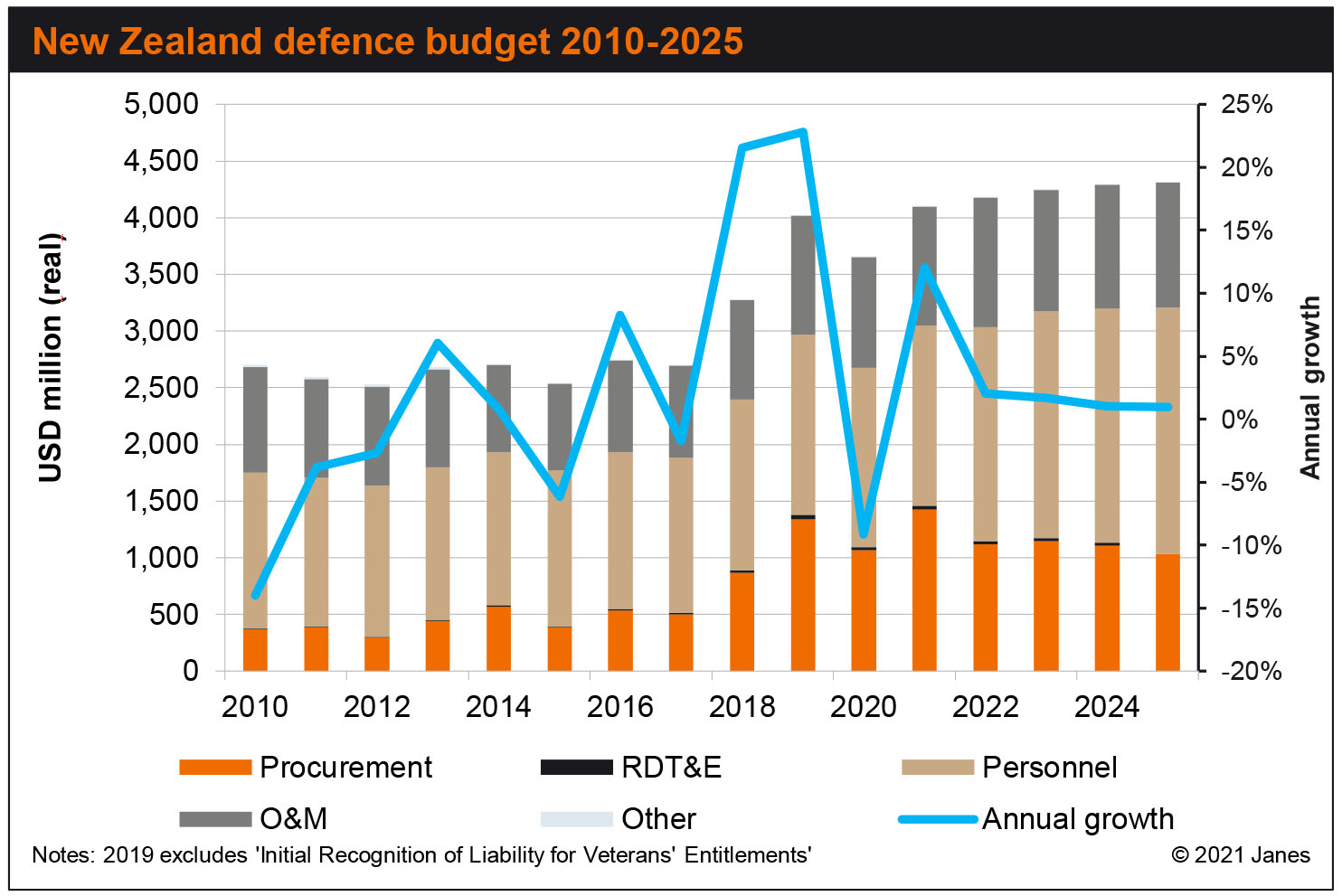
Janes forecasts moderate growth for New Zealand’s defence budget over the next few years (image : Jane's)

New Zealand has announced a strong increase in its defence budget for 2021–22, reflecting the country’s robust economic recovery to the Covid-19 pandemic.

Budgetary documents issued by the New Zealand Treasury on 20 May show that the total military expenditure for 2021–22 will be NZD5.18 billion (USD3.7 billion), a year-on-year increase of nearly 11% over the ‘estimated actual’ defence budget for 2020–21, which was NZD4.68 billion.

The figure for 2020–21 – announced in May 2020, shortly after New Zealand’s worst Covid-19 outbreak – represented a decline against the previous year of about 7%, with cut funding reappropriated for the country’s Covid-19 recovery fund.

New Zealand’s defence budget comprises two appropriations: ‘Vote Defence Force’ and ‘Vote Defence’.

In 2021–22, the Vote Defence Force – covering salaries, training costs, and military preparedness – has been allocated NZD4.28 billion, an increase of 8% against the estimated actual for last year of NZD3.96 billion. The ‘Vote Defence’ expenditure – including funding for procurement and refurbishment of defence equipment – is NZD900.5 million, a rise of 25% over the NZD720.5 million allocation last year.

Contained in the Vote Defence Force allocation is funding for the New Zealand Defence Force (NZDF).

In 2021–22 the Royal New Zealand Air Force (RNZAF) received NZD985.3 million, an increase of 3% over the estimated actual figure for 2020–21 of NZD954.4 million. The New Zealand Army and Royal New Zealand Navy (RNZN) are allocated NZD886 million and NZD500.2 million, increases of 2% and 1% respectively.

The Vote Defence Force allocation also includes NZD1.16 billion for capital expenditure. According to the document, this represents an increase of 36% over the NZD856.4 million allocation in 2020–21.