25 Juni 2013
OLIVER DESIGN is developing the Architectural Design and Turnkey accommodation of the new Sailing Tall Ship for the Indonesian Navy to be built by Astilleros Freire in Vigo (photo : Oliver Design)
The Freire shipyard from Vigo, Spain has finally awarded the construction of a navy sailing tall ship (schooner) Indonesia, with an investment of 70 million dollars (52 million euros), after submitted to a public competition in which he had been a finalist, along with Polish shipyard, as confirmed to Europa Press reported sources close to the operation.
Thus, the company is finalizing the paperwork to close the deal, and that it has completed the period for comment and no complaints were filed regarding the outcome of the contest. In any case, the sources caution that no work would begin this ship until early next year.
The construction of the training ship, awarded on a competitive bidding process of the Ministry of Defence of the Republic of Indonesia, is workload for two years and would employ 63 workers Freire template and hundreds of industry workers Auxiliary.
This is a schooner of 110 meters in length, with rig type Bricbarca and 3350 meters square sail. It will have capacity to accommodate 200 people on board, of which 120 are cadets in training, as explained by the shipyard.
Acknowledgements
Paulino Freire Shipbuilding thanked the efforts and support of the President of the Xunta, Alberto Nunez Feijoo, and the Ministries of Defense and Industry. Also, the company has confirmed that, "soon", a delegation from China travel to the shipyard to formalize the contract.
Moreover, the shipyard, whose workers are affected by a Redundancy Temporary Employment and rotary (early March to end of August), remains "open trading several fronts" to obtain contracts with Saudi Arabia, Norway or India. The company also plans to deliver in coming days the 'Discovery', the most advanced research vessel in the world in its category, commissioned by a scientific research organization in Britain.
(EuropaPress)
25 Juni 2013
BTR-3RK Successfully Shot Out
25 Juni 2013
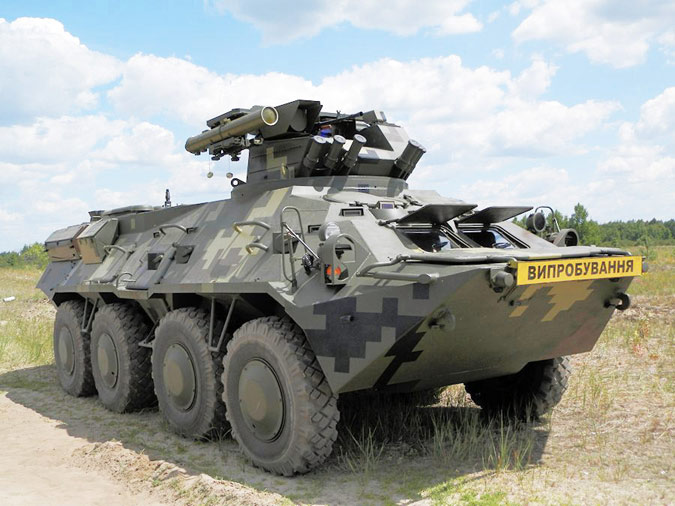
BTR-3RK with four "Barrier" ATGM (photo : mil.ua)
June 20 Goncharovskiy landfill has passed the next phase of testing fire BTR-3RK.
This modification of the BTR-3 is a mobile anti-tank complex, armed with four launchers ATGM "Barrier" with Ammunition stock rockets and 12.7 mm machine gun NSVT.
When checking out the APC trial was "attacked" with inattentive driver behind the wheel - in Armor fresh paint scratched. During the tests carried launches two missiles.
Target at a distance of 3600 m impressed with the deviation of the point of impact within 0.5 m from the center of the target. Normally worked queues and machine gun NSVT.
This machine along with the BTR-3E is prepared for delivery to Thailand.
(Kotobood)
BTR-3RK with four "Barrier" ATGM (photo : mil.ua)
June 20 Goncharovskiy landfill has passed the next phase of testing fire BTR-3RK.
This modification of the BTR-3 is a mobile anti-tank complex, armed with four launchers ATGM "Barrier" with Ammunition stock rockets and 12.7 mm machine gun NSVT.
When checking out the APC trial was "attacked" with inattentive driver behind the wheel - in Armor fresh paint scratched. During the tests carried launches two missiles.
Target at a distance of 3600 m impressed with the deviation of the point of impact within 0.5 m from the center of the target. Normally worked queues and machine gun NSVT.
This machine along with the BTR-3E is prepared for delivery to Thailand.
1000th Mercedes-Benz G-Wagon Delivered to Defence
25 Juni 2013
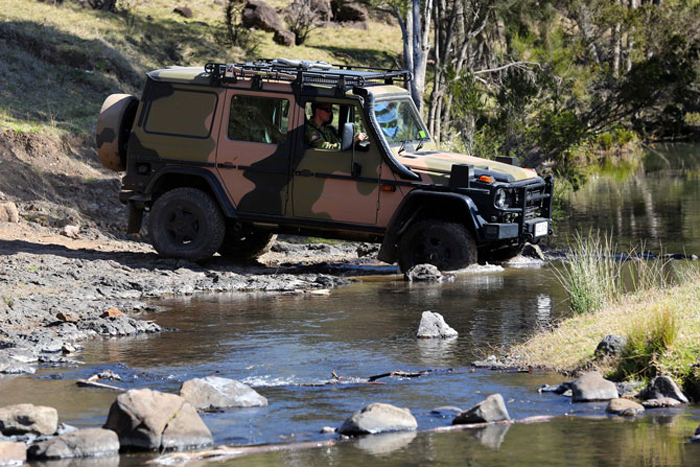
G-Wagon under Land 121 project (all photos : ADF)
Minister for Defence Materiel Dr Mike Kelly AM MP today announced the delivery of the 1000th Mercedes-Benz G-Wagon under Project LAND 121 Phase 3A.
The new G-Wagons, along with Australian-made trailers, are being rolled out to Army and Royal Australian Air Force units as part of LAND 121 ‘Project Overlander’, a $7.5 billion program delivering more than 7500 protected and unprotected vehicles to the Australian Defence Force (ADF) over the next decade.
“The new G-Wagons will help prepare ADF personnel for operations and provide the flexibility to undertake a wide range of tasks in difficult off-road conditions, while ensuring that Australian soldiers are better prepared and equipped,” Dr Kelly said.
The new variants are used as tactical training vehicles and for a wide range of support tasks.
“G-Wagon variants include utility, ambulance, surveillance and reconnaissance, mobile command post variants, and even a canine variant to transport military working dogs and their handlers,” Dr Kelly said.
Dr Kelly congratulated Mercedes-Benz on the delivery of the first 1000 G-Wagons, adding that the G-Wagon represents a big step forward for the ADF’s tactical training capability.
“Today’s handover of the 1000th G-Wagon represents an important milestone at the Mercedes-Benz facility in Mulgrave, Victoria,” Dr Kelly said.
“At the Mulgrave facility, modules and tray bodies provided by G.H. Varley in Newcastle are integrated with the vehicles and pre-delivery work is undertaken.”
A total of 2146 G-Wagons are being rolled out to ADF units between July 2012 and June 2016.
(Aus DoD)
Army Eyes Hi-tech Mounted Artillery
25 Juni 2013
Soltam Atmos 2000 Wheeled self-propelled 155 mm howitzer (photo : Elbit)
THE Philippine Army is planning to purchase a number of self-propelled 155mm artillery to bolster the country’s territorial defense capability, defense and military sources told Manila Standard Today.
The sources did not disclose how many guns are being considered, but Army chief Lt. Gen. Noel Coballes is pushing for the acquisition of a computerized autonomous truck-mounted 155mm artillery system produced by the Israeli defense contractor Soltam Systems.
The military already has 14 Soltam M-71 155mm towed howitzers, 12 M114A1 155mm towed howitzers and hundreds of 105mm howitzers, including 12 that were recently donated by the Italian government.
One source said the delivery of 12 more 155mm howitzers of unspecified make has been delayed and Coballes wants to junk the order and replace it with advanced wheeled howitzers made by Soltam.
The system is called Autonomous Truck Mounted System (ATMOS) 2000, a long range, fast moving, truck mounted howitzer with high firepower and mobility, rapid deployment, short response time, operable in all kinds of terrain.
The system is integrated with a fully computerized system, providing an automatic control, accurate navigation and target acquisition, the system is offered with various gun calibers, but the military is interested in the 39 calibre, or 155mm.
However, the source said the ATMOS 2000 will likely need the approval of the Department of National Defense because the cost of the system may surpass the P50-million cap given to the Armed Forces chief of staff.
Moreover, the source said the project may pose a “little problem” because the prime movers, or artillery tractors, of the 12 155mm guns that the defense department ordered three years ago from an unidentified overseas supplier gas already been delivered.
“I think there are at least 12 prime movers – those big military trucks you saw during one of the presentations made by the AFP – have already been delivered,” the source said.
“If are they going to scrap the purchase and delivery of the 12 cannons, what will they do with the prime movers that are already with the AFP?” he asked.
A second source confirmed said that six of the prime movers are with the Army while the other six are with the Marines.
When aslked to confirm the planned artillery purchase, Armed Forces spokesman Brig. Gen. Domingo Tutaan Jr. declined to confirm or deny the proposal.
“I am not at liberty to discuss the specifics of the AFP Modernization program much more the details and types of armaments to be acquired,” he said.
But a third source said Department of National Defense Assistant Secretary Patrick Velez left for Istael last week along with representatives from the different armed services to shop and possibly initiate purchase agreement with suppliers.
Among the items in the agenda is the possible acquisition of surface-to-air missiles (SAMs) or multiple launch rocket system (MLRS) from Israel Military Industries Ltd. or Rafael Advance Defense Systems, the source said.
(Manila Standard Today)
Sale of Decommissioned Ships Manoora and Kanimbla
25 Juni 2013
HMAS Manoora and HMAS Kanimbla (photo : AustralianAviation)
Minister for Defence Materiel Dr Mike Kelly AM MP today announced the disposal by sale of the Royal Australian Navy’s (RAN) decommissioned ships HMAS Manoora and HMAS Kanimbla.
Dr Kelly said the Navy vessels would be recycled by purchaser Southern Recycling LLC in the United States in a manner commensurate to the environmental standards the Commonwealth expected of such disposal activities by 2014.
“In June 2012, the Department of Defence released a Request for Tender offering the two former Australian naval vessels for sale for recycling to domestic and international markets,” Dr Kelly said.
The disposal of these vessels required US Government consent in accordance with US International Traffic in Arms Regulations, which has now been achieved.
Contract negotiations with the preferred purchaser were completed in early May 2013 and the disposal contract was signed on 20 May 2013. The contract details regarding cost are ‘Commercial in Confidence’. The ships were withdrawn from service in 2011.
“The disposal of Manoora and Kanimbla by sale has been completed in less than two years from the date the vessels were withdrawn from service, providing the best and most competitive net disposal cost to the Commonwealth,” Dr Kelly said.
The ships were formally decommissioned with ceremonies in 2012. Memorabilia from the ships has been transferred to the Naval Heritage Collection Headquarters and the main repository at Spectacle Island, which are both located in Sydney.
HMAS Tobruk and HMAS Choules now continue to provide Navy’s core amphibious capability together with Australian Defence Vessel Ocean Shield, until Australia’s First Landing Helicopter Dock (LHD) HMAS Canberra is commissioned in 2014.
HMAS Choules recently completed a successful period of ‘Shakedown’ training in far north Queensland which included flying operations with a Royal Australian Navy Multi-Role Helicopter (MRH90) and is currently taking part in a joint Navy and Army amphibious exercise called Exercise SEA LION from 10–24 June 2013.
(Aus DoD)
24 Juni 2013
Two Subs Out of Action for Six Years
24 Juni 2013
HMAS Rankin and HMAS Collins have been out of action while undergoing maintenance in Adelaide (photo : DMO)
TWO of navy's six Collins-class submarines will be out service for more than six years under the Gillard government's new maintenance regime.
HMAS Rankin and HMAS Collins have been out of action while undergoing maintenance in Adelaide, and will be returned to the Royal Australian Navy much later than the present three-year deadlines. The Rankin is the youngest submarine in the fleet yet it has been docked since 2008. It will not be released by shipbuilder ASC until the middle of next year at the earliest. The Collins is the fleet's oldest and has been at the ASC facility in Adelaide since last August. It will not be released until 2018.
A Defence spokeswoman said no other ships in the fleet were out of the water.
Opposition defence spokesman David Johnston said the government was conducting a "smoke-and-mirrors" exercise on how the maintenance of submarines affected their availability for service.
"It really does take a forensic detective to work out which way they are moving on this," Senator Johnston said. "On their numbers, this boat (the Collins) is out of the water for six years.
"This announcement is a smoke-and-mirrors exercise that completely exposes the continued failure of this minister to get to grips with cost-effective sustainment of submarines."
Defence Minister Stephen Smith said last week that changes to the fleet's maintenance cycle, to take effect from next year, "will improve Collins-class availability" by reducing the time each submarine spends in dock. Under the changes, each submarine would be docked for two out of every 12 years, which Mr Smith said would allow three or four submarines to be ready for service at any given time. The submarines are presently scheduled for docking three years out of 11.
But Mr Smith said HMAS Collins would not be released for service until mid-2018, despite it having already spent nearly a year out of water.
Last year, Defence had said that the "full-cycle docking" -- where major maintenance work is undertaken -- would begin on the Collins in February. This was pushed back until July 1, before Mr Smith announced last week it would not start the two-year full cycle docking until 2016.
In February, Defence had told a Senate committee that the Collins was scheduled to leave ASC in May 2016. But that also has been pushed back by two years, according to Mr Smith.
A report by British specialist John Coles, commissioned by Mr Smith and delivered last year, said the submarines' poor operational record -- one of the worst in the world -- was caused by issues such as a failure to carry out sufficient and timely preventive maintenance and inefficiencies leading to shortages of spare parts.
A spokesman for ASC said the changes to the maintenance cycles announced last week would result in greater availability of the submarines to the navy, although it differed slightly from what had been recommended in a review of the fleet's use.
"It's been adopted and implemented in a different way to that which the Coles review recommended but it is a method of implementation which is supported by ASC, supported by navy and supported by Defence," the spokesman said. "So that will see, in the longer term, greater availability of our Collins-class submarines, which is welcome."
(The Australian)
DND Bidding for 2 Navy Vessels Still Open
24 Juni 2013
At least five countries have reportedly interest to supply the Philippine Navy with the SSVs. (image : ST Marine)
MANILA, Philippines - The programmed purchase of two Navy vessels is on track, with the scheduled opening of bids next month.
Department of National Defense Bids and Award Committee (DND-BAC) chair Assistant Secretary Efren Fernandez said in a public notice the multibillion defense acquisition project is still open for interested but qualified foreign and local contractors before the holding of the pre-bid conference scheduled on July 2.
“Bid opening shall be on July 15 at 10 a.m., at the DND-BAC Conference Room. Bids will be opened in the presence of bidders’ representatives. Late bids shall not be accepted,” Fernandez said.
He added that bids received in excess of the Approved Budget for the Contract, a funding sourced from the AFP Modernization Act Trust Fund, would be automatically rejected at the bid opening.
The winning bidder is required to deliver the first Strategic Sealift Vessel (SSV) within 730 calendar days from the opening of the Letter of Credit and the second SSV to be delivered a year later, Fernandez said.
The delivery of the first SSV is expected to take place in 2015 and the second in 2016 before the term of President Aquino ends.
At least five foreign defense contractors have reportedly expressed interest to supply the Philippine Navy with the SSVs.
The DND has a P4-billion budget to purchase the SSVs, required to have Integrated Logistics Support (ILS) capability for the Navy.
The two SSVs will serve as the Navy’s platform in its sea- and land-based civil-military operations.
A non-combat ship, the SSV is capable of transporting large numbers of military personnel and logistics like military trucks, tanks and other supplies.
While a little smaller than the Multi-Role Vessel (MRV) the Navy earlier planned to acquire, the SSV is equipped with a mini-hospital, a helipad and watercraft that could bolster the response capabilities in times of maritime disaster.
On top of this, the Navy is awaiting the arrival of its second frigate, BRP Ramon Alcaraz, now enroute to the country from the US.
The former US Coast Guard Weather High Endurance Cutter had just sailed through the Panama Canal and is now en route to San Diego, California.
Alcaraz is expected to reach the country by the first week of August.
Once commissioned in September, Alcaraz will join her sister ship, BRP Gregorio del Pilar, now serving as the Navy’s flagship in securing the country’s maritime territorial domain.
Aside from Del Pilar and Alcaraz, the Navy is also working to purchase two brand new missile firing warships from South Korea, also being eyed to supply the Philippine Air Force with a squadron of T-50 lead-in trainer supersonic fighter jets.
(PhilStar)
Langganan:
Postingan (Atom)