04 Mei 2011

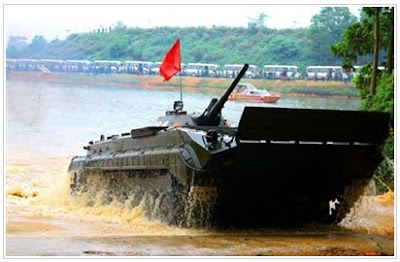
VPA’s Mechanized Infantry Training Crossed The River

04 Mei 2011

Amphibious BMP-1 of the VPA to swim practice crossed the river (all photos : Baomoi, QDND)

The senior officers of Vietnam People's Army has joined the training of command, including performing amphibious tanks, shoot gun.

This is training the army command in 2011 for hundreds of senior officers, was held in April. Here, the amendments in the order the Vietnam People's Army has been introduced to the training.

During training, the senior visiting car amphibious mechanized infantry crossed the river to swim practice.

In addition, senior officers can visit the infantry shoot a gun show to go along with firepower; visit the new defense products are studied, improving the team for training and work practice training of a mechanized infantry unit.


(Baomoi)

03 Mei 2011

RTN Firing Exercise with Exocet

03 Mei 2011

RTN's MM38 surface to surface missiles (all photos : Royal Thai Navy & Sukason Hiranphan-TAF)

HMTS Wittayakhom 322 and HMTS Udomdet 322 on the date April 22, 2011 take part on the Navy's Annual Exercise 2011 in the eastern Gulf of Hua Hin, Prachuap Khiri Khan province, Thailand.

Firing exercises using Exocet missiles. Navy has a Exocet MM38 series type of surface to surface missiles. Exocet is a medium-range miissile, the missile is designed to feature, called "Fire and Forget", has a range of 40 Km. The missile able to attack targets in all weather conditions. The missile to enter service in 1979 and installed on a fast attack craft class.

HMTS Wittayakhom hit the pontoons target. Results of firing Exocet successfully hit the target accurately.

BAE Awarded Contract for Defence’s IBFT

03 Mei 2011

CT-4B basif flying training aircraft (photo : Nathan Long)

BAE Systems Australia Limited has been awarded a six-year contract to provide Interim Basic Flying Training to the ADF until Project AIR 5428 delivers a new pilot training system for the ADF.

The total value of this contract is $86.6m. The contract was awarded after a comprehensive tender process.

Basic Flying Training is an essential stepping stone for the future capability of Australia’s air power.
Under the contract, BAE Systems will continue to provide basic flying training at Tamworth using the CT-4B Airtrainer aircraft, upgraded to meet contemporary crashworthiness requirements.

Instrument panel of the CT-4B (photo : Colin Hunter)

Commencing in January 2012, the six-year contract includes annual extension options for Defence, for up to a further six years.

Basic Flying Training plays an important role in providing a cost-effective training solution for initial flying training for the ADF. Once personnel graduate from this course, Army personnel continue on to helicopter training at Oakey Army Aviation Airfield in Queensland; Navy and Air Force personnel continue to Advanced Flying Training at RAAF Base Pearce outside Perth.

Project AIR5428 is expected to deliver a new pilot training system in the 2015-17 timeframe.

(Australian DoD)

South Korea Develops Vertical Launch for Submarine

03 Mei 2011

After 2018 South Korea plans to build 3,000-ton heavy attack submarines equipped with vertical launching systems that allow a variety of weapons, including long-range cruise missiles, to be deployed. (image : DSME)

Vertical launching system for attack subs developed

Korea has developed a vertical launching system (VLS) to be installed on 3,000-ton heavy attack submarines to be deployed after 2018, according to a shipbuilding industry source, Monday.

Hyundai Heavy Industries and Daewoo Shipbuilding and Marine Engineering are subcontractors for the heavy attack submarines.

It is the first time that the development of a submarine VLS in Korea has been confirmed. The Agency for Defense Development (ADD) has already developed one used aboard the 7,600-ton KDX-III Aegis destroyer.

A VLS is a modern type of missile-firing system used aboard submarines and surface vessels of several navies around the world. When installed on an attack submarine, a VLS allows a greater number and variety of weapons to be deployed in comparison to using only torpedo tubes.

Following the development of the VLS for subs, top shipbuilders in Korea and the ADD are also on track to develop an indigenous horizontal tube to launch torpedoes, cruise missiles and mines, the source said.

“The development of a vertical launching system has already been completed, while the development of a horizontal launching system is still under way,” the source told The Korea Times, asking not to be identified. “Developing the horizontal launching tube requires more sophisticated technology than the VLS development.

Cheonryong long range cruise missile (photo : Chosun)

”The VLS would be used in launching long-range cruise missiles at key targets in North Korea.

The ADD has developed the 500-kilometer-range, ship-launched Cheonryong, which is a modified variant of the surface-to-surface Hyunmoo III-A ballistic missile. The missile range could be extended up to 1,000 kilometers, according to military sources.

The Cheonryong missiles are believed to have already been modified to be installed on Type-214 subs.

South Korea has successfully developed the Hyunmoo III-C surface-to-surface ballistic missile with a maximum range of 1,500 kilometers, following the deployment of the 1,000-kilometer-range Hyunmoo III-B.

With the VLS development, Korea would have an advantage in selling its submarines overseas in the future, the source added.

Currently, the South operates nine 1,200-ton, Type-209 submarines and three 1,800-ton, Type-214 submarines. They are all diesel- and electric-powered and were all built with technical cooperation from HDW of Germany.

As Germany restricts the transfer of key submarine technology, such as launching tubes, Korea would have difficulty exporting any of those locally-built submarines.

The Navy plans to deploy at least three more Type-214 submarines in the years to come.

Beginning in 2018, Seoul plans to build 3,000-ton KSS-III submarines fitted with domestically-built submarine combat systems aimed at automating target detection, tracking, threat assessment and weapons control.

The heavy attack sub will be armed with indigenous ship-to-ground cruise missiles and be capable of underwater operations for up to 50 days with an upgraded Air Independent Propulsion (AIP) system.

02 Mei 2011

Australian Herons Achieve Record Flying Hours

02 Mei 2011

Australia's Heron UAV (all photos : Australian DoD)

The fourth rotation (ROT 4) of Australia’s Heron Remotely Piloted Aircraft (RPA) Detachment in Kandahar, Afghanistan, has set a unit record for monthly flying hours. Commanding Officer Heron RPA Detachment - ROT 4 Wing Commander Greg Wells said his personnel had achieved 475 hours during April.

"This exceeds the efforts of previous Heron rotations and means we have reached a point where we are able to achieve a significant amount of time on station providing an all-important ‘eye in the sky’ for our troops,” Wing Commander Wells said.

“One of the advantages of Heron is it can stay airborne for a very long time. We deliver enhanced situational awareness to our soldiers, which is vital in helping them achieve their mission on the ground.”

“The success of Heron is a combination of both smart technology and people. A typical Heron mission involves a lot of work from a very small team of specialists, ranging from engineers to intelligence officers, imagery analysts and pilots.”

The Heron team comprises 28 Australian and New Zealand Defence Force personnel. The tri-service unit has logged more than 4600 total flight hours since beginning operations in January last year.


Dubbed ‘Bluey’ by the Australians, the Heron can fly for up to 24 hours and is a key asset in the conduct of intelligence, surveillance and reconnaissance missions in the Afghanistan theatre of operations. It helps to protect Australian and Coalition forces, as well as Afghan civilians, from insurgent activity, including the laying of improvised explosive devices.

Information collected by the Heron is analysed and processed in real time. This means the commander has the benefit of having eyes on a target to build a more accurate picture of the battlespace.

Heron are operated from a ground base, controlled by trained pilots and can withstand a range of weather conditions.

“Every suspicious activity we investigate and every improvised explosive device activity we identify is potentially a life saved,” Wing Commander Wells said.

“We are very proud of the record-breaking milestone the team has achieved this month, and we will continue to push our performance to exceed this in the future.”

Heron ROT 4 currently operates three airframes forming part of a larger International Security Assistance Force (ISAF) RPA capability in Afghanistan. The Australian Heron RPAs are unarmed.


(Australian DoD)

Searcher II UAV Akan Datang Tahun Depan

02 Mei 2011

Searcher II UAV India - Saat ini praktis teknologi dan pasar UAV menengah ke atas hanya dikuasasi oleh Israel dan Amerika. Indonesia pada tahun 1997 pernah membeli UAV Fox AT-1 dari Prancis yang dioperasikan BAIS namun mengalami kegagalan setelah dioperasikan (photo : Militaryphotos)

Lanud Supadio Diperkuat Pesawat tanpa Awak

Pangkalan Udara (Lanud) Supadio Pontianak, Kalimantan Barat, akan dilengkapi dengan pesawat tanpa awak buatan Israel, Searcher II. Pihak TNI Angkatan Udara kini tengah membangun hangar secara bertahap menyiapkan kedatangan pesawat itu pada tahun depan.

Panglima Komando Operasi TNI AU I Marsekal Muda TNI Dede Rusamsi, mengatakan, pesawat Searcher II jenis sama yang digunakan angkatan bersenjata India. Pesawat itu digunakan India menjaga perbatasan dengan Cina dan Pakistan.

Dede mengatakan, pesawat tanpa awak berfungsi sangat strategis mempertahankan kedaulatan NKRI. Soalnya pesawat tersebut dapat dikendalikan dari jarak jauh, tanpa menggunakan awak.
Searcher II dapat dipersenjatai dan dilengkapi peralatan deteksi pada kondisi malam dan siang hari. Tahun depan pesawat ditargetkan masuk hangar Lanud Supadio.

Indonesia, kata Dede, juga berencana membeli pesawat T-50 Golden Eagle buatan Korea Selatan. Selain itu TNI AU akan menerima hibah 24 pesawat F16 dari Amerika. Pesawat-pesawat ini nantinya akan ditempatkan di Madiun.

Pesawat T-50 merupakan pengganti dari berbagai pesawat latih dan serang ringan. Termasuk pesawat T-38, Cessna A-37B Close Air Support dan F-5B untuk pelatihan yang dioperasikan di Indonesia.

Program ini pada awalnya dimaksudkan untuk mengembangkan pesawat latih secara mandiri yang mampu mencapai kecepatan supersonic untuk melatih dan mempersiapkan pilot bagi pesawat Sukhoi.

Sementara untuk kelengkapan alutsista (alat utama sistem pertahanan) lainnya sesuai dengan program pengadaan peralatan tempur Mabes TNI AU akan terus dilakukan hingga 2024 mendatang.

"Lanud Supadio sendiri statusnya akan ditingkatkan menjadi Bintang 1 atau A. Dalam waktu dekat rencana pengadaan radar di Kalimantan Barat juga akan direalisasikan. Intinya kita akan terus memperbaiki sistem persenjataan kita," jelasnya.

(Kalbar Online)

Air Force's New Orion Officially Welcomed Into Service

02 Mei 2011

RNZAF welcomed home the first upgraded P-3K2 Orion (photo : Janner88)

The Air Force's new Orion will be officially welcomed into service today.
The new P-3K2 will be shown off at the air base at Whenuapai, after being upgraded in the United States.

The other five Orion's are to be upgraded in Blenheim where they will be given a new data management sensor and communications and navigation systems.

The upgrade is considered a significant milestone for the New Zealand Defence Force because the planes will be able to do more than just marine patrols.

The Government's forking out 373 million to upgrade the six Orion's, in the hope they will be able to keep flying for another 15 years.

(NZ Herald)