27 Juli 2019
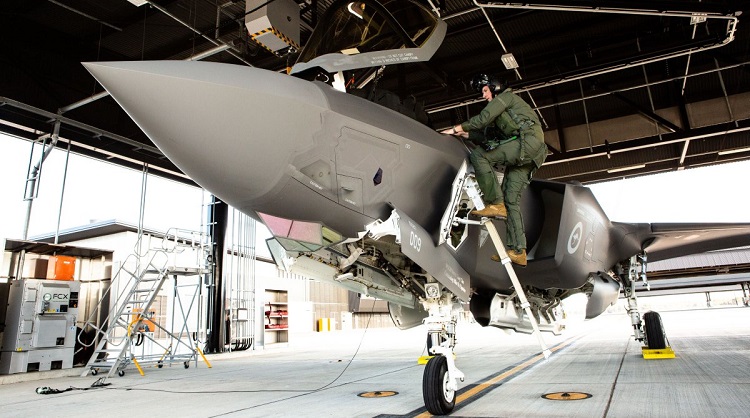
First local trained pilot flown RAAF F-35A (photo : RAAF)
The Air Force’s first pilots to complete a RAAF F-35A Joint Strike Fighter transition course in Australia have flown the aircraft for the first time.
Two pilots conducted their first training mission on the F-35A at RAAF Base Williamtown on 15 July after undertaking an intensive two month academic and simulator training program at the base’s Integrated Training Centre.
Squadron Leader (SQNLDR) William Grady, a former F-22 exchange pilot, said the transition course has been tailored to leverage previous fighter experience.
“The F-35A training is unique in that there is no two-seat variant to aid airborne instruction,” SQNLDR Grady said.
“As a result, we do comparatively more simulator training before flying for the first time.
“It has been an intensive few months, but I’m happy to say the training is first class,” he said.
Commanding Officer Number 3 Squadron (3SQN), Wing Commander (WGCDR) Darren Clare, said the 15 July flights marked an important milestone in the F-35A’s introduction to service.
“Being able to watch the launch of the first two Australian-trained pilots on their first flight was a proud moment,” WGCDR Clare said.
“Although we currently still send pilots to the US for training, this shows Australia is quickly becoming self-sufficient and it all contributes to our F-35A squadrons reaching combat readiness as planned.”
“The introduction of a Fifth-Generation aircraft and all of its new systems has been highly complex.
“It has only been since January that we started testing out how the F-35A integrated with the Australian logistics, base support and local training systems.
“So the credit for today’s milestone goes to all those who have worked tirelessly to ensure the F-35A has had a smooth introduction to service,” he said.
Australia’s fleet of 10 F-35A aircraft based at Luke Air Force Base and RAAF Base Williamtown have collectively achieved over 2900 hours across more than 1750 sorties since 2014.
The F-35A attainment of Initial Operating Capability is on schedule for December 2020.
(RAAF)
26 Juli 2019
Latihan landing dan take off heli Panther (photos : Koarmada2)
Surabaya – Komando Latihan (Kolat) Koarmada II menggelar pelatihan teori dan praktek Pengenalan Helly Deck Party dan memberikan Kursus FDC kepada 30 prajurit Calon Pengawak (Cawak) KRI Teluk Kupang-519 yang mengikuti Pelatihan Kursus penyiapan pengadaan kapal (KPPK), bertempat di RON 400 Wing Udara Puspenerbal Juanda. Rabu (24/07/2019).
Latihan yang telah berjalan selam tiga hari tersebut tidak hanya diikuti oleh para cawak prajurit KRI baru (KPPK), namun juga di ikuti oleh prajurit KRI dari Satuan Kapal Eskorta (Satkor) Koarmada II yaitu KRI sigma class seperti KRI Diponegoro-365, KRI Sultan Iskandar Muda-367 dan KRI Frans Kaisiepo – 368.
Helly Deck Party merupakan kegiatan memandu Helly saat take off dan Landing di atas geladak KRI, meliputi penyiapan alat peralatan, manuver kapal dalam menentukan arah angin dan memandu Helly saat akan Take off maupun Landing di atas KRI.
Koarmada II sebagai Kotama Pembinaan yang memiliki kapal perang jenis angkut dan dilengkapi dengan geladak Helly, harus didukung prajurit pengawak KRI yang memiliki kemampuan melaksanakan helly deck party.
KRI Teluk Kupang 519 yang sempat tersendat pembangunannya (photo : Ang Tjeng Yan)
“Oleh karena itu, sebagai Satuan Pelaksana Pembinaan, Koarmada II melaksanakan latihan helly deck party secara berkesinambungan, bertingkat dan berlanjut dengan tujuan untuk menjaga dan meningkatkan kemampuan prajurit dalam memandu dan mengendalikan helly dari darat dan ke KRI untuk mendukung kemampuan calon pengawak KRI “, terang Dankolat Koarmada II Kolonel Laut (P) Arif Badrudin.
Adapun materi yang diberikan kepada peserta latihan meliputi Prosedur Take Off dan Landing Helly di darat dan di Kapal pada siang hari dan malam hari, Prosedur Marshalling, Perlengkapan Marshaller dan Isyarat Marshaller (General Marshalling Signal), Prosedur komunikasi dan Cross Landing Procedure.
Dalam latihan tersebut bertindak selaku Instruktur dari Tim MTT Kolat Koarmada II dan tim Ron 400 Wing Udara Puspenerbal Juanda.
(Paradigma Bangsa)
26 Juli 2019
ScanEagle UAV of the Philippine (photo : Eagle News)
MANILA, Philippines— National Security Adviser Hermogenes Esperon Jr. on Tuesday said the Philippines will use unmanned aerial vehicles to patrol the country’s maritime territories and strengthen its surveillance capability in the West Philippine Sea.
Speaking during the post-Sona press briefing with other Cabinet officials, Esperon said the government will utilize technology to monitor the Philippines’ maritime domain, particularly the West Philippine Sea, a source of territorail dispute between Manila and Beijing.
“We will add more marine scientific research, the putting up of lighthouses and the use of technology to take care of our maritime domain,” Esperon said.
“So we will have now the use of unmanned aerial vehicles and imagery satellite to take care of our maritime domain that will, therefore, involve and strengthen our fisheries fishing activities in our maritime domain,” he added.
The Philippines, Brunei, Malaysia, Vietnam, Taiwan and China hold different, sometimes overlapping, territorial claims over the South China Sea. China claims more than 80 percent of this extremely significant body of water, which has over 250 small islands, atolls, cays, shoals, reefs and sandbars.
Despite an agreement to refrain from undertaking provocative actions, China has continued to militarize territories that it claims in the region.
Maritime peace in the disputed territories was again tested when a Chinese trawler rammed and sank a Filipino fishing boat in Recto Bank, an area within Manila’s exclusive economic zone. A Vietnamese boat rescued 22 Filipino fishermen who were left floating at sea.
(Inquirer)
26 Juli 2019
The latest graduates of the RAAF’s Introductory Fighter Course made extensive use of synthetic training with support from CAE (photo : RAAF)
CAE today announced it has supported the Royal Australian Air Force in the trial and implementation of advanced synthetic training capabilities as part of the Introductory Fighter Course (IFC) at RAAF Base Williamtown.
The first class of pilots taking part in the IFC leveraging an increased use of synthetic training, including networked simulators, recently graduated and are now proceeding to training on their assigned fast-jet aircraft.
Utilising the two CAE-built Hawk Mk127 full-mission simulators at RAAF Williamtown, CAE and RAAF training personnel developed new virtual training scenarios focused on a range of advanced mission profiles, including air combat maneuvering and multi-jet intercept. In addition to enhancing the operating performance of constructive computer-generated forces within the training scenarios, CAE added realism to the advanced final stages of lead-in fighter training by networking the two FMSs, thus allowing multiple students and instructors to fly the same mission or fly against each other.
For its support in developing and implementing the enhancements to the Introductory Fighter Course, CAE Australia received a Certificate of Appreciation from Air Vice-Marshal Catherine Roberts, Head of the Aerospace Systems Division, Royal Australian Air Force.
“CAE developed new lesson plans and mission scenarios to accurately simulate elements of the Introductory Fighter Course traditionally conducted in airborne events,” said Air Vice-Marshal Roberts. “Maximum training benefit was delivered by supporting our 76 Squadron flying instructors in the use of the new mission profiles, and CAE’s efforts have been outstanding in supporting the Lead-In Fighter Training enterprise for the RAAF.”
During the latest IFC, use of the two Hawk Mk127 FMSs more than doubled compared to previous courses. RAAF and CAE instructors delivered the simulator training after rapid development of the new mission training scenarios. In addition, CAE’s on-site maintenance and support personnel introduced improved maintenance procedures to ensure maximum availability for the increased use of the simulators.
“The enhanced Introductory Fighter Course is a great example of how a government-industry relationship should work to deliver value and capability,” said Ian Bell, CAE’s Vice President and General Manager, Asia/Pacific/Middle East. “We are honoured to be part of the integrated team supporting the RAAF’s lead-in fighter training program at both RAAF Williamtown and RAAF Pearce, and privileged to play a role in helping prepare its next-generation fighter pilots.”
(CAE)
26 Juli 2019
Air to Air Refueling of A400M with Su-30MKM (photos : RMAF)
In-flight refueling is the process of transferring aviation fuel from one military aircraft to another during flight.
Tactical locations are often long distances from supporting airfields, which means aircraft may require refueling midflight. Operating a specialized from A400M,
In-flight Refueling Specialist pump jet fuel into aircraft in need of fuel.
These highly trained experts must have a steady hand and nerves in order to complete this remarkable and crucial task so we can continue to successfully complete all of our missions.
"Enroute In-flight Refuelling performed by Su30MKM from No 11 Sqn over South China Sea in support of East Malaysia Operation."
(RMAF)
26 Juli 2019
Latihan Angkasa Yudha 2019 (photos : TNI AU, Keris, SIndonews)
JAKARTA - Panglima TNI Marsekal TNI Hadi Tjahjanto menghadiri puncak latihan Angkasa Yudha 2019 TNI AU, bertempat di Pandanwangi, Kabupaten Lumajang, Jawa Timur.
Angkasa Yudha merupakan latihan puncak TNI Angkatan Udara, sebagai akumulasi dari berbagai latihan yang dilaksanakan secara bertahap, bertingkat dan berlanjut, Rabu (24/7/2019).
Angkasa Yudha Tahun 2019 pada hakikatnya merupakan puncak dari berbagai latihan Komando Utama (Kotama) TNI AU. Dengan demikian latihan ini menjadi refleksi hasil pembinaan yang telah dilakukan mulai dari unsur intelijen, operasi, personel, logistik, komlek, serta unsur-unsur lainnya.
Latihan ini bertujuan untuk menguji tingkat kesiapan operasional satuan-satuan di jajaran TNI Angkatan Udara mulai dari tingkat Kotama Operasi sampai dengan satuan setingkat Lanud dan Skadron dengan berbagai unsur kekuatannya.
Dalam skenario puncak latihan kali ini TNI Angkatan Udara menggelar Fire Power Demo atau demo penembakan udara di Air Weapon Range (AWR) Fire Power Demo yang merupakan demo penembakan dilakukan secara langsung yang diikuti oleh sejumlah alutsista milik TNI AU antara lain 42 pesawat tempur, 12 pesawat angkut, 5 helikopter, dan 2 pesawat intai serta Lebih dari 2.000 prajurit TNI AU terlibat dalam demo penembakan udara ini.
Fire Power Demo terdiri atas sejumlah aksi antara lain penerjunan tim Kopaskhas, juga demo penembakan udara yang bertempat di pesisir pantai selatan Jawa.
"Kegiatan ini bertujuan untuk menampilkan kekuatan dan kemampuan daya gempur udara sebagai wujud kesiap-siagaan operasional satuan TNI AU," tegas Panglima TNI.
Selain itu sasaran yang hendak dicapai adalah terujinya kemampuan dan keterampilan personel TNI AU dalam melaksanakan tugas-tugas operasi udara sesuai fungsinya masing-masing.
Sementara itu dalam kegiatan ini Lanud Iswahjudi menyiapkan beberapa jenis Bom antara lain MK 12, Maverick, Roket FFAR 70mm, Bom MK 82. Semua Bom dan roket akan terpasang di pesawat F16 Fighting Falcon, Pesawat T 50I Golden Eagle dan Pesawat Hawk 100/200.
Sedangkan untuk pesawat SU 27/30 Sukhoi EMB 314 Super Tucano yang berhome base di Lanud Abdulrachman Saleh Malang, mengunakan jenis OFAB 250, Roket S8 Kom, MK 66 dan Bom MK 81.
(SindoNews)
25 Juli 2019
ADF MRH-90 Taipan helicopter (photo : George Canciani)
The ADF has reportedly grounded its entire fleet of 47 Airbus MRH 90 Taipan helicopters following a recent precautionary landing caused by a tail rotor vibration.
A report in Fairfax Media says a Navy MRH 90 was flying from the LHD HMAS Adelaide off the Queensland coast to Brisbane recently when it experienced the vibration, causing it to make a precautionary return to the ship.
“The aircraft captain aborted the mission and returned to HMAS Adelaide for a precautionary landing,” the report said, quoting a Defence spokesman. “No personnel were injured during the incident.”
The Navy operates six MRH 90s from the ADF’s larger pool, and regularly rotates aircraft back through the pool for periodical maintenance, most of which is conducted by Airbus at Brisbane Airport or a combined Airbus and Army team at Townsville. The aircraft are operated by Navy’s 808SQN at Nowra, and Army’s A and B SQNs of 5 Aviation Regiment (5Avn) at Townsville.
The grounding follows an ABC report last month which revealed Project AIR 9000 Phases 2, 4 and 6 which resulted in the acquisition of the MRH 90 in three batches to initially complement and ultimately replace Army’s S-70A-9 Black Hawk and Navy’s Sea King helicopters, remain on the Government Projects of Concern list.
The MRH 90 was originally scheduled to have been declared fully operational (FOC) in 2014, a milestone which, despite improvements in aircraft availability and sustainment in recent years, is still yet to be formally achieved. As a result, Army has been forced to retain about a dozen Black Hawks for the special operations support role some five years beyond their originally planned retirement.
The grounding will likely have a significant effect on the ADF’s ability to provide airborne assault and logistics support to the multi-national Exercise Talisman Saber currently underway off central Queensland.
(ADBR)